Data Modeling for Systems
Learn how product behavior, access patterns, entities, relationships, and state transitions shape production data models.
What you will be able to do
Data modeling is deciding what facts the system must remember, who owns them, how they change, and how they will be read. Good models start from product behavior, not from database fashion.
Start With Product Flows
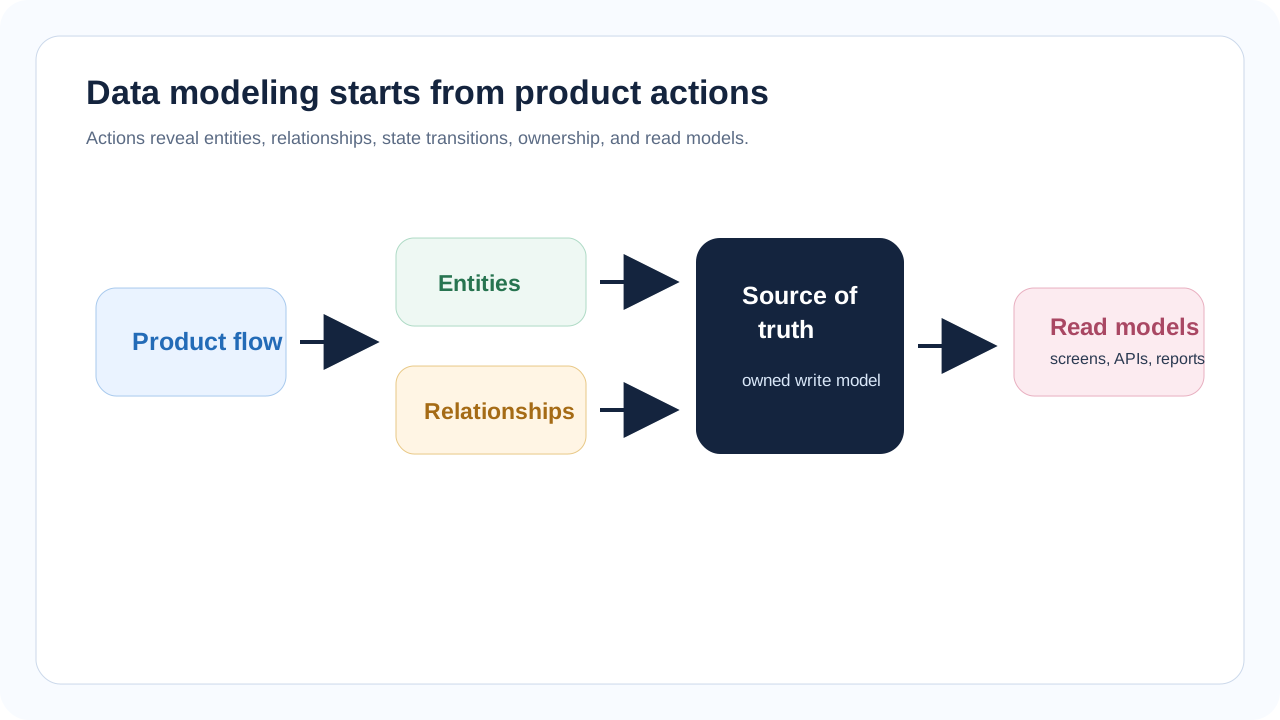
Before tables or collections, write the flows. A product flow reveals the entities, state changes, consistency needs, and read patterns the model must support.
| Question | Why it matters | Example |
|---|---|---|
| What action happens? | Defines state change | User places an order. |
| What facts must be stored? | Defines entities and fields | Order, items, address, payment intent. |
| Who owns the data? | Defines service boundary | Order service owns order state. |
| How is it read? | Defines indexes/read models | Order history by user and status. |
| What must be correct? | Defines consistency need | Payment state and order state must not conflict. |
Scenario: Course Progress System
SkillSkore needs to track course progress: enrolled courses, completed lessons, module scores, assessment attempts, and certificate eligibility. A naive model stores a single progress percentage. A better model stores the events and state needed to explain that percentage.
| Entity | Important fields | Why |
|---|---|---|
| Enrollment | userId, courseId, enrolledAt, status | Connects a learner to a course. |
| LessonProgress | userId, lessonId, completedAt, timeSpent | Tracks learning progress. |
| AssessmentAttempt | userId, assessmentId, score, passed, submittedAt | Supports strict scoring and retry logic. |
| ModuleScore | userId, moduleId, score, unlockedAt | Supports beginner/intermediate/advanced motivation. |
| Certificate | userId, courseId, issuedAt, finalScore | Durable proof of completion. |
Write Model vs Read Model
The write model protects correctness. The read model makes screens fast. They can be the same for simple systems, but high-read products often add derived views, indexes, caches, or search documents.
| Model | Optimized for | Example |
|---|---|---|
| Write model | Correct changes | Store assessment attempt with immutable submitted answers. |
| Read model | Fast display | Show dashboard with course progress, next lesson, and current score. |
| Derived view | Precomputed summary | Module completion percentage by user. |
| Search model | Text and ranking | Search lessons by title, concept, and keyword. |
| Analytics model | Long-term analysis | Daily active learners and pass rates. |
Design principle
Model the truth first, then add read optimizations. If you only model the current UI, the system breaks when product requirements evolve.
Cloud Storage Mapping
| Need | AWS | GCP | Azure |
|---|---|---|---|
| Relational truth | RDS/Aurora | Cloud SQL/Spanner | Azure SQL |
| Document/key-value access | DynamoDB | Firestore/Bigtable | Cosmos DB |
| Object/files | S3 | Cloud Storage | Blob Storage |
| Search model | OpenSearch | Vertex AI Search/Elastic on GCP | Azure AI Search |
| Analytics store | Redshift/Athena | BigQuery | Synapse/Fabric |
Modeling Brief
| Section | What to write |
|---|---|
| Core entities | The main nouns the system must remember. |
| Ownership | Which service/module owns each entity. |
| State transitions | How each entity changes over time. |
| Read patterns | The screens, APIs, jobs, and reports that read data. |
| Correctness rules | What must be consistent and what may lag. |
| Retention | How long data must be stored and why. |
Beginner Mistakes
- Starting with SQL vs NoSQL before understanding access patterns.
- Saving only the current UI state and losing important history.
- Letting multiple services own the same data.
- Ignoring read patterns until the application is slow.
- Forgetting retention, audit, and deletion requirements.
Guided Practice
Practice task
Model a basic comments feature. List entities, important fields, owner, read patterns, and one correctness rule.
Sample Answer
| Part | Example |
|---|---|
| Entities | Post, Comment, User, CommentReaction. |
| Owner | Comment service/module owns comments and reactions. |
| Read patterns | List comments by post, count comments by post, list recent comments by user. |
| Correctness rule | A deleted comment should not appear in normal reads, but may remain in audit history. |
| Optimization | Maintain comment count as derived data if reads are heavy. |
Before You Continue
- You should be able to model data from flows.
- You should understand entities, ownership, read patterns, and state transitions.
- You should know the difference between write models and read models.
- You are ready to choose SQL or NoSQL based on the model instead of hype.