Sync vs Async Communication
Learn when services should respond immediately, when work should move to queues/events, and how retries, ordering, and idempotency affect design.
What you will be able to do
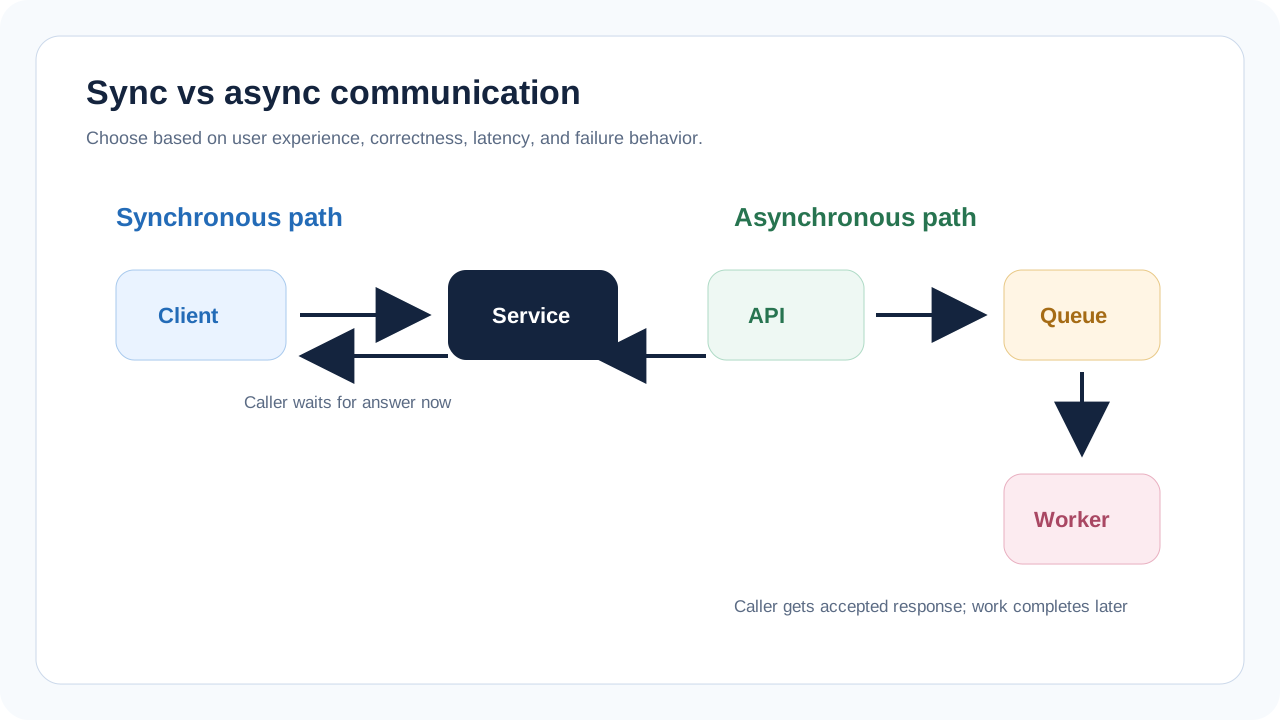
Synchronous communication waits for an answer now. Asynchronous communication accepts work now and finishes it later. The decision changes latency, reliability, user experience, and operational complexity.
Sync and Async in Plain Language
If the user cannot continue without the result, the work is often synchronous. If the work can happen after acknowledgement, or must survive provider failures and retries, it is often asynchronous.
| Pattern | How it feels | Use when | Risk |
|---|---|---|---|
| Synchronous API call | Caller waits | User needs immediate result | Slow dependency slows user. |
| Queue | Caller gets accepted response | Work can happen later and must retry | User may not see final outcome immediately. |
| Pub/sub event | Many consumers react independently | Multiple systems need to know something happened | Ordering and duplicate handling become important. |
| Stream | Continuous ordered event flow | High-volume event processing | Operational complexity and retention decisions. |
Scenario: Order Confirmation
When a user places an order, some work must finish before the response. Other work should not block checkout. This separation is one of the most important production design habits.
| Work | Sync or async? | Reason |
|---|---|---|
| Validate cart and address | Sync | User needs immediate correction. |
| Create order record | Sync | Order must exist before success. |
| Authorize payment | Usually sync or near-sync | User must know whether checkout can proceed. |
| Send confirmation email | Async | Can retry without blocking checkout. |
| Update analytics | Async | Can lag without affecting user. |
| Notify warehouse | Async or event-driven | Downstream systems can process after order is accepted. |
Failure Behavior Decides the Pattern
The key question is not only can this be delayed. Ask what should happen when the dependency is slow or down. Async communication gives you buffering and retries, but it also introduces eventual completion and duplicate handling.
| Question | If yes | Likely pattern |
|---|---|---|
| Does the user need the result before continuing? | Yes | Synchronous. |
| Can the work be safely completed later? | Yes | Queue or event. |
| Can the dependency be temporarily unavailable? | Yes | Async with retry and DLQ. |
| Do multiple systems need to react? | Yes | Pub/sub event. |
| Does order of events matter? | Yes | Ordered queue/stream or careful per-entity sequencing. |
Design principle
Async is not a shortcut for hard work. It moves complexity from user latency into retries, idempotency, ordering, monitoring, and operational recovery.
Queues, Events, and DLQs
A queue stores work until a worker can process it. An event tells other systems that something happened. A dead-letter queue stores messages that repeatedly failed so engineers can inspect or replay them.
| Concept | Beginner meaning | Example |
|---|---|---|
| Queue | A waiting line of work | Send confirmation email. |
| Event | A fact that happened | OrderCreated. |
| Consumer/worker | Code that processes queued work | Email worker sends message through provider. |
| Retry | Try failed work again | Retry provider timeout with backoff. |
| DLQ | Place for repeatedly failed messages | Invalid template messages go to investigation. |
| Idempotency | Safe repeated processing | Same OrderCreated event does not send five emails. |
Cloud Communication Services
| Need | AWS | GCP | Azure |
|---|---|---|---|
| Simple queue | SQS | Cloud Tasks or Pub/Sub subscription | Service Bus queue |
| Pub/sub fanout | SNS/EventBridge | Pub/Sub/Eventarc | Event Grid or Service Bus topic |
| Stream processing | Kinesis/MSK | Pub/Sub + Dataflow | Event Hubs + Stream Analytics |
| Workflow orchestration | Step Functions | Workflows/Cloud Composer | Logic Apps/Durable Functions |
| Dead-letter handling | SQS DLQ/SNS DLQ | Dead-letter topics/subscriptions | Service Bus dead-letter queue |
Observability for Async Work
Async systems need different monitoring than normal APIs. A 200 response only means work was accepted, not that the background work succeeded.
| Signal | Why it matters |
|---|---|
| Queue depth | Shows whether workers are falling behind. |
| Oldest message age | Shows user-visible delay risk. |
| Retry count | Reveals unstable dependencies or bad messages. |
| DLQ count | Shows work that needs human or automated recovery. |
| End-to-end completion latency | Measures time from accepted request to final outcome. |
| Idempotency conflict count | Shows duplicate requests or duplicate events. |
Beginner Mistakes
- Making everything synchronous because it is easier to reason about at first.
- Making everything asynchronous and then losing clear product feedback.
- Using a queue without defining retry, DLQ, idempotency, and monitoring.
- Publishing events before the source-of-truth state is safely stored.
- Forgetting that async work can complete out of order or more than once.
Guided Practice
Practice task
For account signup, decide which steps are sync and async: create account, send welcome email, verify captcha, create audit log, notify sales, generate recommendations.
Sample Answer
| Step | Decision |
|---|---|
| Verify captcha | Sync because signup should not continue if bot protection fails. |
| Create account | Sync because the account must exist before success. |
| Create audit log | Often sync or durable event before success depending on compliance. |
| Send welcome email | Async because it can retry later. |
| Notify sales | Async because it does not affect user signup. |
| Generate recommendations | Async because it is expensive and can appear later. |
Module 2 Wrap-Up
You now understand how clients enter systems through API contracts, how requests move through production layers, how boundaries divide responsibilities, and how sync or async communication changes reliability and latency.
Before You Continue
- You should be able to choose sync vs async with a clear reason.
- You should understand queues, events, retries, DLQs, and idempotency.
- You should know why async work needs separate observability.
- You are ready for Module 3, where service behavior meets data modeling and storage decisions.