SQL vs NoSQL Thinking
Learn how to choose relational, document, key-value, wide-column, and graph storage based on access patterns and consistency needs.
What you will be able to do
SQL vs NoSQL is not a personality test. It is a storage decision based on data shape, access patterns, consistency needs, scale, schema evolution, and operational maturity.
The Real Decision
Do not ask which database is best. Ask what operations the system performs most often, what relationships matter, what must be transactionally correct, and how the data grows.
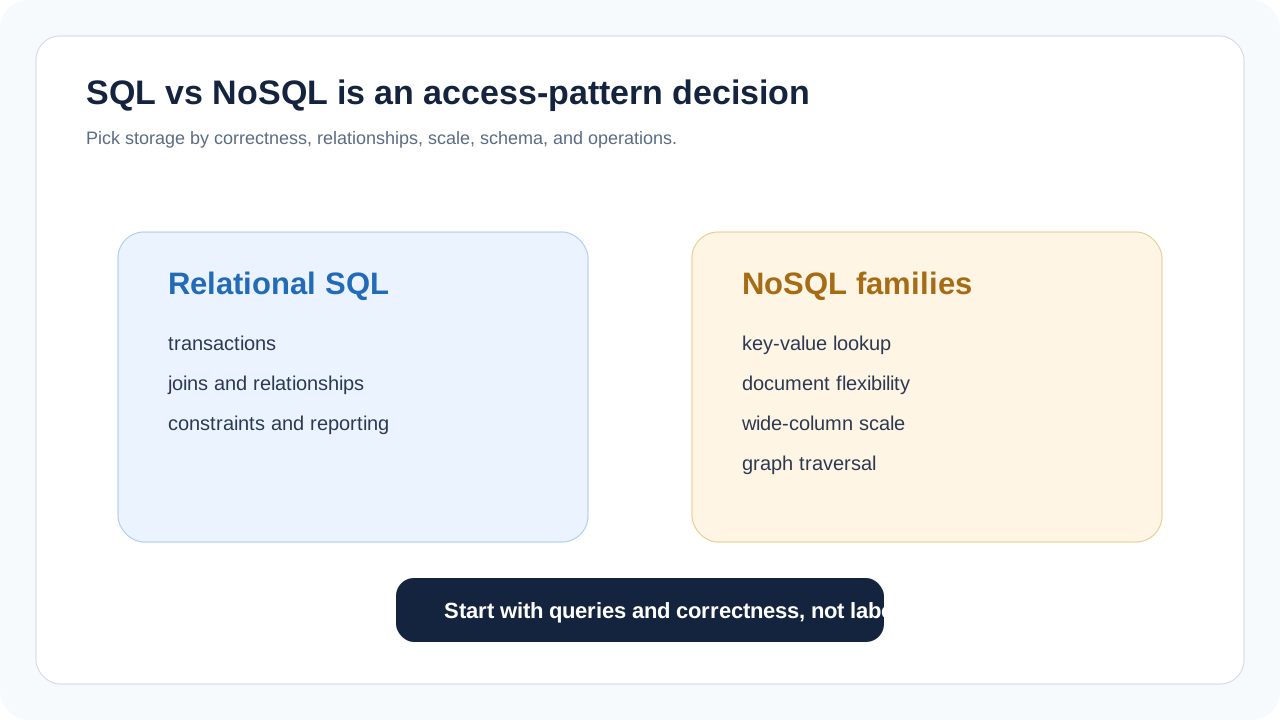
| Storage type | Good fit | Watch out for |
|---|---|---|
| Relational SQL | Structured data, joins, transactions, reporting | Very high horizontal write scale may need partitioning. |
| Document | Nested objects and flexible schema | Cross-document transactions and reporting can be harder. |
| Key-value | Very fast lookup by key | Limited query flexibility. |
| Wide-column | High-scale access by partition key | Query-first modeling and hot partitions. |
| Graph | Relationship traversal | Operational complexity and specialized query model. |
Scenario: Product Catalog
A product catalog has products, categories, sellers, prices, inventory summaries, search filters, and recommendations. One storage system may not serve every access pattern equally well.
| Need | Possible storage | Reason |
|---|---|---|
| Product source of truth | Relational or document | Structured fields plus updates by catalog team. |
| Product search | Search index | Text ranking and filter queries. |
| Product page cache | Key-value/cache | Fast repeated reads for popular items. |
| Inventory truth | Relational or strongly consistent key-value | Avoid incorrect availability for scarce items. |
| Analytics | Warehouse/lake | Large scans and reports should not slow product APIs. |
When SQL Is the Right Answer
Relational databases are still excellent for many production systems. They provide strong constraints, transactions, joins, indexes, mature tooling, and understandable data modeling.
| Signal | Why SQL helps |
|---|---|
| Business transactions matter | ACID transactions protect correctness. |
| Relationships are important | Joins and foreign keys model connected data. |
| Ad hoc reporting matters | SQL query ecosystem is mature. |
| Schema discipline is valuable | Constraints prevent invalid data. |
| Team knows relational operations | Operational maturity beats theoretical scale. |
When NoSQL Is the Right Answer
NoSQL stores are useful when the access pattern is simple and high-scale, the schema is flexible, or data naturally fits key-value/document/wide-column models. They are not automatically simpler.
| Signal | Likely NoSQL fit |
|---|---|
| Lookup by key at huge scale | Key-value store. |
| User-specific document with nested state | Document store. |
| High write volume by partition key | Wide-column or managed key-value. |
| Flexible event metadata | Document or object storage plus analytics. |
| Relationship traversal dominates | Graph database. |
Design principle
Choose the simplest storage system that satisfies correctness and access patterns. Polyglot persistence is powerful, but every extra database adds operational cost.
Cloud Storage Options
| Need | AWS | GCP | Azure |
|---|---|---|---|
| Relational | RDS/Aurora | Cloud SQL/Spanner | Azure SQL |
| Document/key-value | DynamoDB/DocumentDB | Firestore/Bigtable | Cosmos DB |
| Object | S3 | Cloud Storage | Blob Storage |
| Search | OpenSearch | Vertex AI Search/Elastic on GCP | Azure AI Search |
| Analytics | Redshift/Athena | BigQuery | Synapse/Fabric |
Decision Checklist
- List the top read and write queries.
- Identify what must be transactionally correct.
- Estimate data size and write/read growth.
- Decide whether joins are core or avoidable.
- Consider team operating experience.
- Choose one primary source of truth before adding derived stores.
Beginner Mistakes
- Choosing NoSQL only because the system may become large someday.
- Choosing SQL while ignoring hot tables, indexes, and write contention.
- Using many databases before one clear source of truth exists.
- Ignoring query patterns and then discovering the database cannot answer product screens efficiently.
- Assuming managed cloud databases remove data modeling responsibility.
Guided Practice
Practice task
For a user profile system, decide whether SQL, document, or key-value is the best starting point. Include three access patterns and one correctness requirement.
Sample Answer
| Part | Example |
|---|---|
| Access patterns | Get profile by userId, update profile fields, list public creator profiles by category. |
| Correctness | Only the owner or authorized admin can update profile. |
| Starting choice | Relational if profiles connect to users, permissions, subscriptions, and reporting. |
| Possible derived store | Search index for public creator discovery. |
| Reason | SQL protects relationships and permissions; search handles discovery separately. |
Before You Continue
- You should choose storage from access patterns and correctness needs.
- You should understand SQL strengths and NoSQL strengths.
- You should know why one source of truth matters.
- You are ready to learn how indexes make query patterns fast.