Time Complexity as Input Growth
Understand Big O as an engineering model for how work grows when input size grows, and use it to predict latency, throughput, and failure risk.
What you will be able to do
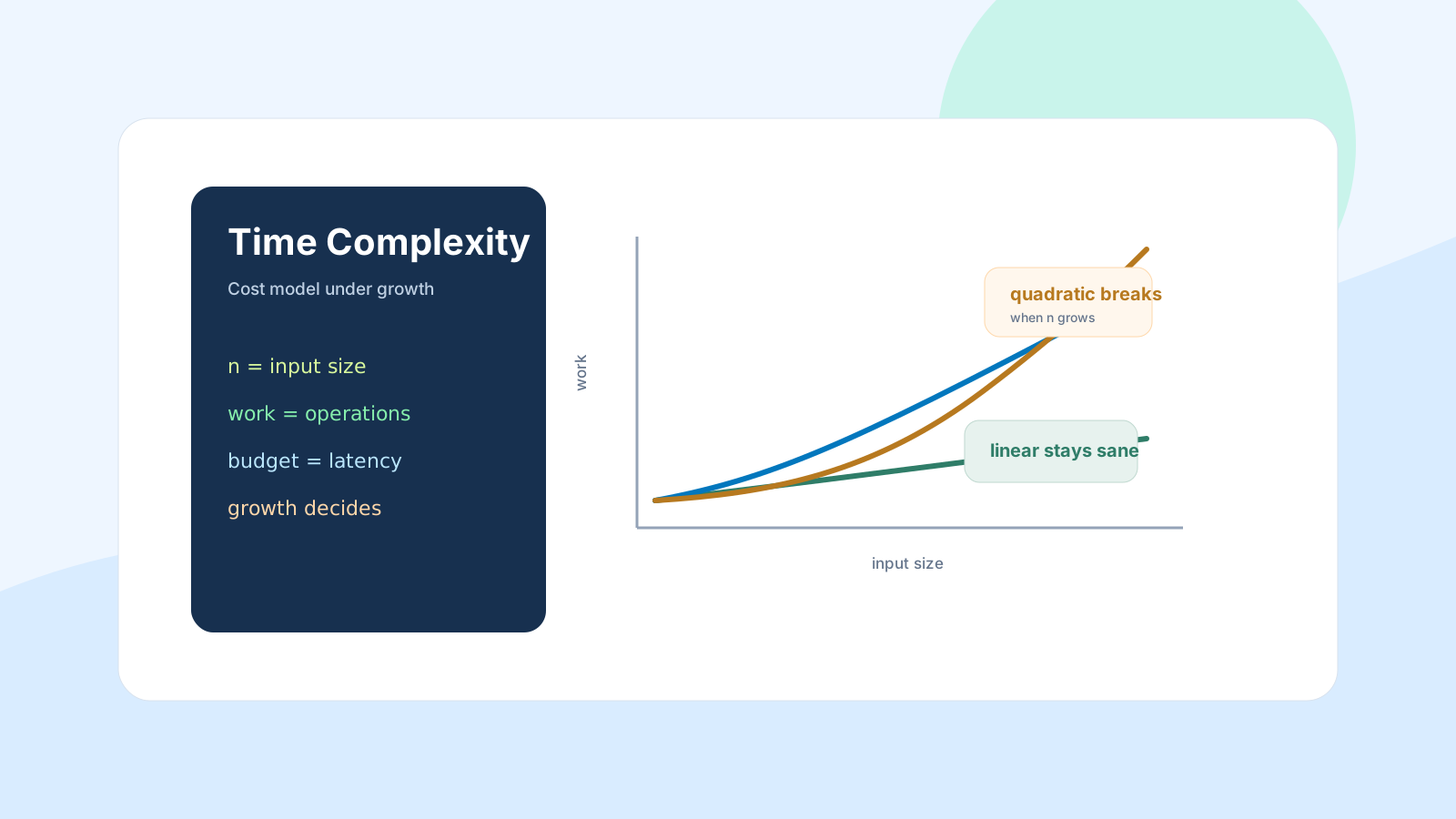
Time complexity is how engineers talk about the shape of work. It does not tell you exactly how many milliseconds code will take today. It tells you whether the code has a future when the input becomes 10x, 100x, or 10,000x larger.
Complexity Is About Growth
A program can be fast in development and still have the wrong complexity. Local test data is usually small, caches are warm, and nobody is competing for CPU. Production changes the question: what happens when more users, rows, events, files, messages, or relationships arrive?
Big O ignores constants and machine details on purpose. It focuses on the part of cost that keeps growing with input size. That is why Big O is useful before you benchmark: it helps you identify which implementation is structurally likely to survive growth.
SkillSkore principle
Time complexity is not about proving you know notation. It is about predicting whether a feature still works when the business succeeds.
First Find the Input Variable
Every complexity discussion starts with naming n. If you cannot name what grows, you cannot reason about cost. In real systems, n is rarely just 'array length'. It could be organizations in an account, products in a catalog, commits in a repository, rules in a policy engine, alerts in a dashboard, or candidates in a recommendation pipeline.
| Feature | Possible input variable | Dominant operation |
|---|---|---|
| Dashboard | projects, alerts, incidents | Aggregate and filter records per request. |
| Autocomplete | dictionary terms, prefixes, ranking candidates | Find matching prefixes while the user types. |
| Permission check | roles, grants, resource policies | Decide whether an action is allowed. |
| Code search | files, symbols, tokens | Find matches without scanning every file live. |
| Feed ranking | candidate posts, graph edges, signals | Select and rank the best few items. |
Common mistake
Do not say 'this is O(n)' until you have said what n means. Different inputs can grow independently, and the real cost may be O(users × permissions), O(projects × alerts), or O(files × tokens).
The Complexity Families Engineers Use Most
You do not need to memorize every possible function to become strong at DSA. You need fluency with the common families and the engineering behavior they imply.
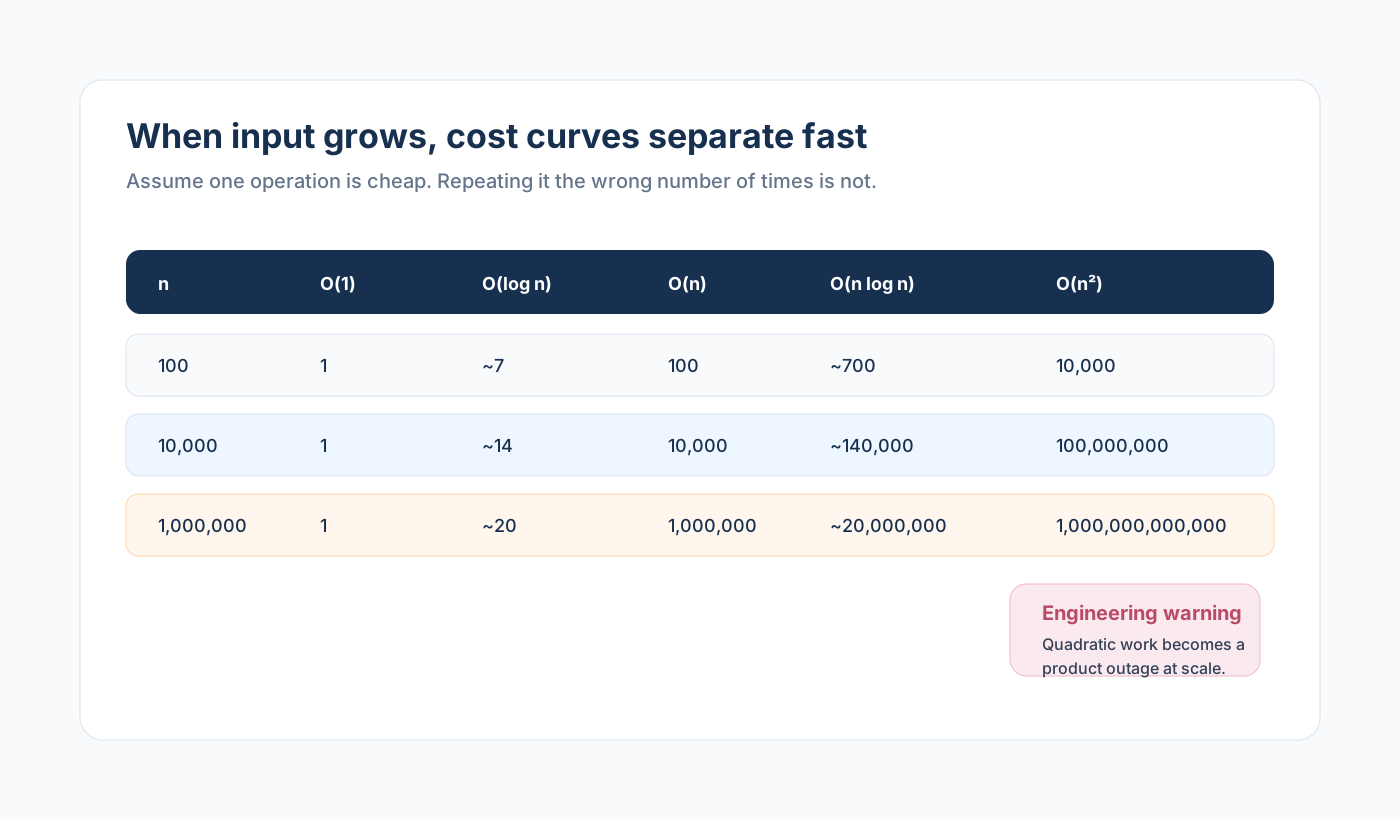
| Complexity | Engineering meaning | Common source |
|---|---|---|
| O(1) | Work stays bounded as input grows. | Hash lookup, array index access, cached counter. |
| O(log n) | Each step cuts the remaining search space. | Binary search, balanced trees, heap height. |
| O(n) | Work grows in direct proportion to input. | Single pass, scan, count, filter. |
| O(n log n) | Repeated divide-and-merge or sort-style work. | Efficient sorting, many divide-and-conquer algorithms. |
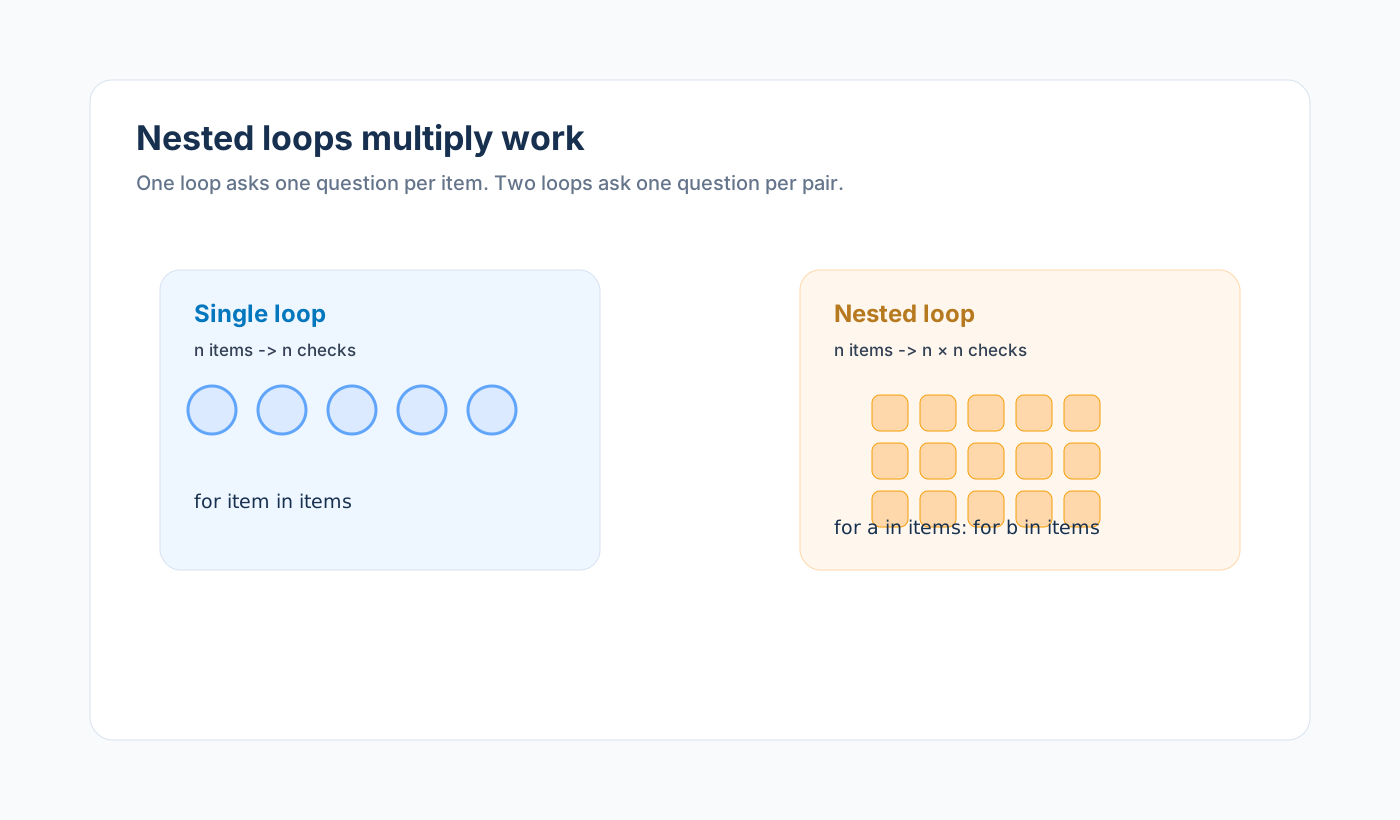
| O(n^2) | Work grows by pairs or repeated scans. | Nested loops, comparing every item to every other item. |
Scenario: Dashboard API Latency
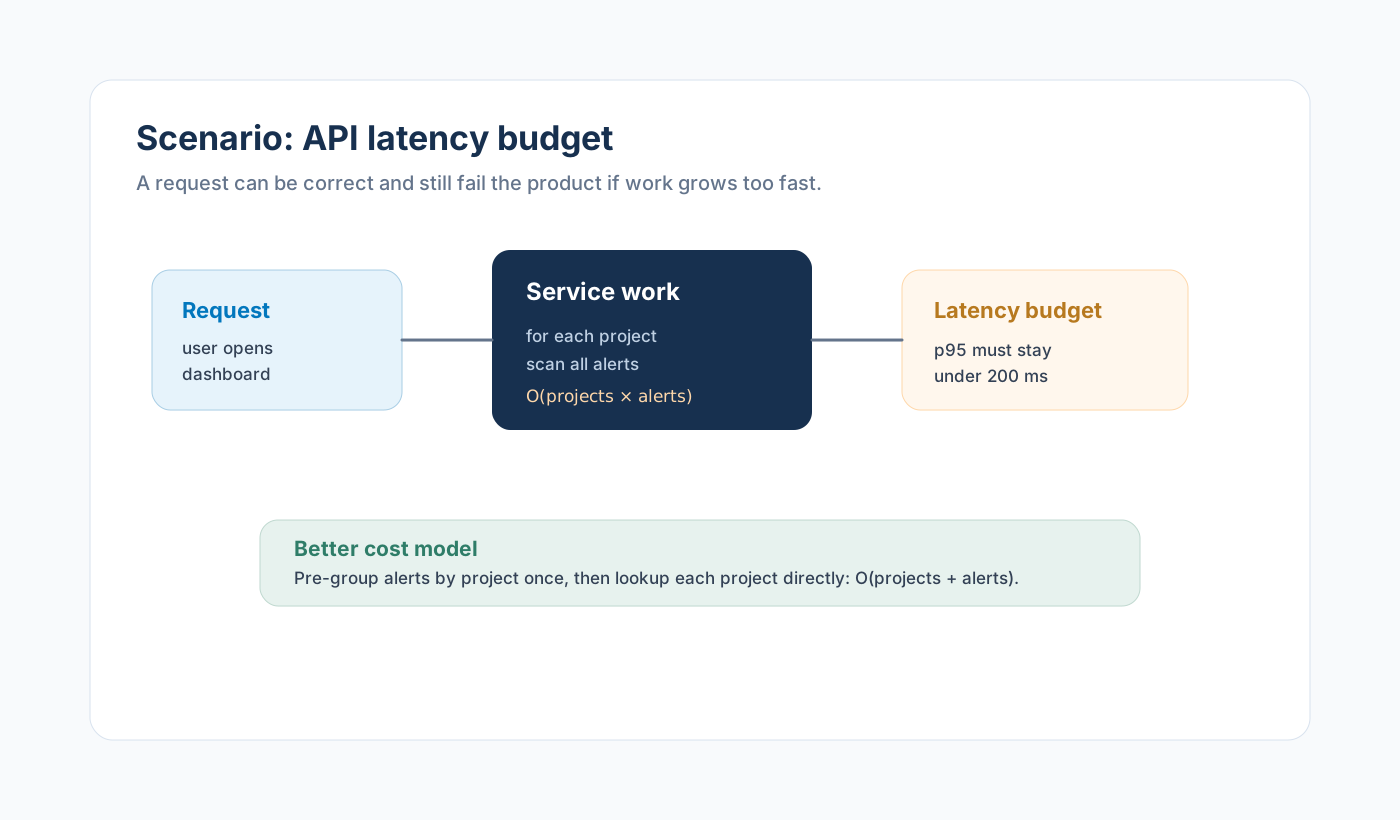
Imagine a dashboard endpoint. For each project in an organization, it must show the latest unresolved alert count. A straightforward implementation loops through projects, then scans all alerts to find the ones for that project.
type Project = { id: string; name: string };
type Alert = { projectId: string; resolved: boolean };

function unresolvedCounts(projects: Project[], alerts: Alert[]) {
  return projects.map((project) => ({
    projectId: project.id,
    count: alerts.filter(
      (alert) => alert.projectId === project.id && !alert.resolved,
    ).length,
  }));
}
If there are p projects and a alerts, this does p scans over the alerts list. The complexity is O(p × a). With 20 projects and 500 alerts, nobody notices. With 2,000 projects and 1,000,000 alerts, this is not a small bug; it is a request-path design failure.
Changing the Shape of the Work
The better implementation changes the access pattern. Instead of scanning every alert for every project, scan alerts once, group unresolved counts by project ID, then lookup each project directly. The syntax changes by language; the cost model does not.
Now the endpoint scans alerts once and projects once. The complexity becomes O(a + p). This is the kind of improvement that matters in production: not because Map is fashionable, but because the dominant work changed from multiplication to addition.
import java.util.*;

record Project(String id) {}
record Alert(String projectId, boolean resolved) {}

class DashboardCounts {
  static Map<String, Integer> unresolvedCounts(
      List<Project> projects,
      List<Alert> alerts
  ) {
    Map<String, Integer> countsByProject = new HashMap<>();

    for (Alert alert : alerts) {
      if (alert.resolved()) continue;
      countsByProject.merge(alert.projectId(), 1, Integer::sum);
    }

    Map<String, Integer> result = new LinkedHashMap<>();
    for (Project project : projects) {
      result.put(project.id(), countsByProject.getOrDefault(project.id(), 0));
    }
    return result;
  }
}
Production judgment
The optimized version uses extra memory. That is acceptable when memory grows linearly and the request path avoids repeated scans. Complexity work is usually a trade: spend memory, preprocessing, indexing, or caching to reduce repeated time cost.
Dominant Terms and Why Constants Disappear
If a function scans a list twice, the exact operation count may be 2n. Big O calls this O(n), because doubling a linear scan is still linear growth. If a function does one nested pair comparison and then three linear passes, the cost may look like n² + 3n. Big O calls this O(n²), because the squared term dominates as n grows.
| Raw expression | Big O | Reason |
|---|---|---|
| 5 | O(1) | The work is bounded and does not grow with input. |
| 3n + 20 | O(n) | The linear term dominates fixed work. |
| n log n + n | O(n log n) | Sorting-style work dominates a single scan. |
| n² + 10n + 50 | O(n²) | Pairwise work dominates at large n. |
| p × a + p | O(p × a) | The multiplied scan dominates the project pass. |
Best, Average, and Worst Case
Complexity can describe different cases. Best case is what happens under unusually favorable input. Worst case is the upper bound when input is adversarial or unlucky. Average case is expected behavior under assumed input distribution. In product engineering, worst case matters for reliability; average case matters for cost; best case rarely protects users.
function containsUser(userIds: string[], target: string) {
  for (const userId of userIds) {
    if (userId === target) return true;
  }
  return false;
}

// Best case: target is first -> O(1)
// Worst case: target is missing or last -> O(n)
// We usually describe this scan as O(n).
Assessment trap
If code can exit early, do not blindly answer O(1). Ask which case the question is testing. Most engineering reviews care about the worst credible path, because that is where incidents hide.
How to Review Code for Time Complexity
- Name every input that can grow independently.
- Find loops, recursion, sorting, database queries inside loops, and repeated scans.
- Ask whether loops are sequential, nested, or bounded by a constant.
- Look for hidden work inside helper calls such as filter, includes, contains, sort, query, parse, or serialize.
- Reduce the expression to the dominant growth term.
- Connect the result to a product constraint: latency, throughput, CPU cost, queue delay, or timeout risk.
Practice Before You Continue
Take one endpoint or UI operation you have built before. Write down the input variables, then classify the dominant work. If your answer is only 'it loops', go one level deeper: what does it loop over, and does anything inside the loop also grow?
Field judgmentEngineering Notes
- Time complexity models growth, not exact runtime.
- Always define n before naming Big O.
- Sequential loops usually add; nested loops usually multiply.
- O(n²) is often acceptable for tiny bounded inputs and dangerous for unbounded product data.
- Hash maps, indexes, preprocessing, and caching often trade memory or write cost for lower repeated read cost.
- Strong assessment answers connect complexity to user-visible constraints, not just notation.
Interview signalFrequently Asked Interview Questions
These are canonical interview patterns for this topic, phrased as concrete problem statements. They avoid vague theory questions and prepare you for the exact reasoning interviewers expect: invariant, edge cases, complexity, and trade-off.
- Optimize active user filtering where active IDs are checked repeatedly.
- Return the first event ID that appears twice in a stream.
- Return the k largest values from a large list.
Production practiceCompany-Style Practice Examples
These are not claimed as exact company-specific questions. They are the interview patterns repeatedly used by product companies to test whether you can move from brute force to a defensible implementation.
| Example | Brute-force approach | Stronger solution | Production notes |
|---|---|---|---|
| Active user filtering | `users.filter(u => activeIds.includes(u.id))`. | Build a set from active IDs, then filter with membership lookup. | Before: O(users * activeIds). After: O(users + activeIds) expected. |
| Duplicate detection | Compare each event with every previous event. | Track seen event IDs in a set during one pass. | Spend O(n) memory to prevent O(n^2) repeated comparisons. |
| Top candidates | Sort every candidate when only top few are needed. | Use a heap/selection strategy when k is much smaller than n. | Sorting may still be fine if n is small or output needs full order. |
Solved modelInterview Question Solutions
Question 1: Hidden Nested Membership
Optimize active user filtering where active IDs are checked repeatedly. The brute force version performs a scan inside a scan. Convert active IDs to a set once, then filter in one pass.
import java.util.*;

class ActiveUsers {
    static List<User> filterActive(List<User> users, Set<String> activeIds) {
        List<User> result = new ArrayList<>();
        for (User user : users) {
            if (activeIds.contains(user.id())) result.add(user);
        }
        return result;
    }
}
record User(String id) {}
Question 2: First Duplicate Event
Return the first event ID that appears twice in a stream. A nested comparison checks each event against all earlier events. A set tracks membership in one pass.
import java.util.*;

class FirstDuplicate {
    static String firstDuplicate(List<String> events) {
        Set<String> seen = new HashSet<>();
        for (String event : events) {
            if (!seen.add(event)) return event;
        }
        return null;
    }
}
Question 3: Top K Values
Return the k largest values from a large list. Sorting all values costs O(n log n). A min-heap of size k costs O(n log k), which is stronger when k is much smaller than n.
import java.util.*;

class TopK {
    static List<Integer> topK(int[] values, int k) {
        PriorityQueue<Integer> heap = new PriorityQueue<>();
        for (int value : values) {
            heap.offer(value);
            if (heap.size() > k) heap.poll(); // Keep only k largest seen so far.
        }
        return new ArrayList<>(heap);
    }
}
Solved modelWorked Interview Answer
Review `users.filter(user => activeIds.includes(user.id))` for 200,000 users and 80,000 active IDs. The hidden cost is multiplicative because `includes` scans for every user. Build a set once, then perform direct membership checks.
import java.util.*;

class ActiveUsers {
    static List<User> filterActive(List<User> users, Set<String> activeIds) {
        List<User> result = new ArrayList<>();
        for (User user : users) {
            if (activeIds.contains(user.id())) result.add(user);
        }
        return result;
    }
}
record User(String id) {}
Hands-on drillTry It Yourself
Practice task
Take one code path with a loop. Identify the input size, count how often the loop runs, then explain what happens when the input becomes 100 times larger.
Failure patternsCommon Mistakes to Avoid
- Describing Big O as exact runtime instead of growth behavior.
- Ignoring hidden loops inside helpers such as includes, filter, map, split, or database calls.
- Using worst-case notation without explaining whether the case is realistic.
Execution guardrailQuick-Start Checklist
- Define n.
- Count repeated work.
- Look for nested or hidden loops.
- Separate worst case from typical case.
- Connect growth to latency, cost, or reliability.
Recall drillKnowledge Check
| Question | Strong answer |
|---|---|
| What does O(n) mean? | Work grows roughly linearly with input size. |
| Why is O(n^2) dangerous? | Doubling input can roughly quadruple pairwise work. |
| What is hidden linear work? | A helper call that scans data while appearing constant at the call site. |
VocabularyKey Terms
| Term | Meaning |
|---|---|
| n | The input size being modeled. |
| Worst case | The input arrangement that causes maximum work. |
| Amortized | Average cost across a sequence of operations. |
Next practiceFurther Reading
- Compare growth curves with real input sizes.
- Review code review examples that hide nested work.
- Study amortized analysis before dynamic arrays and hash maps.