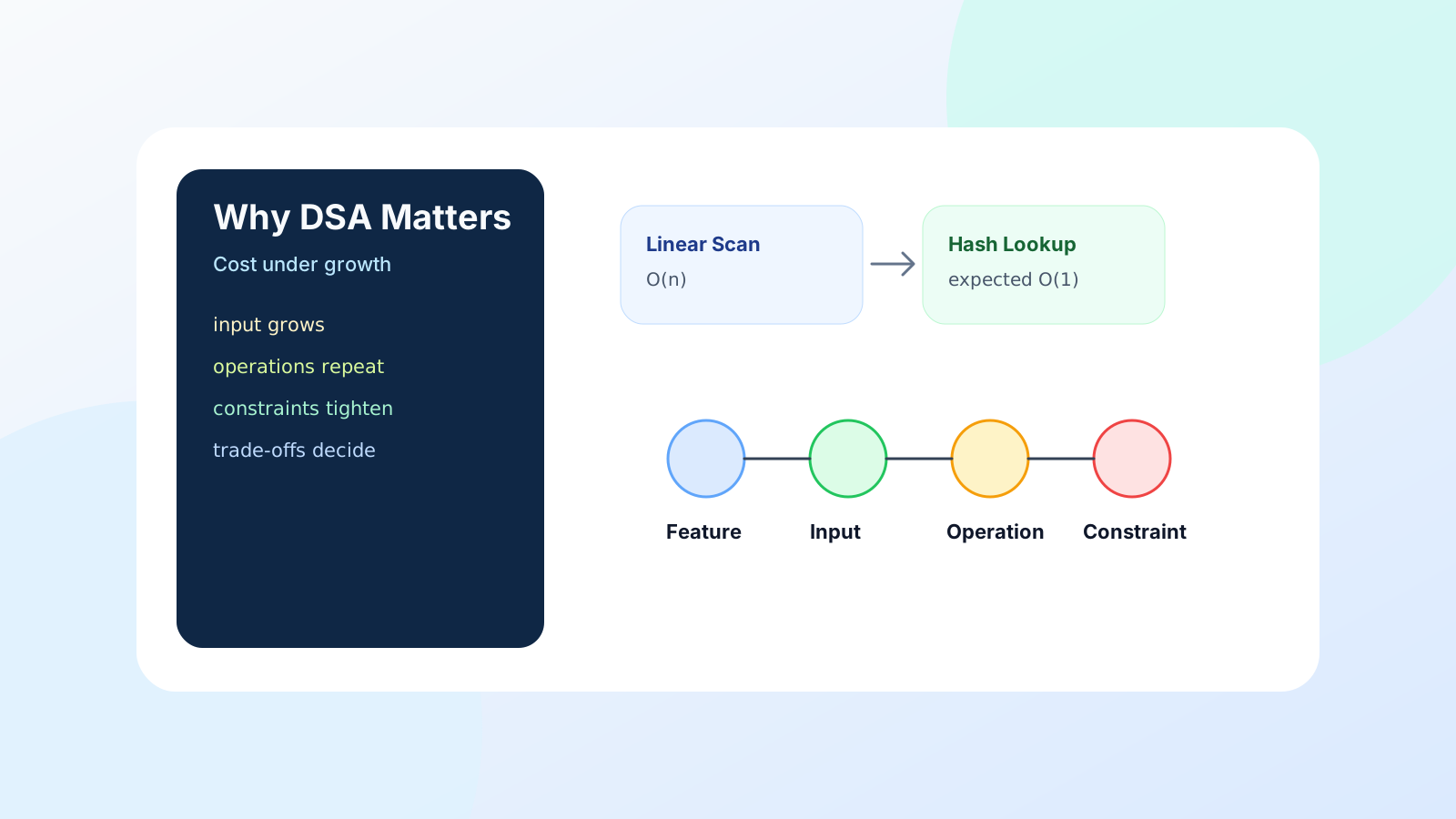
Why DSA Still Matters in Real Engineering
Understand DSA as a practical engineering decision system: cost, scale, latency, reliability, and product behavior.
What you will be able to do
Data Structures and Algorithms are not a separate academic island. They are the vocabulary engineers use when a feature must stay correct, fast, and affordable as real users, real data, and real traffic increase.
The Real Purpose of DSA
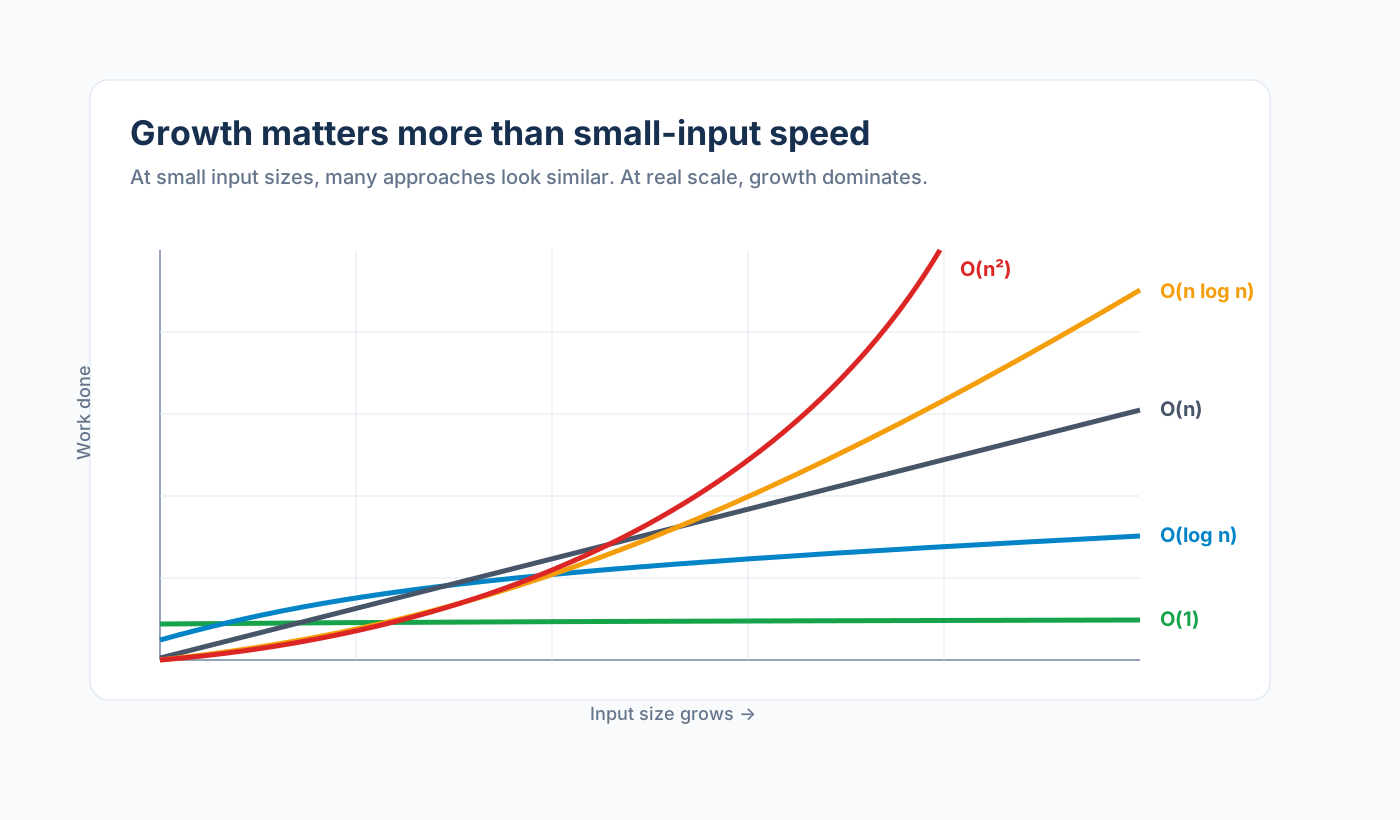
In production engineering, DSA answers one question again and again: what will this decision cost when the input grows? That input might be users in a social graph, items in a cart, rows in a database export, files in a code search index, events in a stream, or candidates in a ranking system.
A beginner often sees DSA as a list of named techniques. A professional sees it as a cost model. Arrays, hash maps, heaps, graphs, queues, and dynamic programming are tools for shaping access patterns, memory use, update cost, ordering, and recomputation.
SkillSkore principle
You are not learning DSA to memorize solutions. You are learning to choose the cheapest correct behavior under explicit constraints.
Where DSA Shows Up Today
| Product surface | DSA underneath | Why it matters |
|---|---|---|
| Autocomplete | Trie, prefix search, ranking heaps | Low-latency suggestions while the user is still typing. |
| Feed ranking | Heaps, sorting, graph signals | Choose the best few items from a large candidate set. |
| Fraud detection | Graphs, hash sets, sliding windows | Find suspicious relationships and repeated behavior quickly. |
| Observability | Queues, sketches, streaming windows | Aggregate massive event streams without storing everything forever. |
| Search indexing | Inverted indexes, maps, compression | Make document lookup fast enough for interactive use. |
| Schedulers | Priority queues, interval handling | Run the right task at the right time with bounded delay. |
A Small Choice With a Large Effect
Imagine a team building a permission check. For each request, the service receives a user ID and an action. It must decide whether the user has that action in their allowed permissions.
const permissions = ["read", "comment", "deploy", "billing:view"];

function canPerform(action: string) {
  return permissions.includes(action);
}
For four permissions, this is clear and fine. For thousands of permissions checked across millions of requests, repeated linear scans become unnecessary latency. A set changes the access pattern from scanning to direct membership lookup.
const permissions = new Set(["read", "comment", "deploy", "billing:view"]);

function canPerform(action: string) {
  return permissions.has(action);
}
Same Idea in Java, Python, and JavaScript
Professional DSA knowledge transfers across languages. The syntax changes, but the decision is the same: repeated membership checks should use a structure built for membership, not repeated scans.
import java.util.Set;

class PermissionCheck {
  private final Set<String> permissions = Set.of("read", "comment", "deploy", "billing:view");

  boolean canPerform(String action) {
    return permissions.contains(action);
  }
}
Production judgment
The array version is not automatically bad. The set version is not automatically good. The right choice depends on size, frequency, construction cost, memory budget, and clarity. DSA gives you the language to make that trade-off deliberately.
The Four Questions Engineers Ask
- What is the input, and how can it grow?
- What operations happen most often: read, write, search, sort, merge, traverse, or update?
- What constraints matter most: latency, memory, correctness, throughput, implementation time, or maintainability?
- What fails when the input becomes 10x, 100x, or 10,000x larger?
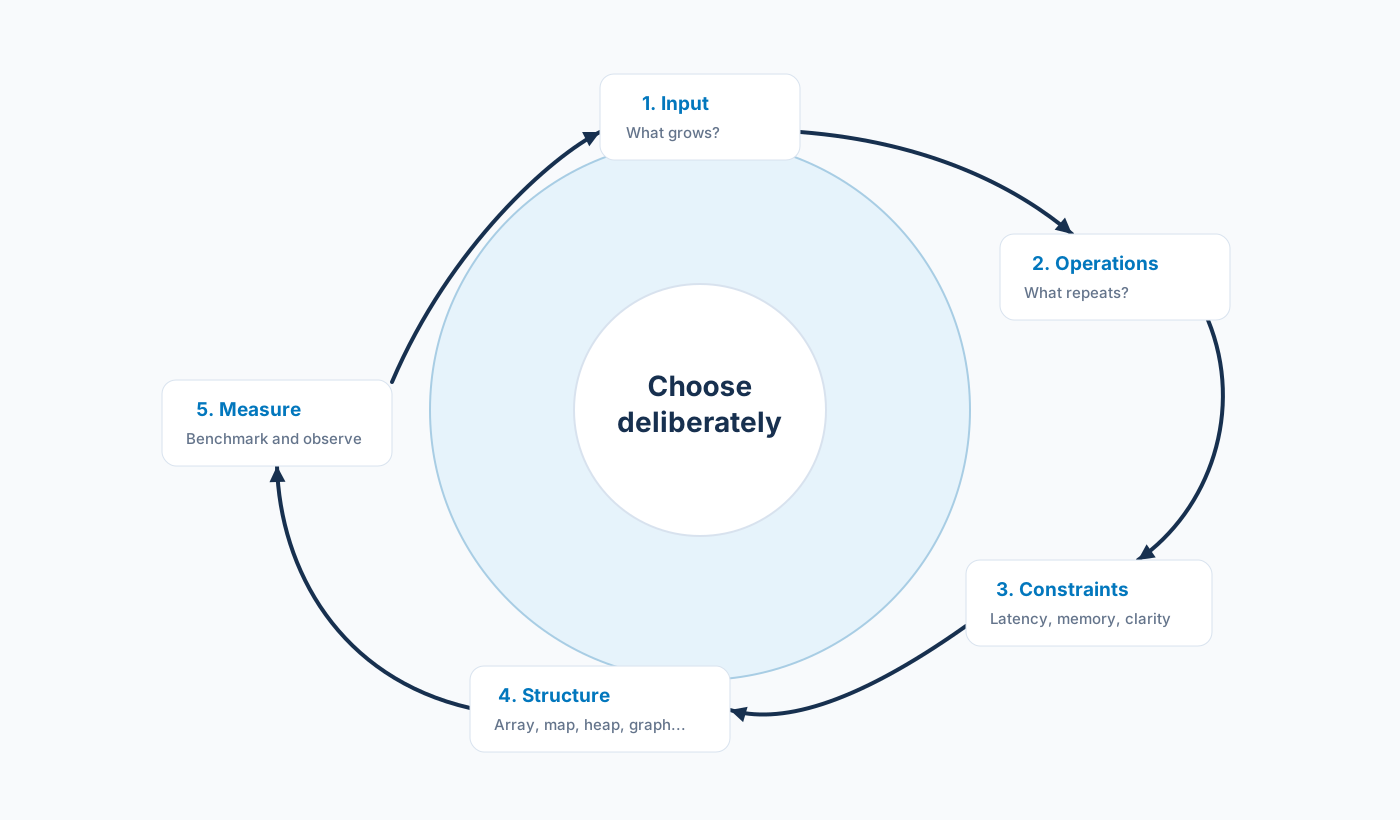
These questions are more important than memorizing Big O names. Big O is the notation. Engineering judgment is the skill.
Scenario: Building a Notification Inbox
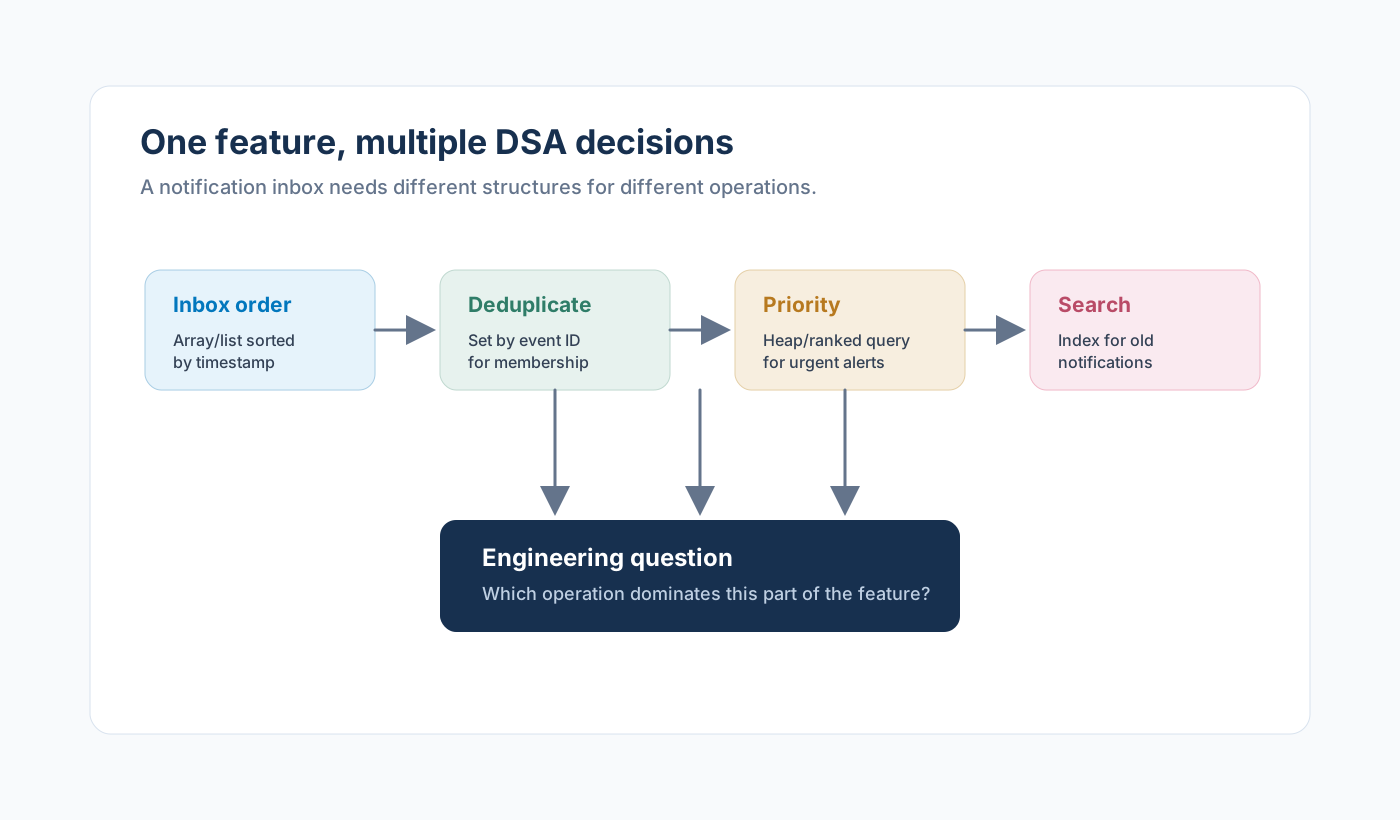
A notification inbox starts simply: fetch notifications, show unread first, let users mark items as read. Early on, a list sorted by timestamp may be enough. Then product asks for unread counts, priority alerts, deduplication, device sync, and search. Each request changes the operations the system must support.
| Requirement | Likely structure | Reason |
|---|---|---|
| Show newest first | Array/list with timestamp sort | Ordering dominates the view. |
| Check if a notification was already sent | Hash set by event ID | Fast duplicate detection. |
| Always show urgent alerts first | Priority queue or ranked query | Highest-priority item must surface quickly. |
| Group related notifications | Map from entity ID to notification group | Direct access to the group avoids repeated scans. |
| Search across old notifications | Index | Scanning every notification does not scale. |
Common beginner mistake
Do not ask, 'Which data structure is best?' Ask, 'Best for which operation, at what size, under which constraint?'
Failure patternsCommon Mistakes Engineers Make
- Optimizing before naming the dominant operation.
- Using the most advanced structure instead of the simplest structure that satisfies the constraint.
- Ignoring memory cost when replacing scans with maps or sets.
- Forgetting construction cost: building a set once is different from rebuilding it inside every request.
- Treating Big O as a replacement for measurement. Big O predicts growth; profiling confirms real bottlenecks.
When Not to Optimize
If the input is tiny, the operation is rare, and the code is clearer as a simple list, a scan may be the right engineering choice. DSA is not a mandate to complicate code. It is a discipline for knowing when complexity is justified.
Senior engineer signal
A strong engineer can say: 'The array scan is acceptable here because the list is capped at 20 items and this path runs only during admin setup. If that cap changes, switch to a set and add a benchmark.'
How This Course Will Train You
This course is organized into Beginner, Intermediate, and Advanced levels. Each level contains modules. Each module contains lessons and ends with a stringent module assessment. Passing assessments earns score movement; reading alone does not.
- Beginner modules build the cost model: complexity, arrays, strings, linear patterns, hashing, stacks, queues, recursion, and backtracking.
- Intermediate modules build structural fluency: linked lists, binary search, sorting, trees, heaps, graphs, BFS, DFS, and shortest paths.
- Advanced modules build algorithmic judgment: dynamic programming, greedy proof, advanced graphs, specialized structures, and production DSA trade-offs.
Practice Before You Continue
Pick one feature from a product you use every week. Write down the input, the most frequent operation, and the constraint that probably matters most. If you cannot name those three things, you are not ready to choose a data structure yet.
Field judgmentEngineering Notes
- DSA is cost modeling for software behavior under growth.
- The first question is always: what input grows?
- The second question is: which operation repeats most often?
- The third question is: which constraint matters most right now?
- The correct structure depends on workload, not popularity.
- Assessments in this course test decisions, implementation, complexity, edge cases, and real-world trade-offs.
Interview signalFrequently Asked Interview Questions
These are canonical interview patterns for this topic, phrased as concrete problem statements. They avoid vague theory questions and prepare you for the exact reasoning interviewers expect: invariant, edge cases, complexity, and trade-off.
- A service checks whether an action exists in a user's permissions on every request.
- Render a user's feed in ranked order and support opening an item by visible position.
- Given a slow endpoint, identify whether repeated algorithmic work is the likely cause.
Production practiceCompany-Style Practice Examples
These are not claimed as exact company-specific questions. They are the interview patterns repeatedly used by product companies to test whether you can move from brute force to a defensible implementation.
| Example | Brute-force approach | Stronger solution | Production notes |
|---|---|---|---|
| Permission check at scale | Scan an array of permissions on every request. | Use a set/map for repeated membership checks; O(n) build, expected O(1) lookup. | Mention memory, construction cost, and consistency when permissions change. |
| Feed rendering | Store feed items in any lookup structure because lookup is fast. | Use an array/list when ordered traversal and visible position dominate. | Maps can help by ID, but rendering order still needs a sequence. |
| Slow endpoint review | Guess the data structure from the symptom. | Identify input size, repeated operation, latency budget, and failure mode before changing code. | The best interview answers ask clarifying constraints first. |
Solved modelInterview Question Solutions
Question 1: Permission Check at Scale
A service checks whether an action exists in a user's permissions on every request. The brute-force approach scans a list every time. The stronger approach uses a set for membership because lookup is the dominant repeated operation.
import java.util.Set;

class PermissionCheck {
    private final Set<String> permissions = Set.of("read", "comment", "deploy");

    boolean canPerform(String action) {
        return permissions.contains(action);
    }
}
Question 2: Ordered Feed Rendering
Render a user's feed in ranked order and support opening an item by visible position. A map alone does not preserve render order. Use an array/list for ordered traversal; optionally maintain a separate map by ID if direct lookup is also needed.
import java.util.*;

record Post(String id, String title) {}

class FeedModel {
    private final List<Post> orderedFeed;
    private final Map<String, Post> byId;

    FeedModel(List<Post> posts) {
        orderedFeed = new ArrayList<>(posts); // Preserves ranking order for rendering.
        byId = new HashMap<>();
        for (Post post : posts) byId.put(post.id(), post);
    }

    Post atPosition(int index) {
        return orderedFeed.get(index);
    }

    Post byId(String id) {
        return byId.get(id);
    }
}
Question 3: Slow Endpoint Triage
Given a slow endpoint, identify whether repeated algorithmic work is the likely cause. Instrument the code path and count operations. A practical answer measures input size and repeated work before changing data structures.
class EndpointTriage {
    static long estimatePairChecks(int items) {
        // A nested pair comparison performs n * (n - 1) / 2 checks.
        return (long) items * (items - 1) / 2;
    }

    static boolean shouldReviewAlgorithm(int items, long maxComfortableChecks) {
        return estimatePairChecks(items) > maxComfortableChecks;
    }
}
Solved modelWorked Interview Answer
Given repeated permission checks, replace repeated array scans with a structure that matches membership lookup. A strong answer names the dominant operation first: repeated membership lookup. The set/map version spends memory to avoid scanning on every request.
import java.util.Set;

class PermissionCheck {
    private final Set<String> permissions = Set.of("read", "comment", "deploy");

    boolean canPerform(String action) {
        return permissions.contains(action);
    }
}
Hands-on drillTry It Yourself
Practice task
Pick a feature you have built or used recently. Write down its input, dominant operation, growth risk, and one trade-off you would defend in a code review.
Failure patternsCommon Mistakes to Avoid
- Saying a data structure is good or bad without naming the operation.
- Optimizing for theoretical speed when the input is tiny and clarity matters more.
- Ignoring memory, construction cost, and correctness while discussing runtime.
- Treating interview notation as separate from production behavior.
Execution guardrailQuick-Start Checklist
- Name the input.
- Name the operation that repeats.
- Estimate how the input can grow.
- State the current cost.
- State the trade-off of the proposed structure.
Recall drillKnowledge Check
| Question | Strong answer |
|---|---|
| Why is DSA useful outside interviews? | It gives engineers a language for cost, growth, correctness, memory, and trade-offs. |
| When is a simple array acceptable? | When input is small, operations are rare, order matters, and clarity beats extra structure. |
| What makes an answer assessment-grade? | It names constraints, compares options, and defends consequences. |
VocabularyKey Terms
| Term | Meaning |
|---|---|
| Dominant operation | The operation that drives most of the cost or risk. |
| Trade-off | A deliberate exchange such as speed for memory or clarity for flexibility. |
| Input growth | How data size or operation frequency changes over time. |
Next practiceFurther Reading
- Review the Engineering Cost Models module before attempting assessments.
- Study Big O with concrete product examples, not isolated formulas.
- Read production incident writeups and identify hidden cost-model failures.