
Space Complexity and Memory Trade-offs
Reason about auxiliary memory, data copies, caches, recursion, output size, and memory pressure as first-class engineering constraints.
What you will be able to do
Space complexity is the part of DSA that makes algorithms real. Time tells you how long work grows. Space tells you whether the machine, container, browser tab, mobile device, cache, or queue worker can survive the work at all.
Memory Is a Budget, Not a Footnote
Many engineers learn space complexity as a small label after time complexity: O(1), O(n), maybe O(n^2). In production, memory is not a footnote. Memory affects container limits, garbage collection pauses, cache hit rates, browser responsiveness, mobile battery, database pressure, and whether a job gets killed halfway through a large input.
A solution that is faster because it builds a map may be excellent. A solution that copies a multi-gigabyte payload three times may be impossible. The skill is not avoiding memory. The skill is spending memory deliberately.
SkillSkore principle
Space complexity asks: which memory grows with input, who owns it, how long does it live, and what constraint does it buy us?
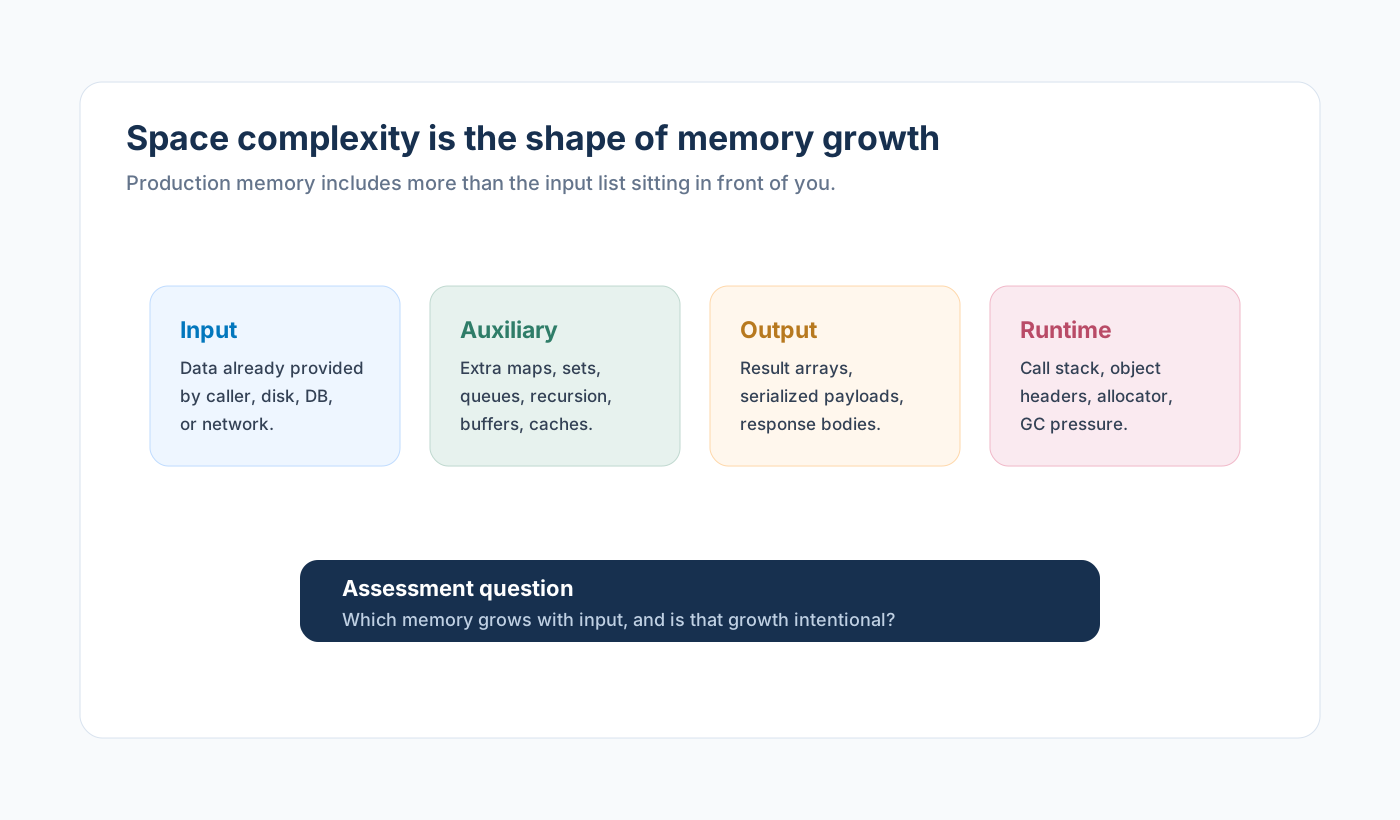
What Counts as Space?
When analyzing an algorithm, engineers usually focus on auxiliary space: extra memory allocated by the algorithm beyond the input. But production systems also care about output size and runtime overhead. If an endpoint reads 100 MB, builds a 100 MB transformed copy, serializes another 100 MB response, and keeps all three live at once, the peak memory is the problem.
| Memory category | What it means | Engineering risk |
|---|---|---|
| Input | Data already provided to the algorithm. | Large request bodies, large query results, uploaded files. |
| Auxiliary | Extra data structures created to solve the problem. | Maps, sets, heaps, queues, buffers, recursion stack. |
| Output | The result that must be returned or stored. | Large response payloads, generated reports, transformed arrays. |
| Runtime overhead | Memory used by frames, objects, iterators, allocator, and runtime. | Stack overflow, GC pauses, object churn. |
Auxiliary Space: The Most Useful Lens
Auxiliary space is the extra working memory a solution needs as input grows. A two-counter scan is O(1) auxiliary space. A hash set containing every seen ID is O(n). A matrix for every pair of items is O(n^2).
| Pattern | Auxiliary space | Why |
|---|---|---|
| Track min and max while scanning | O(1) | Only a few variables grow independent of input size. |
| Build a frequency map | O(k) or O(n) | Memory grows with distinct keys, bounded by input size. |
| Copy an array before sorting | O(n) | The copied array grows with input length. |
| Recursive DFS on a deep tree | O(h) | Call stack grows with tree height. |
| Dynamic programming table | O(states) | Stored subproblem results grow with state count. |
Assessment trap
Do not answer O(1) just because the code does not create an obvious array. Recursion, library calls, sorting, string concatenation, slicing, serialization, and hidden copies can allocate memory.
Scenario: Duplicate Event Ingestion
Imagine an ingestion service receiving events from clients and queues. Retries happen. Network failures happen. The same event ID may arrive more than once. The service must write each event once. One implementation scans all previously accepted events to see whether the new ID already exists. Another keeps a set of seen IDs.
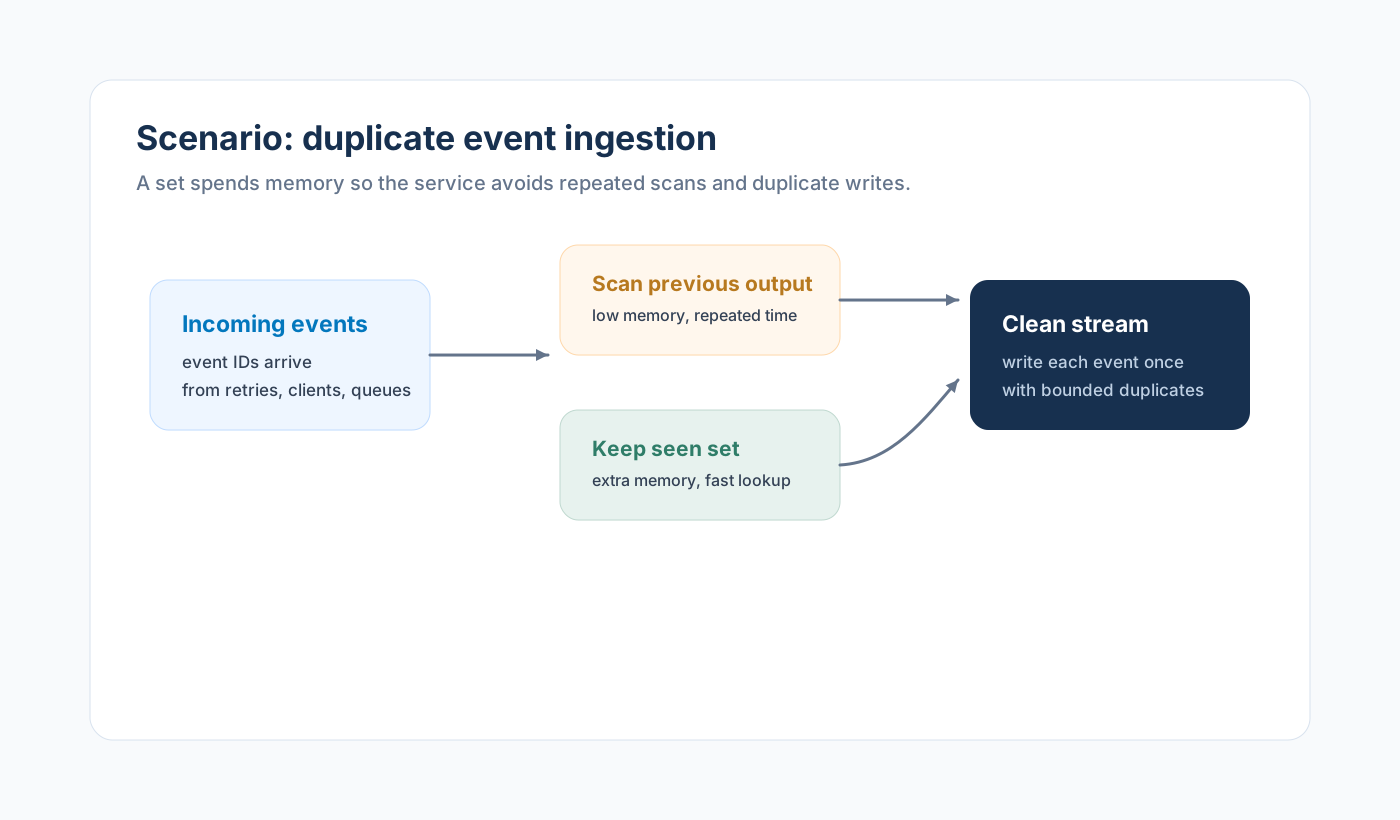
This is not a case where O(1) extra memory automatically wins. The scan-based version saves memory but can become O(n^2) time across a stream. The set-based version spends O(n) memory to keep each membership check expected O(1).
type Event = { id: string; payload: string };

function uniqueEventsSlow(events: Event[]) {
  const accepted: Event[] = [];

  for (const event of events) {
    const alreadyAccepted = accepted.some((item) => item.id === event.id);
    if (!alreadyAccepted) accepted.push(event);
  }

  return accepted;
}
The slow version has low auxiliary memory beyond the output, but every new event scans the accepted list. For large streams, that repeated scan is usually the wrong trade.
Spending Memory Deliberately
A memory-aware improvement keeps a set of seen IDs. The output still grows with unique events, but the auxiliary set also grows with unique IDs. That extra memory is intentional: it buys faster duplicate checks and more predictable latency.
import java.util.*;

record Event(String id, String payload) {}

class DeduplicateEvents {
  static List<Event> uniqueEvents(List<Event> events) {
    Set<String> seenIds = new HashSet<>();
    List<Event> accepted = new ArrayList<>();

    for (Event event : events) {
      if (seenIds.add(event.id())) {
        accepted.add(event);
      }
    }

    return accepted;
  }
}
Production judgment
The set is not free. You must consider cardinality, lifetime, eviction, and whether IDs can be streamed, batched, or persisted. But if duplicate checks are frequent, O(n) auxiliary memory can be the cheapest correct behavior.
In-Place Mutation vs Copy-Based Transformation
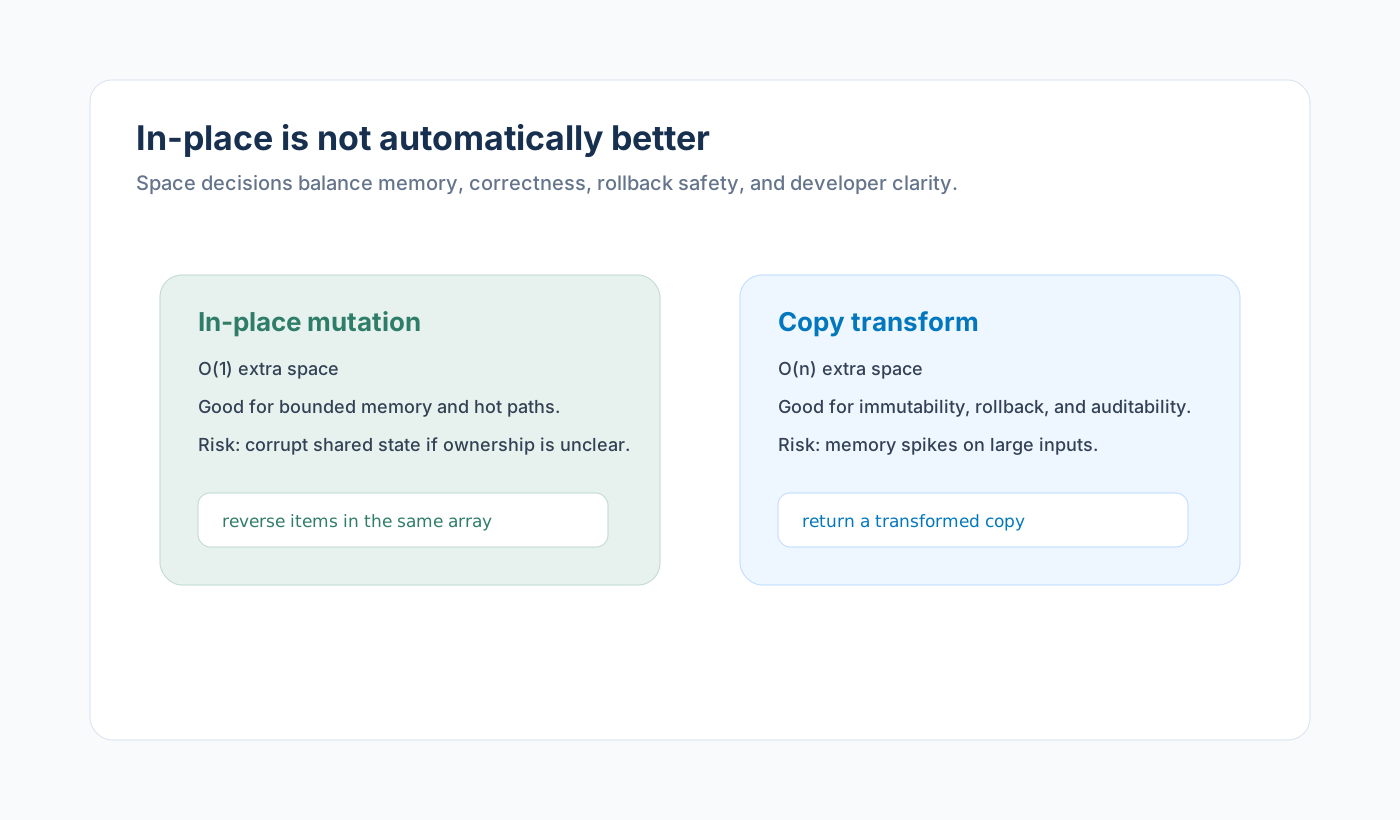
In-place algorithms modify the existing data structure and often use O(1) auxiliary space. Copy-based algorithms allocate a new result and often use O(n) space. Neither is automatically more professional. The right choice depends on ownership, safety, concurrency, debugging, rollback, and memory limits.
| Choice | Space | Good when | Risk |
|---|---|---|---|
| In-place mutation | Often O(1) | Input is owned, memory is tight, hot path needs low allocation. | Can corrupt shared state or make rollback harder. |
| Copy transform | Often O(n) | Immutability, auditability, rollback, or concurrent readers matter. | Can double peak memory or trigger GC pressure. |
| Streaming | Often O(1) or bounded | Data can be processed incrementally. | May complicate ordering, retries, or aggregation. |
| Caching/indexing | Often O(n) | Repeated reads dominate and memory is available. | Stale data, eviction complexity, memory growth. |
Hidden Memory Costs in Real Code
Modern languages make allocation easy, which is productive but dangerous when inputs grow. A line that looks simple can allocate a new array, a new string, a new iterator, a boxed object, or a serialized copy.
- Array slicing often creates a copy unless the language/runtime explicitly uses a view.
- String concatenation in a loop can create many temporary strings.
- Sorting may allocate temporary buffers depending on the algorithm and implementation.
- Recursive functions use stack frames even when no heap data structure is visible.
- JSON parsing and serialization can hold both object form and string form in memory.
- Collecting a stream into a list removes the memory benefit of streaming.
function normalizeNames(names: string[]) {
  return names
    .map((name) => name.trim())
    .filter((name) => name.length > 0)
    .map((name) => name.toLowerCase());
}

// Clear code, but each stage can allocate another array.
// For small input this is fine. For huge input, consider one pass or streaming.
How to Review Code for Space Complexity
- Name the input sizes that can grow independently.
- Separate input, output, auxiliary structures, and runtime overhead.
- Identify every allocation that grows with input: maps, sets, arrays, strings, buffers, recursion, caches.
- Ask how long the memory lives: one loop iteration, one request, one batch, one process lifetime, or indefinitely.
- Ask what the memory buys: faster lookup, safer rollback, less recomputation, clearer code, or streaming behavior.
- Connect the trade-off to constraints: memory limit, GC pauses, p95 latency, mobile device limits, container OOM risk, or cost.
Practice Before You Continue
Find a function that builds a map, set, array, cache, or transformed copy. Write down its auxiliary space, output space, and lifetime. Then answer this: what product constraint does that memory purchase?
Field judgmentEngineering Notes
- Space complexity models memory growth as input grows.
- Auxiliary space is the extra working memory beyond the input.
- Output memory still matters for production peak memory, even if some algorithm analysis excludes it.
- O(1) extra space is not automatically better than O(n) extra space.
- Hash sets, maps, caches, and indexes often trade memory for faster repeated access.
- Strong assessment answers mention memory lifetime, peak usage, ownership, and the constraint being optimized.
Interview signalFrequently Asked Interview Questions
These are canonical interview patterns for this topic, phrased as concrete problem statements. They avoid vague theory questions and prepare you for the exact reasoning interviewers expect: invariant, edge cases, complexity, and trade-off.
- Return the first duplicate event in a large stream.
- Transform a large list of records without holding every transformed result in memory.
- Deduplicate only the most recent N event IDs to prevent unbounded memory growth.
Production practiceCompany-Style Practice Examples
These are not claimed as exact company-specific questions. They are the interview patterns repeatedly used by product companies to test whether you can move from brute force to a defensible implementation.
| Example | Brute-force approach | Stronger solution | Production notes |
|---|---|---|---|
| Deduplicate stream | Keep scanning accepted output for duplicates. | Use a seen set for membership. | Discuss unbounded memory and possible batching/windowing. |
| Transform records | Create many intermediate arrays for each transformation step. | Stream or combine passes when memory pressure matters. | Clarity can justify separate passes for small data. |
| Cache expensive lookup | Recompute from source every request. | Cache/index repeated lookup results. | Mention staleness, invalidation, and memory lifetime. |
Solved modelInterview Question Solutions
Question 1: First Duplicate With Memory Trade-Off
Return the first duplicate event in a large stream. Use O(n) memory for a set to avoid O(n^2) repeated scans. Explain memory lifetime and possible bounding strategies.
import java.util.*;

class FirstDuplicate {
    static String firstDuplicate(List<String> events) {
        Set<String> seen = new HashSet<>();
        for (String event : events) {
            if (!seen.add(event)) return event;
        }
        return null;
    }
}
Question 2: Stream Transform Without Storing Everything
Transform a large list of records without holding every transformed result in memory. If the caller can consume records incrementally, stream/yield one transformed record at a time instead of building a full output list.
import java.util.*;
import java.util.function.Consumer;

record RecordItem(String id, int value) {}

class StreamTransform {
    static void transform(List<RecordItem> records, Consumer<String> output) {
        for (RecordItem record : records) {
            // Emit one result at a time instead of storing all transformed rows.
            output.accept(record.id() + ":" + (record.value() * 2));
        }
    }
}
Question 3: Bounded Recent Deduplication
Deduplicate only the most recent N event IDs to prevent unbounded memory growth. Use a set for membership and a queue for eviction. This keeps memory bounded by the recent-window size.
import java.util.*;

class RecentDeduper {
    private final int limit;
    private final Set<String> seen = new HashSet<>();
    private final Deque<String> order = new ArrayDeque<>();

    RecentDeduper(int limit) { this.limit = limit; }

    boolean isDuplicate(String id) {
        if (seen.contains(id)) return true;
        seen.add(id);
        order.addLast(id);
        if (order.size() > limit) seen.remove(order.removeFirst());
        return false;
    }
}
Solved modelWorked Interview Answer
Return the first duplicate event in a large stream while explaining the memory trade-off. Use a set to remember seen events. This spends O(n) memory in the worst case to avoid repeated scans and keep the stream pass linear.
import java.util.*;

class FirstDuplicate {
    static String firstDuplicate(List<String> events) {
        Set<String> seen = new HashSet<>();
        for (String event : events) {
            if (!seen.add(event)) return event;
        }
        return null;
    }
}
Hands-on drillTry It Yourself
Practice task
Find one algorithm that uses a map or set. Write down what grows with input, how long it lives, and whether the memory can be bounded or streamed.
Failure patternsCommon Mistakes to Avoid
- Calling O(1) memory automatically better than O(n) memory.
- Ignoring object overhead, allocation rate, and garbage collection.
- Counting output memory as auxiliary memory without explaining the distinction.
Execution guardrailQuick-Start Checklist
- Identify every growing allocation.
- Separate auxiliary memory from required output.
- Estimate peak memory.
- State lifetime and ownership.
- Explain why the memory spend is or is not worth it.
Recall drillKnowledge Check
| Question | Strong answer |
|---|---|
| What is auxiliary memory? | Extra memory used by the algorithm beyond the input and required output. |
| Why can O(n) memory be acceptable? | It may reduce repeated work, latency, or complexity under the right constraints. |
| What is peak memory? | The maximum memory held at one time. |
VocabularyKey Terms
| Term | Meaning |
|---|---|
| Auxiliary space | Extra working memory used by an algorithm. |
| Peak usage | Highest simultaneous memory footprint. |
| Memory lifetime | How long allocated data must be retained. |
Next practiceFurther Reading
- Study deduplication with sets and streaming alternatives.
- Review memory profiles for allocation-heavy code.
- Compare in-place mutation with copy-on-write workflows.