
Reading Constraints Like an Engineer
Convert input limits, operations, latency budgets, memory budgets, and failure modes into defensible implementation choices.
What you will be able to do
Constraints are the engineering contract around an algorithm. They tell you what can grow, what must stay fast, what memory is available, what must remain correct, and what failure would hurt users. If you learn to read constraints well, the right DSA choice often becomes obvious.
Read Constraints Before You Write Code
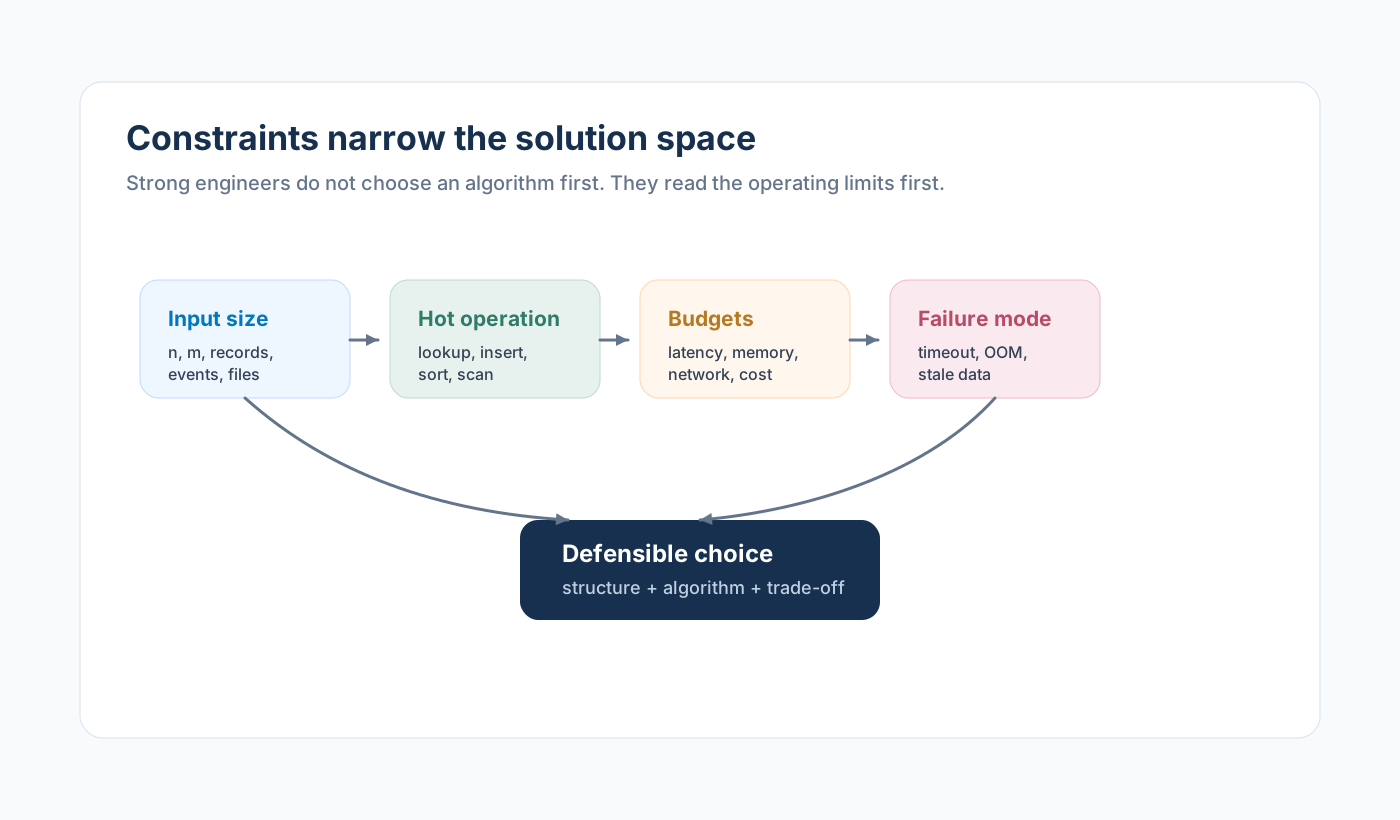
A weak engineer starts with a favorite technique. A strong engineer starts with the constraint sheet. The same feature can require a simple scan, a set, a sorted array, a heap, an index, a streaming pass, or a cache depending on input size, operation frequency, latency budget, memory budget, and update behavior.
This is why assessment questions include concrete numbers: 200,000 users, 80,000 active IDs, 150 ms p95 latency, 512 MB container limit, writes every second. Those numbers are not decoration. They are the map from theory to implementation.
SkillSkore principle
The answer is not 'use a hash map'. The answer is 'because the dominant operation is repeated membership lookup under this input size and latency budget, I would use a hash map and pay memory plus consistency cost.'
The Five Constraint Questions
Before choosing a data structure or algorithm, ask five questions. They turn vague requirements into engineering decisions.
- What inputs can grow independently: n, m, users, files, records, events, terms, graph edges?
- Which operation is hot: lookup, insertion, deletion, sorting, traversal, aggregation, range query, or top-k selection?
- Which budget is tight: p95 latency, throughput, memory, network, disk, battery, or implementation time?
- Which invariant can we rely on: sorted order, uniqueness, bounded size, monotonic values, acyclic graph, or stable IDs?
- What is the failure mode: timeout, out-of-memory, stale result, duplicate write, missed alert, inconsistent permission, or unreadable code?
Numbers Change Answers
A nested loop over 20 items may be clearer than an optimized structure. A nested loop over 200,000 by 80,000 items is a production incident. Reading constraints means knowing when a simple implementation is intentionally simple and when it is accidentally explosive.
| Constraint clue | What it usually means | Likely DSA response |
|---|---|---|
| n <= 100 | Small bounded input. | Prefer clarity unless operation is extremely frequent. |
| n up to 200,000 | Linear or n log n likely; quadratic probably unsafe. | Scan, sort, hash, heap, binary search depending on operation. |
| m and n both large | Watch multiplication. | Avoid nested scans; build lookup, index, or sort/merge. |
| p95 latency < 150 ms | Worst common path matters. | Precompute, index, cache, or avoid repeated work. |
| memory <= 512 MB | Peak memory matters. | Avoid unnecessary copies; stream, mutate in place, or bound caches. |
| writes frequent | Indexes/caches must be maintained. | Consider write amplification and consistency. |
Common assessment mistake
Do not solve only for runtime. A solution can pass time complexity and fail memory, freshness, correctness, or operational simplicity.
Scenario: Searchable Customer Notes
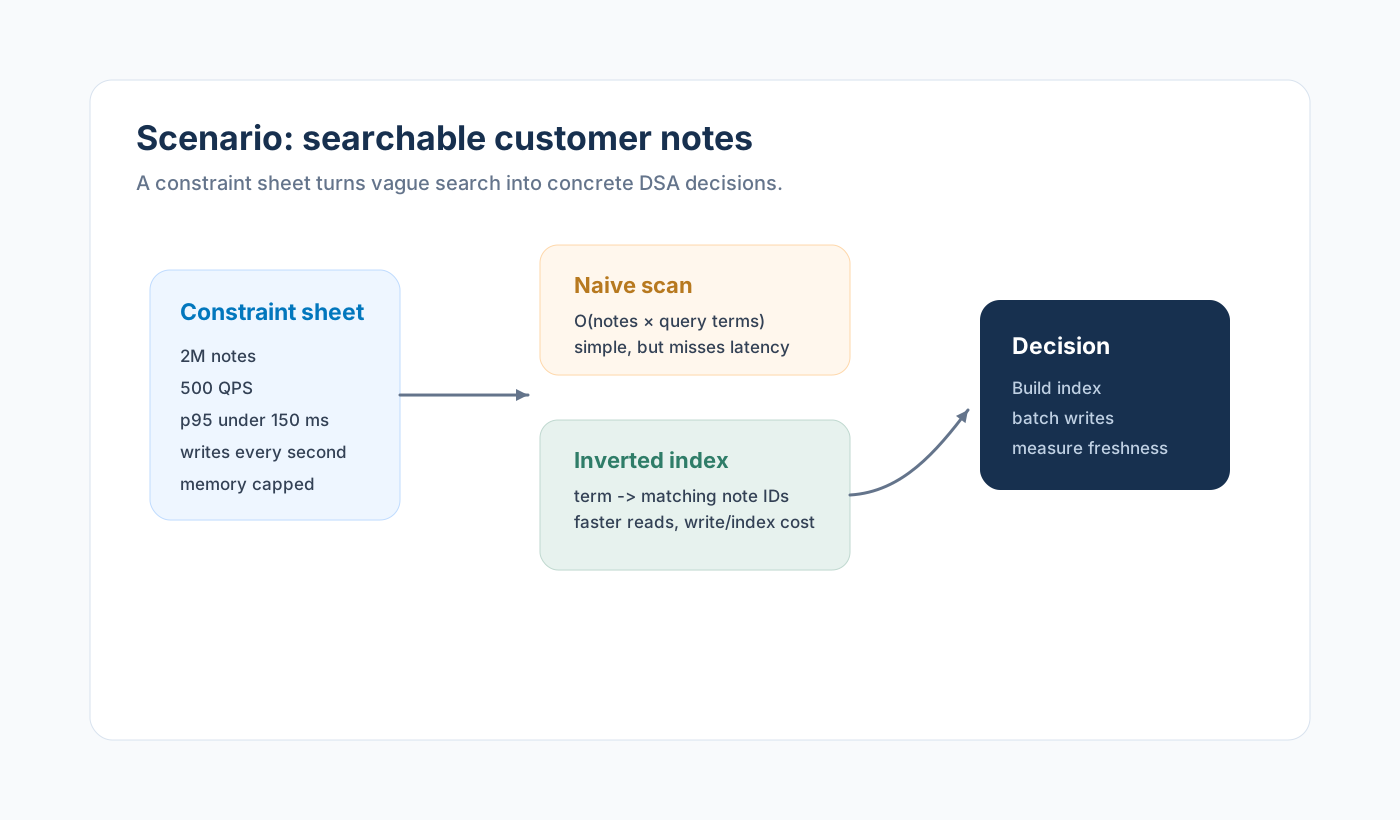
A support product stores customer notes. Product asks for keyword search. The first implementation scans every note and checks whether it contains the query term. For a prototype this is fine. Then the constraints arrive: two million notes, 500 queries per second, p95 under 150 ms, writes every second, and a memory cap.
type Note = { id: string; text: string };

function searchNotesSlow(notes: Note[], term: string) {
  const normalizedTerm = term.toLowerCase();

  return notes.filter((note) =>
    note.text.toLowerCase().includes(normalizedTerm),
  );
}
This code is readable, but it scans every note for every query and repeatedly normalizes note text. With two million notes and hundreds of queries per second, the hot operation is not acceptable. The constraints point toward an index: pay memory and write/update cost so reads avoid scanning everything.
Constraint-Driven Decision
An inverted index maps each token to the note IDs containing that token. Queries become lookups and intersections instead of full scans. This is not free. It consumes memory, complicates writes, and introduces freshness questions. But under the stated read latency and query rate, those are the right trade-offs to evaluate.
import java.util.*;

record Note(String id, String text) {}

class NoteSearchIndex {
  private final Map<String, Set<String>> index = new HashMap<>();

  void add(Note note) {
    for (String token : note.text().toLowerCase().split("\\W+")) {
      if (token.isBlank()) continue;
      index.computeIfAbsent(token, _key -> new HashSet<>()).add(note.id());
    }
  }

  Set<String> search(String term) {
    return index.getOrDefault(term.toLowerCase(), Set.of());
  }
}
Production judgment
This index is intentionally simplified. A production search system may need stemming, permissions, ranking, deletions, partial updates, persistence, sharding, and memory limits. The lesson is the decision pattern: constraints make indexing worth discussing.
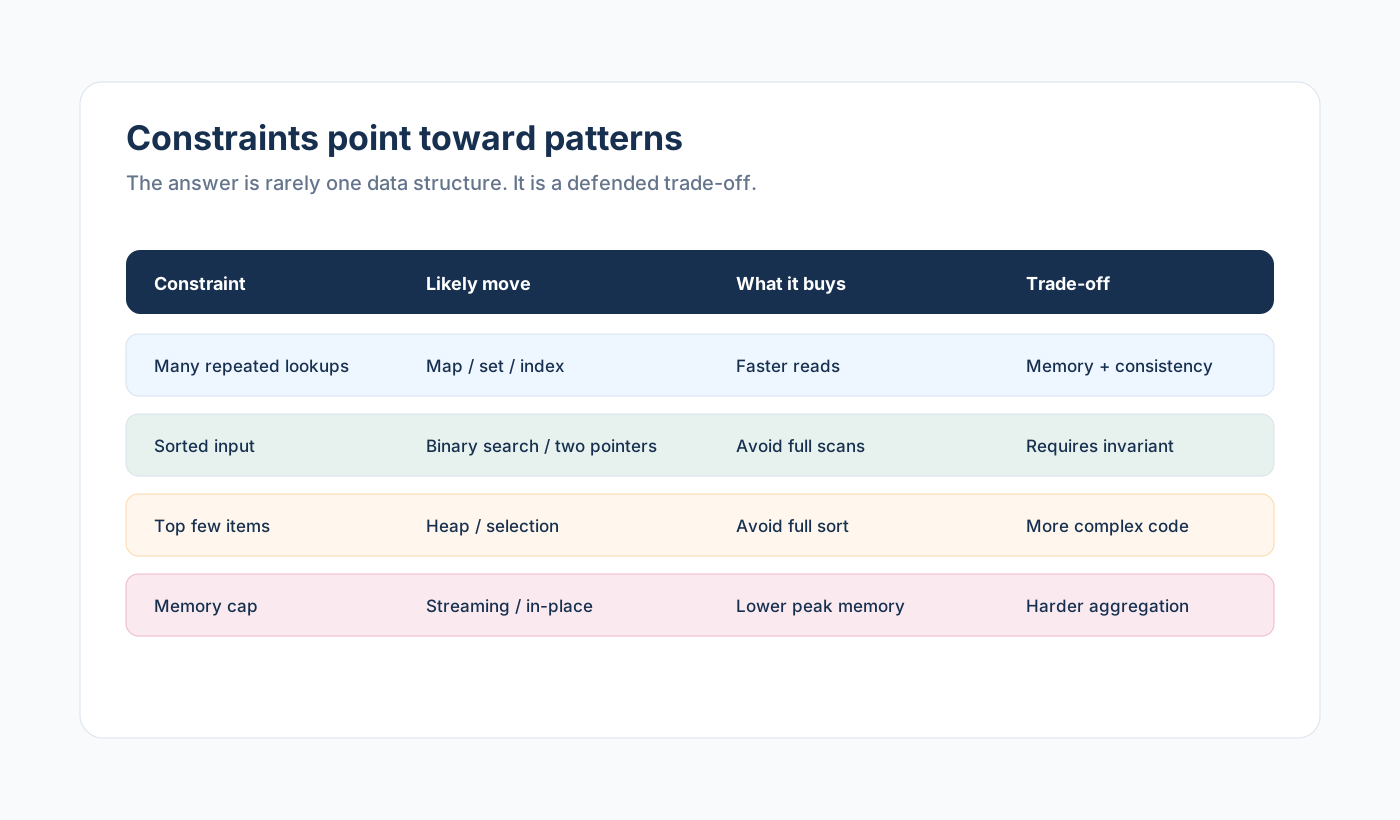
Reading Common Constraint Patterns
| When you read | Think | Possible move |
|---|---|---|
| Return first duplicate in millions of events | Streaming membership lookup. | Set; explain O(n) memory. |
| Find two values in a sorted array | Sorted invariant is useful. | Two pointers or binary search. |
| Repeated range sum queries | Same aggregate requested many times. | Prefix sum or segment tree depending on updates. |
| Always process highest priority task | Need repeated max/min retrieval. | Heap or priority queue. |
| Many dependency relationships | Relationships form a graph. | Adjacency list, DFS/BFS, topological sort if DAG. |
| Input too large to hold | Memory budget dominates. | Streaming, batching, external storage, approximate structures. |
How to Write an Assessment-Grade Answer
SkillSkore assessments are intentionally stricter than casual quizzes. A good answer must explain the decision, not just name a tool. Use this structure when answering scenario questions.
- Name the growing inputs and their limits.
- Name the dominant operation and how often it happens.
- Reject the unsafe approach using time or space reasoning.
- Propose a structure or algorithm that matches the access pattern.
- State the complexity before and after.
- Defend the trade-off: memory, preprocessing, consistency, freshness, implementation complexity, or maintainability.
- Mention the measurement or guardrail you would add in production.
Worked Assessment-Style Answer
Prompt: `users.filter(u => activeIds.includes(u.id))`. Users can contain 200,000 records and activeIds can contain 80,000 IDs. Explain the risk and rewrite the core idea.
const activeSet = new Set(activeIds);
const activeUsers = users.filter((user) => activeSet.has(user.id));
Assessment-grade explanation: the original code hides nested linear work because `includes` scans activeIds for every user, which can become O(users × activeIds). Build a set once in O(activeIds) time and memory, then filter users with expected O(1) membership checks for O(users + activeIds) time. The trade-off is extra memory for the set and a one-time construction cost, which is justified by the large input sizes.
Module 1 synthesis
Lesson 1 taught why DSA matters. Lesson 2 taught time growth. Lesson 3 taught memory growth. Lesson 4 teaches how to read constraints and turn those ideas into a defensible engineering answer.
Practice Before the Module Assessment
Choose one real feature: search, permissions, notifications, dashboard analytics, billing reconciliation, or feed ranking. Write a constraint sheet with input size, hot operation, latency budget, memory budget, update behavior, and failure mode. Then propose one simple approach and one scalable approach with trade-offs.
Field judgmentEngineering Notes
- Constraints are not decoration; they are the input to algorithm choice.
- Always identify independently growing variables before writing Big O.
- Hot operations matter more than rare operations.
- Latency, memory, update frequency, and correctness can point to different structures.
- A strong answer rejects unsafe approaches with concrete growth reasoning.
- Assessment-grade answers state both the improvement and the trade-off.
Interview signalFrequently Asked Interview Questions
These are canonical interview patterns for this topic, phrased as concrete problem statements. They avoid vague theory questions and prepare you for the exact reasoning interviewers expect: invariant, edge cases, complexity, and trade-off.
- Search many notes repeatedly under latency constraints.
- A settings screen has eight ordered options. Should you replace the array with a map?
- A dashboard asks many stable date-range totals for the same data.
Production practiceCompany-Style Practice Examples
These are not claimed as exact company-specific questions. They are the interview patterns repeatedly used by product companies to test whether you can move from brute force to a defensible implementation.
| Example | Brute-force approach | Stronger solution | Production notes |
|---|---|---|---|
| Search 2M notes | Scan and normalize every note for each query. | Normalize/index documents once; normalize query at read time. | Use QPS and p95 latency to reject full scans. |
| Small settings screen | Replace every list with maps for theoretical speed. | Keep arrays for tiny, rarely accessed ordered options. | Professional judgment includes clarity. |
| Write-heavy dashboard | Use prefix sums for every metric without considering updates. | Choose based on read/write ratio; prefix sums fit stable data. | Frequent updates may require different structures later. |
Solved modelInterview Question Solutions
Question 1: Search Index Instead of Full Scan
Search many notes repeatedly under latency constraints. Repeated query-time scans do not fit high QPS and low p95 latency. Normalize and index notes once, then query the index.
import java.util.*;

class NoteIndex {
    private final Map<String, List<Integer>> index = new HashMap<>();

    void add(int noteId, String text) {
        for (String token : text.toLowerCase(Locale.ROOT).split("\\s+")) {
            index.computeIfAbsent(token, _k -> new ArrayList<>()).add(noteId);
        }
    }

    List<Integer> search(String token) {
        return index.getOrDefault(token.toLowerCase(Locale.ROOT), List.of());
    }
}
Question 2: Keep Small Ordered Options Simple
A settings screen has eight ordered options. Should you replace the array with a map? For tiny ordered data, array clarity is usually better. The answer should be based on size, frequency, and operation, not reputation.
import java.util.*;

class SettingsOptions {
    static final List<String> OPTIONS = List.of("Email", "SMS", "Push", "None");

    static void render() {
        for (String option : OPTIONS) {
            System.out.println(option); // Ordered rendering dominates.
        }
    }
}
Question 3: Choose Precomputation for Repeated Reads
A dashboard asks many stable date-range totals for the same data. When reads repeat over stable values, precompute cumulative totals. Mention update cost if data changes frequently.
class PrefixSum {
    private final long[] prefix;

    PrefixSum(int[] values) {
        prefix = new long[values.length + 1];
        for (int i = 0; i < values.length; i++) prefix[i + 1] = prefix[i] + values[i];
    }

    long rangeSum(int left, int right) {
        return prefix[right + 1] - prefix[left];
    }
}
Solved modelWorked Interview Answer
Choose whether a support-note search feature should scan all notes or use an index. For repeated queries over many notes, normalize and index documents once. Query-time work should use the index instead of rescanning every note.
import java.util.*;

class NoteIndex {
    private final Map<String, List<Integer>> index = new HashMap<>();

    void add(int noteId, String text) {
        for (String token : text.toLowerCase(Locale.ROOT).split("\\s+")) {
            index.computeIfAbsent(token, _k -> new ArrayList<>()).add(noteId);
        }
    }

    List<Integer> search(String token) {
        return index.getOrDefault(token.toLowerCase(Locale.ROOT), List.of());
    }
}
Hands-on drillTry It Yourself
Practice task
Write constraints for a real endpoint: input size, request rate, latency target, memory limit, update frequency, and correctness risk. Then eliminate one unsuitable approach.
Failure patternsCommon Mistakes to Avoid
- Ignoring numbers in the prompt.
- Choosing an algorithm before understanding read/write frequency.
- Treating constraints as decoration instead of design inputs.
Execution guardrailQuick-Start Checklist
- Read every number in the prompt.
- Identify read frequency and write frequency.
- Estimate acceptable complexity.
- Name the failure mode.
- Defend the simplest approach that fits.
Recall drillKnowledge Check
| Question | Strong answer |
|---|---|
| Why do constraints matter? | They determine which costs are acceptable. |
| What is a failure mode? | The concrete way a design breaks: latency, memory, correctness, or maintainability. |
| When is precomputation useful? | When repeated reads justify upfront build and memory cost. |
VocabularyKey Terms
| Term | Meaning |
|---|---|
| p95 latency | The latency below which 95 percent of requests complete. |
| QPS | Queries or requests per second. |
| Constraint | A hard or soft limit that shapes the design. |
Next practiceFurther Reading
- Study latency budgets and p95/p99 behavior.
- Review capacity planning examples.
- Practice turning prompt numbers into complexity limits.