Arrays and Indexed Access
Understand arrays as indexed sequence storage: direct reads, scans, cache-friendly traversal, mutation costs, and production trade-offs.
What you will be able to do
Arrays look simple because every language gives you one early. In real engineering, that simplicity is exactly why they matter. Arrays are the default shape for ordered data, API payloads, UI lists, database result pages, logs, ranking candidates, time-series points, and almost every batch job you will ever write.
What an Array Really Promises
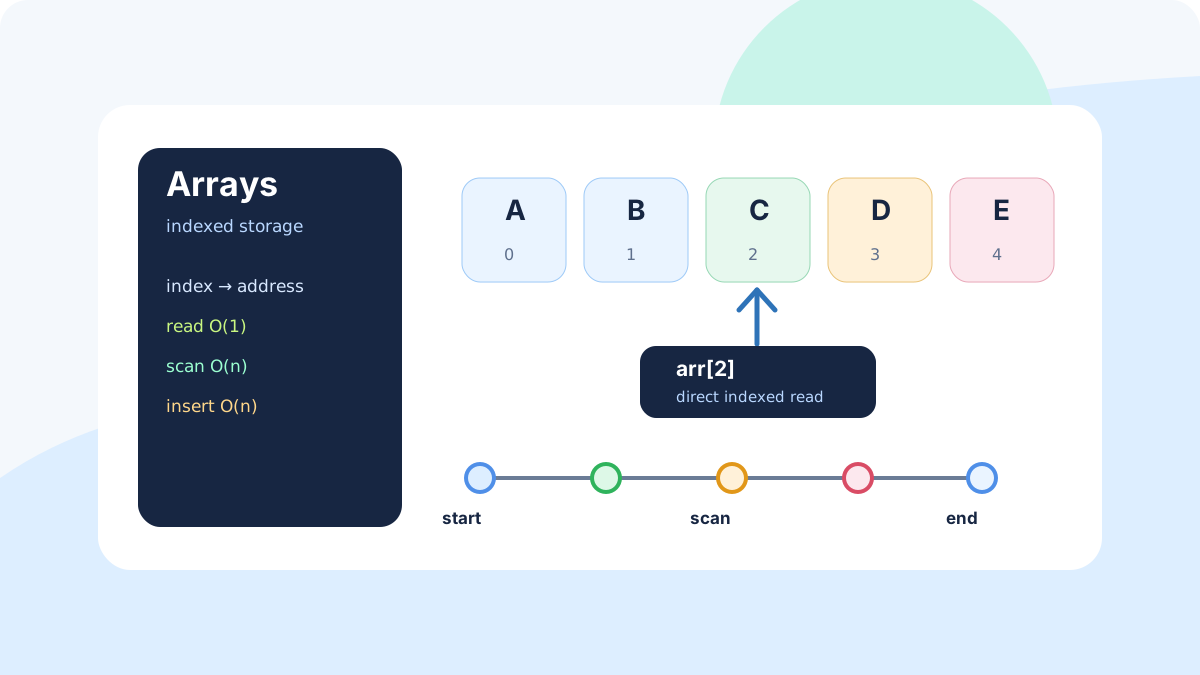
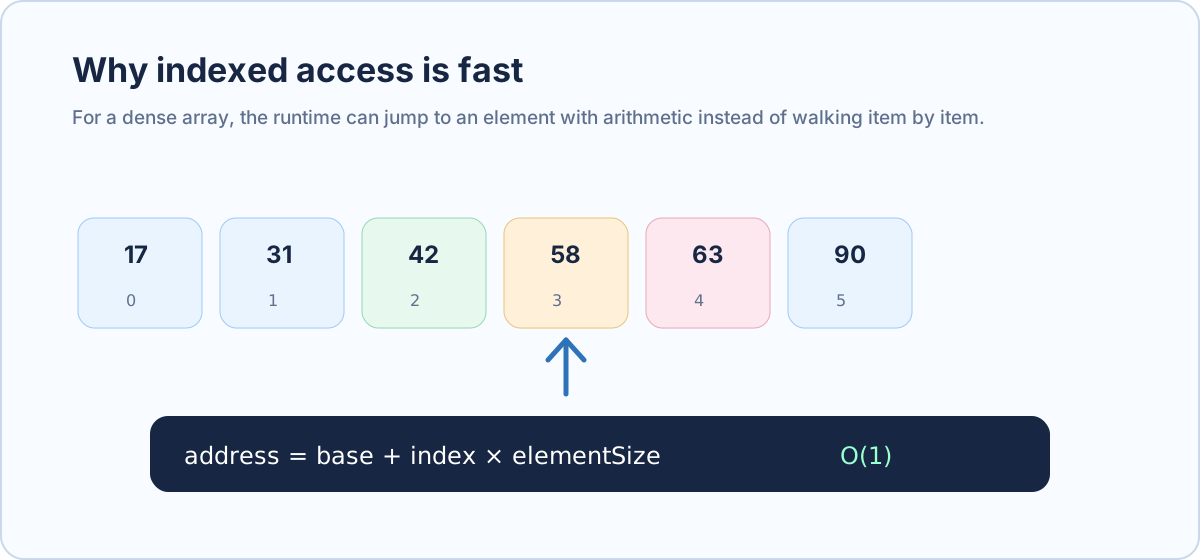
An array is an ordered sequence where each item has a numeric position called an index. The important promise is not only storage. The important promise is addressability: if the runtime knows where the sequence starts and the size of each slot, it can calculate where item i lives without checking every item before it.
That is why array access is normally described as O(1). Reading arr[500000] does not require 500,000 reads before it. The runtime computes a position and reads that slot. This is the same idea behind result pagination, leaderboard pages, image pixels, time-series samples, analytics buckets, and many in-memory buffers.
Professional mental model
Arrays are excellent when position matters, traversal is common, data is compact, and you can tolerate mutation costs. They are weak when the dominant operation is arbitrary insertion, deletion, or membership lookup by value.
Random Access vs Scanning
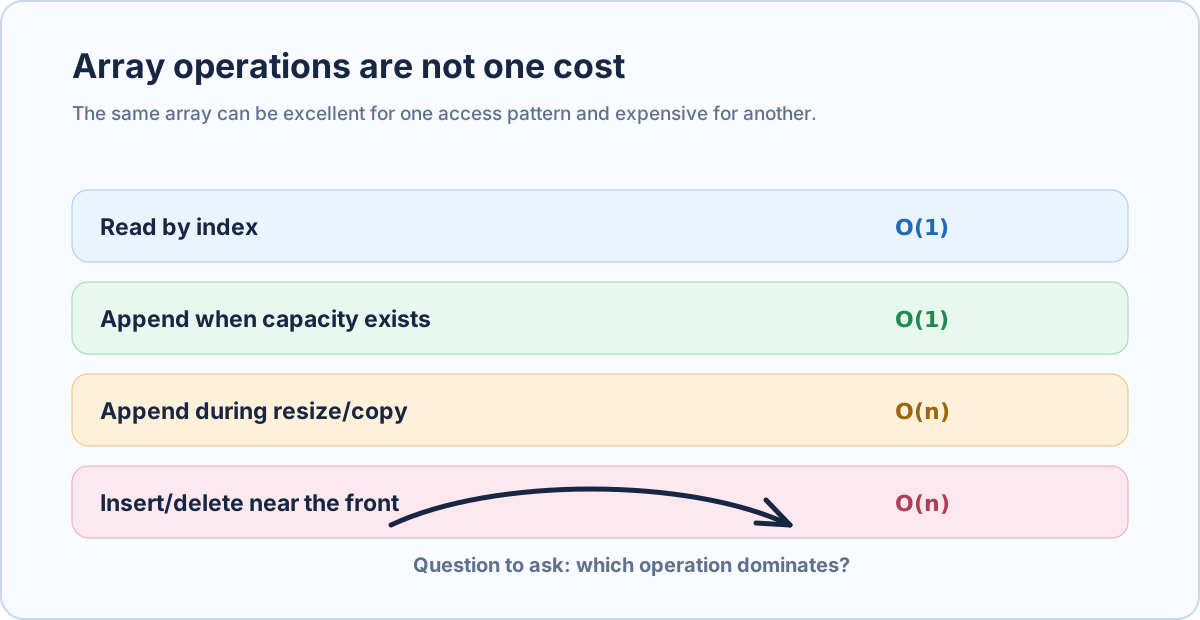
The most common beginner mistake is saying arrays are O(1). That is incomplete. Reading by index is O(1). Searching for a value is O(n). Computing a sum is O(n). Rendering a list is O(n). Filtering a result set is O(n). One data structure can support many operations, and each operation has its own cost.
| Operation | Typical cost | Production example | Question to ask |
|---|---|---|---|
| Read arr[i] | O(1) | Open the 30th item in a paginated result page. | Do I already know the index? |
| Scan all items | O(n) | Render notifications or compute total cart price. | How large can the list become? |
| Search by value | O(n) | Find whether a user ID exists in a plain array. | Is lookup repeated enough to justify a set/map? |
| Append at end | Amortized O(1) | Add a log event to an in-memory buffer. | Can capacity grow without frequent copying? |
| Insert/delete near front | O(n) | Add newest item at the top of a large array-backed feed. | How many elements shift? |
Scenario: Rendering a User Feed
Imagine a product feed. The API returns a page of posts ordered by ranking score and timestamp. The frontend receives an array because order matters. The first item is visually first, the second item is visually second, and the render loop naturally walks from index 0 to the end.
For this part of the feature, an array is the right fit. The dominant operation is ordered traversal. The UI must render each visible post anyway. Random access also helps when virtualization jumps to a visible range such as items 200 through 240. A map would not automatically make this better because the UI does not primarily ask: 'do I have post ID X?' It asks: 'what items are in this order?'
Real-world usage
Arrays are used heavily in feeds, search results, charts, log viewers, CSV imports, ranking pipelines, recommendation candidate lists, and ML feature batches because those systems often preserve order and process items sequentially.
The Cost of Position Changes
Array strength comes from dense positions. That same density creates a cost when positions change. If you insert an item at the front, the old item at index 0 must move to index 1, old index 1 moves to index 2, and so on. If you delete from the front, items shift left. The operation may be logically simple but physically expensive.
This matters in systems that constantly add items at the beginning: chat timelines, activity feeds, notification lists, live logs, collaborative cursors, and streaming dashboards. If the list is small, the simplicity is worth it. If the list is large and mutation is frequent, you may need a different structure, batching, pagination, append-at-end with reversed display, a deque, or server-side windowing.
Assessment trap
Do not optimize away arrays just because insertion can be O(n). The correct answer depends on list size, mutation frequency, user-visible latency, memory budget, and whether ordered traversal is still the dominant operation.
Same Pattern in Java, Python, and JavaScript
The code below models a common production task: given an ordered page of latency samples, compute average latency and find the first sample that violates an SLO threshold. This is array work because we must preserve order and scan until the first violation.
import java.util.List;

class LatencyScan {
    static int firstViolation(List<Integer> latencies, int thresholdMs) {
        for (int i = 0; i < latencies.size(); i++) {
            if (latencies.get(i) > thresholdMs) {
                return i;
            }
        }
        return -1;
    }

    static double average(List<Integer> latencies) {
        if (latencies.isEmpty()) return 0.0;
        long total = 0;
        for (int value : latencies) {
            total += value;
        }
        return (double) total / latencies.size();
    }
}
The cost model is the same in all three languages. Reading a known index is constant time. Scanning until the first violation is O(k), where k is the position of the first violation, and O(n) in the worst case. Computing the average must inspect every value, so it is O(n).
Why Arrays Often Feel Fast in Practice
Big O describes growth, not every machine detail. Arrays also tend to perform well because nearby items are stored close together. Modern CPUs load memory in chunks, so scanning a dense array can be cache-friendly. This is one reason arrays often beat pointer-heavy structures even when both are O(n) for traversal.
This does not mean arrays always win. It means the real engineering answer has two layers: asymptotic cost and practical constants. If two designs have the same Big O, memory layout, allocation behavior, branching, and cache locality can decide which one is better.
When an Array Is the Wrong Center
- Repeated membership lookup by value: use a set or map when lookup dominates.
- Frequent insertion or deletion near the front or middle of a large sequence: consider a deque, linked representation, batching, or a different workflow.
- Unbounded growth in memory: page, stream, spill to storage, or aggregate instead of keeping every item.
- Sparse numeric keys such as user IDs or database IDs: a map may avoid massive empty ranges.
- Need priority retrieval such as next most urgent job: a heap fits the operation better than a plain array scan.
Practice Before You Continue
Answer like an engineer
A dashboard stores 20 visible chart points in an array and redraws them every second. Keep the array. A telemetry service stores 20 million events in memory and checks whether each incoming event ID exists by scanning an array. Redesign it. The data structure choice changes because the dominant operation and input size changed.
| Situation | Likely answer | Reason |
|---|---|---|
| Known position lookup | Array | Index gives direct access. |
| Ordered rendering | Array | Traversal preserves product order. |
| Repeated contains checks | Set/map | Membership lookup dominates. |
| Frequent front insertions | Deque/windowing/append strategy | Avoid shifting large suffixes repeatedly. |
| Small static options list | Array | Clarity beats unnecessary structure. |
Field judgmentEngineering Notes
- Name the operation before naming the complexity.
- Use arrays confidently when order and indexed traversal are central.
- Do not use array search for repeated large-scale membership checks.
- Insertion and deletion costs come from shifting positions.
- Assessment answers must include the trade-off: speed, memory, simplicity, mutation cost, and expected growth.
Interview signalFrequently Asked Interview Questions
These are canonical interview patterns for this topic, phrased as concrete problem statements. They avoid vague theory questions and prepare you for the exact reasoning interviewers expect: invariant, edge cases, complexity, and trade-off.
- Find the first latency sample above a threshold.
- Represent a page of ordered search results and allow direct lookup by ID.
- Given a large list of product IDs, check many incoming IDs for membership.
Production practiceCompany-Style Practice Examples
These are not claimed as exact company-specific questions. They are the interview patterns repeatedly used by product companies to test whether you can move from brute force to a defensible implementation.
| Example | Brute-force approach | Stronger solution | Production notes |
|---|---|---|---|
| Find first bad latency | Assume array access makes the whole task O(1). | Scan until first violation; O(k), O(n) worst case. | Indexed read is O(1), search/scan is not. |
| Render paginated results | Use a map because lookup is fast. | Use an array/list because order and traversal dominate. | A side map by ID can supplement, not replace, ordered data. |
| Check product membership repeatedly | Call includes on a large array for every request. | Convert to a set if membership dominates. | Mention build cost and memory. |
Solved modelInterview Question Solutions
Question 1: First Bad Latency
Find the first latency sample above a threshold. This is a scan, not an O(1) indexed read, because the violating index is unknown.
class Latency {
    static int firstViolation(int[] latencies, int thresholdMs) {
        for (int i = 0; i < latencies.length; i++) {
            if (latencies[i] > thresholdMs) return i;
        }
        return -1;
    }
}
Question 2: Ordered Page With ID Lookup
Represent a page of ordered search results and allow direct lookup by ID. Use an array/list for ordered traversal and an optional map for direct lookup. This combines sequence and lookup needs.
import java.util.*;

record Result(String id, String title) {}

class ResultPage {
    final List<Result> ordered;
    final Map<String, Result> byId;

    ResultPage(List<Result> results) {
        ordered = new ArrayList<>(results);
        byId = new HashMap<>();
        for (Result result : results) byId.put(result.id(), result);
    }
}
Question 3: Repeated Membership Checks
Given a large list of product IDs, check many incoming IDs for membership. Convert the array to a set once when membership checks repeat. Keep the array only if order is also needed.
import java.util.*;

class ProductMembership {
    private final Set<String> productIds;

    ProductMembership(List<String> ids) {
        productIds = new HashSet<>(ids); // O(n) build for repeated lookup.
    }

    boolean exists(String id) {
        return productIds.contains(id);
    }
}
Solved modelWorked Interview Answer
Find the first latency sample that violates an SLO threshold in an ordered array. This is an ordered scan. Indexed access is O(1), but finding the first violation is O(k) where k is the first violating position, O(n) worst case.
class Latency {
    static int firstViolation(int[] latencies, int thresholdMs) {
        for (int i = 0; i < latencies.length; i++) {
            if (latencies[i] > thresholdMs) return i;
        }
        return -1;
    }
}
Hands-on drillTry It Yourself
Practice task
Given a list of 1,000,000 product IDs, compare the cost of reading item 500,000, rendering all items, and checking whether ID X exists.
Failure patternsCommon Mistakes to Avoid
- Saying arrays are O(1) without naming the operation.
- Using arrays for repeated large membership checks.
- Ignoring insertion, deletion, and copy costs.
Execution guardrailQuick-Start Checklist
- Do I know the index?
- Does order matter?
- Will I scan the whole sequence?
- Will I repeatedly check membership?
- Will the array mutate near the front or middle?
Recall drillKnowledge Check
| Question | Strong answer |
|---|---|
| Why is indexed access fast? | The runtime can compute the slot from the base address and index. |
| Why is searching an array O(n)? | The value may require checking every element. |
| When is an array appropriate? | When ordered traversal, compact storage, or indexed access dominates. |
VocabularyKey Terms
| Term | Meaning |
|---|---|
| Index | Numeric position in an ordered sequence. |
| Random access | Reading a known position directly. |
| Sequential scan | Visiting items one by one. |
Next practiceFurther Reading
- Study dynamic arrays and amortized append.
- Compare arrays with linked lists and hash maps.
- Review UI virtualization for large ordered lists.