Array Operations and Mutation Cost
Analyze append, insert, delete, resize, copy, and mutation costs in real code and production data flows.
What you will be able to do
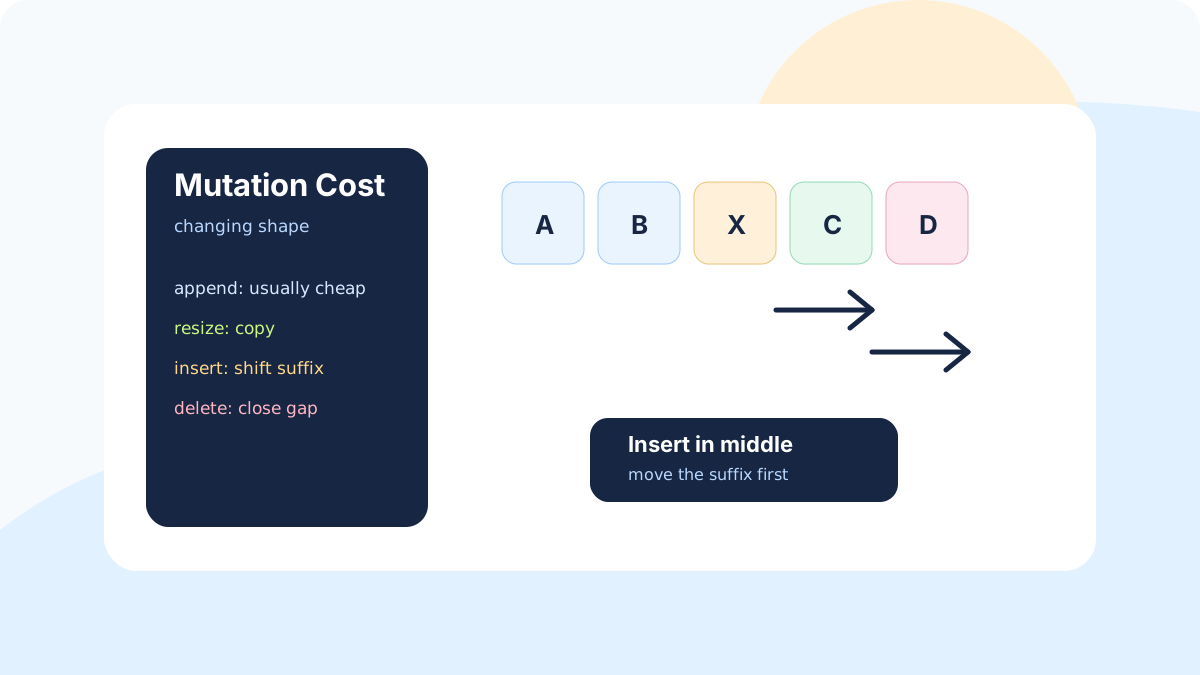
Arrays become interesting when they change shape. Reading by index is only the calm part. Real systems append events, insert rows, delete notifications, reorder tasks, copy payloads, resize buffers, and transform results. Mutation is where simple-looking array code can become a performance, memory, or correctness problem.
Changing Shape Is the Cost
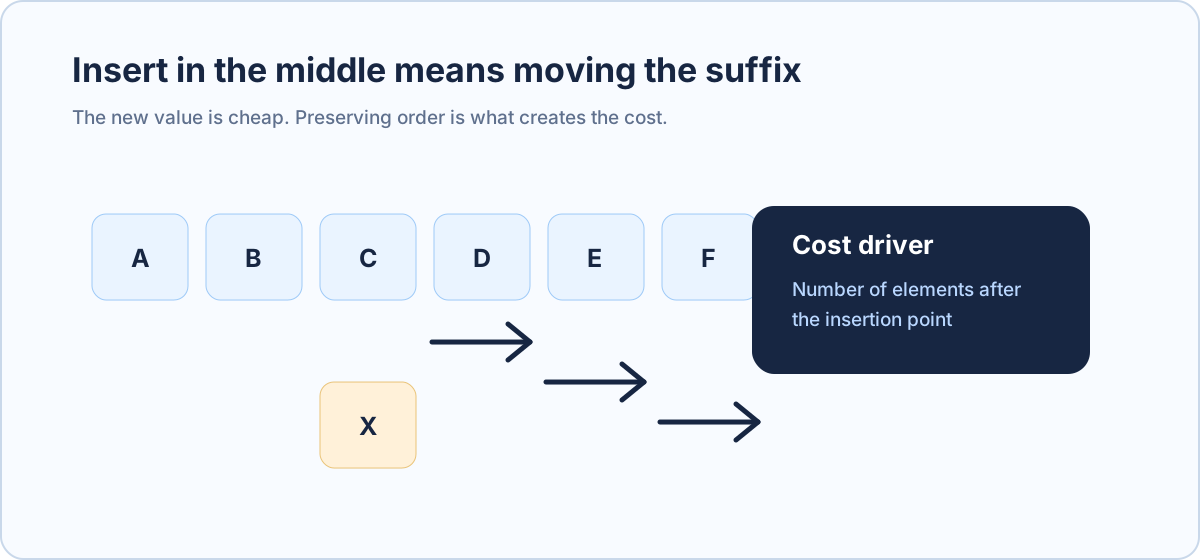
An array keeps items in order. That order is useful, but preserving it has consequences. If a new item is inserted in the middle, every later item must shift right. If an item is deleted from the middle, every later item must shift left. The inserted or deleted value is not the expensive part. Moving the suffix is the expensive part.
| Operation | Best case | Worst case | Why |
|---|---|---|---|
| Append at end with capacity | O(1) | O(1) | Write into the next free slot. |
| Append when full | O(n) | O(n) | Allocate larger storage and copy existing items. |
| Insert at front | O(n) | O(n) | Every existing item shifts right. |
| Insert in middle | O(n) | O(n) | The suffix shifts right. |
| Delete from end | O(1) | O(1) | Remove the last slot. |
| Delete from front/middle | O(n) | O(n) | The suffix shifts left to close the gap. |
Dynamic Arrays and Resize Events
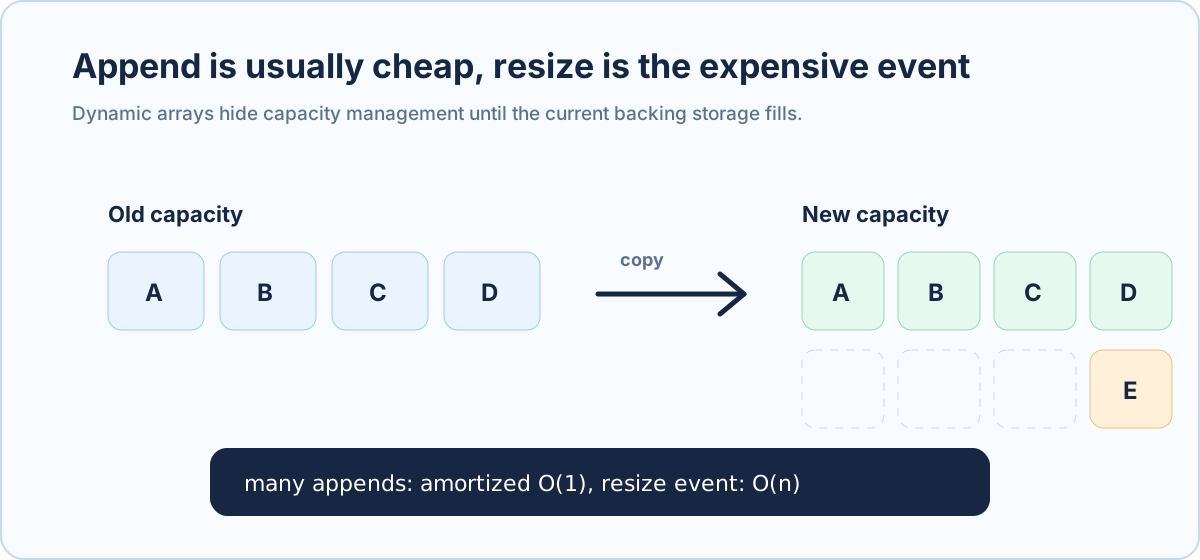
Most modern languages expose growable arrays: Java ArrayList, Python list, and JavaScript Array. They feel like arrays that can grow forever, but internally they usually maintain capacity. When the backing storage fills, the runtime allocates a larger block and copies existing elements.
This is why append is usually described as amortized O(1). A single append may be expensive when it triggers resize, but across many appends the occasional copy cost is spread out. For most application code this is an excellent trade-off. For latency-sensitive systems, the resize spike can still matter.
Assessment wording
Say 'append is amortized O(1), but a resize event copies O(n) existing elements.' That answer is materially stronger than saying only 'append is O(1)'.
Scenario: Notification List Mutation
A notification screen displays newest notifications first. A simple implementation stores the list as an array and inserts each new notification at index 0. With 30 notifications this is harmless. With 50,000 notifications and frequent live updates, each front insertion can shift the entire list.
A better product design might append new notifications to the end and render newest-first, keep only a visible window in memory, batch updates, or let the server return pages already ordered. The important lesson is not that arrays are bad. The lesson is that repeated front mutation fights the physical shape of the structure.
Real-world usage
Frontend frameworks, mobile apps, log viewers, collaborative editors, ETL jobs, and analytics systems all run into mutation cost. The performance issue often appears as dropped frames, slow reducers, high garbage collection, or unexpected memory spikes.
Mutation vs Copy
Array operations are also correctness decisions. Mutating an array in place can be memory-efficient and fast, but it can surprise callers that still hold a reference to the same array. Copying before changing is safer for immutable workflows, state management, undo history, concurrent readers, and predictable APIs, but it uses additional memory and time.
| Choice | Strength | Risk | Common use |
|---|---|---|---|
| Mutate in place | Lower memory, fewer allocations | Shared references observe the change | Tight loops, internal buffers, controlled ownership |
| Copy then mutate | Safer API boundaries | O(n) copy cost and extra memory | React state, audit logs, undo/redo, immutable data flows |
| Batch mutations | Reduces repeated shifting/copying | Adds buffering complexity | Live feeds, stream processors, collaborative updates |
| Change representation | Matches dominant operation | More code and new trade-offs | Deque for front operations, map for lookup, heap for priority |
Same Operation in Java, Python, and JavaScript
The code below inserts a priority alert into an ordered list. The syntax changes by language, but the cost model is the same: find the insertion point, then shift or copy the suffix to keep order.
import java.util.ArrayList;
import java.util.List;

class AlertInsert {
    static void insertByPriority(List<Integer> priorities, int newPriority) {
        int index = 0;
        while (index < priorities.size() && priorities.get(index) >= newPriority) {
            index++;
        }
        priorities.add(index, newPriority); // shifts the suffix right
    }

    static List<Integer> immutableInsert(List<Integer> priorities, int newPriority) {
        List<Integer> copy = new ArrayList<>(priorities);
        insertByPriority(copy, newPriority);
        return copy;
    }
}
The search for the insertion point is O(n) in the worst case. The insertion itself is also O(n) in the worst case because later elements shift. If this happens once on a small list, it is fine. If it happens repeatedly on a large live list, the design deserves review.
Hidden Cost in Real Code
Many expensive array operations hide behind friendly methods: splice, insert, remove, shift, unshift, slice, spread, filter, map, concat, and copy constructors. These methods are useful. They are not free. They may allocate, copy, shift, or scan.
- JavaScript unshift on a large array shifts existing elements.
- Python list.insert(0, value) shifts existing elements.
- Java ArrayList.add(0, value) shifts existing elements.
- Copying with spread, slice, or a copy constructor is O(n).
- Repeated copy-inside-a-loop can accidentally become O(n^2).
Practice Before You Continue
Code review prompt
A reducer handles 10,000 live events by returning [event, ...events] for every event. Explain why this can become expensive. A strong answer mentions front insertion semantics, copying, repeated suffix movement, memory churn, and batching or append/window alternatives.
| Review question | Strong signal |
|---|---|
| Where is the mutation? | Name the exact operation: append, insert, delete, copy, resize, shift. |
| How much moves? | Count the suffix or copied array size. |
| How often does it happen? | Once, per request, per event, per frame, or inside a loop. |
| Who observes the data? | Single owner, shared reference, UI state, concurrent reader, API caller. |
| What is the alternative? | Batch, append, window, copy once, use deque/map/heap, or change product flow. |
Field judgmentEngineering Notes
- Append is usually cheap, but resizing can copy the existing array.
- Insert/delete cost depends on how many elements shift.
- Copying for immutability improves safety but costs time and memory.
- Repeated array copies inside loops are a common source of accidental quadratic behavior.
- Assessment answers should connect the operation cost to user-visible latency, memory pressure, or correctness risk.
Interview signalFrequently Asked Interview Questions
These are canonical interview patterns for this topic, phrased as concrete problem statements. They avoid vague theory questions and prepare you for the exact reasoning interviewers expect: invariant, edge cases, complexity, and trade-off.
- Insert a priority item into a sorted priority list.
- Avoid repeatedly doing front-copy insertion for many live events.
- Update one item in an array without mutating the original array.
Production practiceCompany-Style Practice Examples
These are not claimed as exact company-specific questions. They are the interview patterns repeatedly used by product companies to test whether you can move from brute force to a defensible implementation.
| Example | Brute-force approach | Stronger solution | Production notes |
|---|---|---|---|
| Live notification insertion | Insert every new item at index 0. | Append plus reverse render, batch, or keep a visible window. | Avoid repeated suffix shifts and allocation churn. |
| Immutable reducer | Return `[event, ...events]` for every stream item. | Batch updates or append and derive display order. | Repeated copies can become O(n^2) total work. |
| Priority insertion | Sort the entire list after every inserted alert. | Find insertion point and insert, or use a heap if priority retrieval dominates. | If middle insert is frequent and large, reconsider representation. |
Solved modelInterview Question Solutions
Question 1: Priority Insert
Insert a priority item into a sorted priority list. Find the insertion point, then insert. The suffix may shift, so this is O(n) in the worst case.
import java.util.*;

class PriorityInsert {
    static List<Integer> insert(List<Integer> values, int priority) {
        List<Integer> copy = new ArrayList<>(values);
        int i = 0;
        while (i < copy.size() && copy.get(i) >= priority) i++;
        copy.add(i, priority);
        return copy;
    }
}
Question 2: Batch Live Events
Avoid repeatedly doing front-copy insertion for many live events. Append new events to a batch, then combine once. This avoids copying a growing array per event.
import java.util.*;

class EventBatch {
    static List<String> appendBatch(List<String> current, List<String> incoming) {
        List<String> result = new ArrayList<>(current.size() + incoming.size());
        result.addAll(incoming); // Newest first if product wants incoming before existing.
        result.addAll(current);
        return result;
    }
}
Question 3: Immutable Update by ID
Update one item in an array without mutating the original array. Copy only the array shell and replace the matching item. This is O(n) scan/copy but safe for immutable UI state.
import java.util.*;

record Item(String id, int count) {}

class ImmutableUpdate {
    static List<Item> update(List<Item> items, String id, int count) {
        List<Item> result = new ArrayList<>(items.size());
        for (Item item : items) {
            result.add(item.id().equals(id) ? new Item(id, count) : item);
        }
        return result;
    }
}
Solved modelWorked Interview Answer
Insert a priority item into an already sorted priority list and explain the mutation cost. Finding the insertion point is O(n), and insertion may shift the suffix. Copying first makes the operation safer for immutable state but adds O(n) memory/time.
import java.util.*;

class PriorityInsert {
    static List<Integer> insert(List<Integer> values, int priority) {
        List<Integer> copy = new ArrayList<>(values);
        int i = 0;
        while (i < copy.size() && copy.get(i) >= priority) i++;
        copy.add(i, priority);
        return copy;
    }
}
Hands-on drillTry It Yourself
Practice task
Write two versions of adding live events to a list: one with front copy insertion and one with append plus reverse render. Compare total work for 10,000 events.
Failure patternsCommon Mistakes to Avoid
- Forgetting that spread, slice, concat, and copy constructors allocate.
- Calling append O(1) without mentioning resize.
- Mutating shared arrays without considering references.
Execution guardrailQuick-Start Checklist
- What operation changes the array shape?
- How many elements move or copy?
- How often does it happen?
- Who owns the array reference?
- Can batching or windowing reduce churn?
Recall drillKnowledge Check
| Question | Strong answer |
|---|---|
| What causes insertion cost? | Elements after the insertion point shift. |
| What does amortized append mean? | Most appends are cheap; occasional resize copies are spread across many appends. |
| Why copy for immutability? | To avoid surprising shared references at the cost of time and memory. |
VocabularyKey Terms
| Term | Meaning |
|---|---|
| Resize | Allocating larger backing storage and copying existing items. |
| Suffix shift | Moving all elements after an insertion or deletion point. |
| Copy-on-write | Creating a modified copy instead of mutating the original. |
Next practiceFurther Reading
- Review reducers and immutable state performance.
- Study dynamic array growth strategies.
- Compare arrays, deques, and linked lists for front operations.