Sorting Algorithms and Trade-offs
Choose sorting strategies using stability, memory, input size, key design, runtime guarantees, and product semantics.
What you will be able to do
Sorting is one of the strongest preprocessing moves in DSA. It turns unordered data into a structure where adjacency, binary search, two pointers, grouping, and range reasoning become possible. But sorting also costs time, may use memory, and may change product semantics.
What Sorting Buys
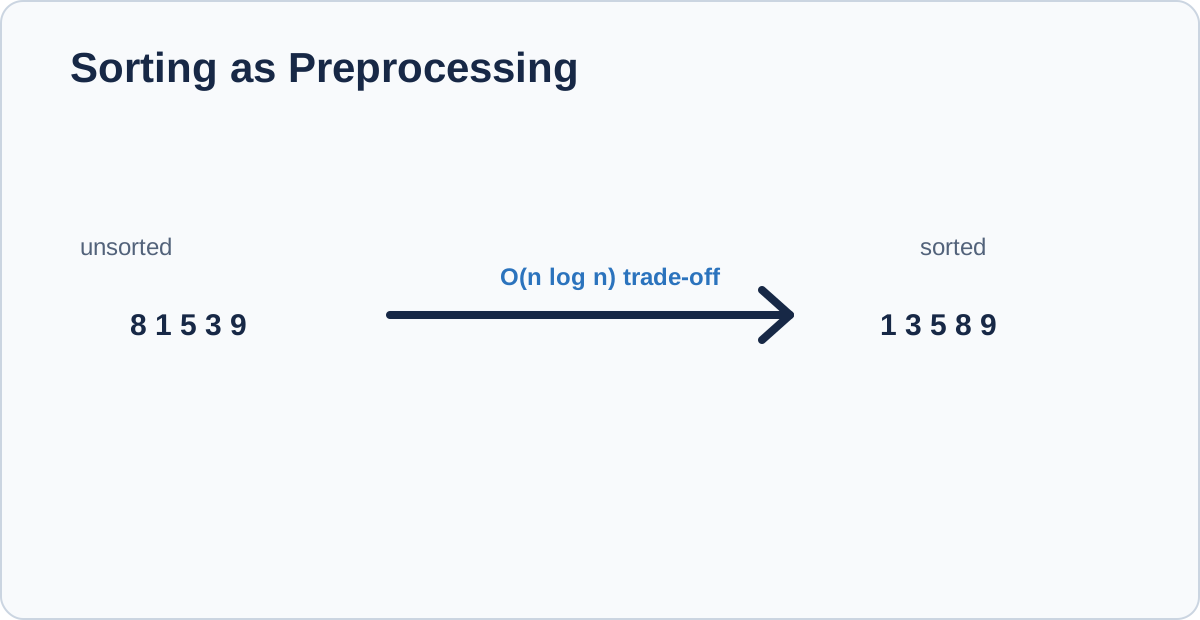
After sorting, equal or related items become neighbors. Smallest and largest values are easy to find. Two-pointer and binary-search patterns become valid. The trade-off is usually O(n log n) time for comparison sorting and potential loss of original order.
Scenario: Audit Event Ordering
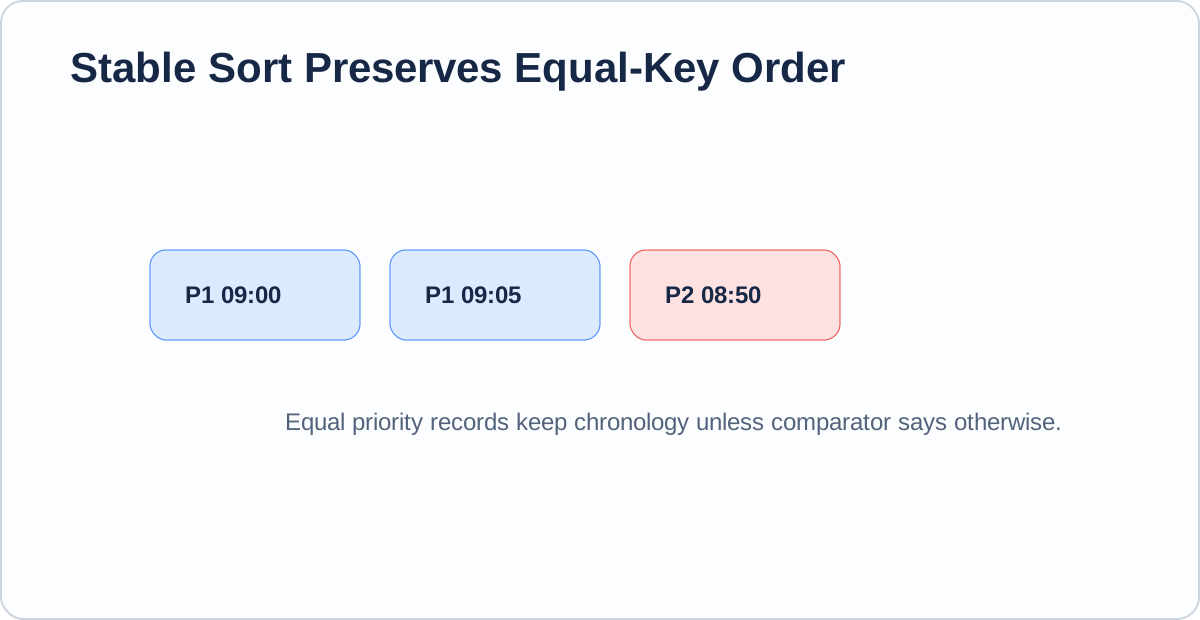
A compliance dashboard sorts audit events by severity, then timestamp. If two events have equal severity, users still expect chronological order. A stable sort or explicit secondary comparator prevents confusing output.
| Sorting concern | Why it matters | Example |
|---|---|---|
| Stability | Equal keys keep original relative order. | Severity sort keeps timestamp order. |
| Comparator correctness | Bad comparators produce inconsistent order. | Sort by severity desc, then time asc. |
| Memory | Some algorithms allocate helper arrays. | Large exports may need streaming/external sort. |
| Key range | Small bounded integers may support counting sort. | Scores 0-100. |
Same Pattern in Java, Python, and JavaScript
The examples sort tickets by priority descending, then creation time ascending. The comparator encodes product semantics.
import java.util.*;

record Ticket(String id, int priority, long createdAt) {}

class TicketSort {
    static void sortTickets(List<Ticket> tickets) {
        tickets.sort(
            Comparator.comparingInt(Ticket::priority).reversed()
                .thenComparingLong(Ticket::createdAt)
        );
    }
}
When Not to Sort
- You need only the top k items and k is much smaller than n.
- The input is already indexed by a database in the needed order.
- Original order is semantically meaningful and cannot be recovered.
- The key range is tiny, making counting/bucket strategies stronger.
- The data is too large for memory and needs external sorting or streaming.
Assessment trap
Sorting is not free. State what later operation it enables and what semantic or memory cost it introduces.
Interview signalFrequently Asked Interview Questions
These are canonical interview patterns for this topic, phrased as concrete problem statements. They avoid vague theory questions and prepare you for the exact reasoning interviewers expect: invariant, edge cases, complexity, and trade-off.
- Sort tickets by priority descending, creation time ascending, then ID.
- Merge overlapping intervals.
- Arrange non-negative integers to form the largest possible concatenated number.
Production practiceCompany-Style Practice Examples
These are not claimed as exact company-specific questions. They are the interview patterns repeatedly used by product companies to test whether you can move from brute force to a defensible implementation.
| Example | Brute-force approach | Stronger solution | Production notes |
|---|---|---|---|
| Audit event ordering | Sort by severity only. | Sort by severity, timestamp, then ID. | Tie-breakers make output deterministic. |
| Merge intervals | Compare every interval with every other interval. | Sort by start, then merge adjacent overlaps. | Sorting makes overlap local. |
| Score buckets 0-100 | Use comparison sort blindly. | Use counting/bucket strategy if range is truly bounded. | Bounded key range can beat O(n log n). |
Solved modelInterview Question Solutions
Question 1: Sort Records With Tie-Breakers
Sort tickets by priority descending, creation time ascending, then ID. Comparator rules must encode product semantics and deterministic ties.
import java.util.*;

record Ticket(String id, int priority, long createdAt) {}

class SortTicketsAnswer {
    static List<Ticket> sort(List<Ticket> tickets) {
        List<Ticket> copy = new ArrayList<>(tickets);
        copy.sort(Comparator.comparingInt(Ticket::priority).reversed().thenComparingLong(Ticket::createdAt).thenComparing(Ticket::id));
        return copy;
    }
}
Question 2: Merge Intervals
Merge overlapping intervals. Sort by start time so overlapping candidates become adjacent, then merge into the last output interval.
import java.util.*;
class MergeIntervals { static int[][] merge(int[][] intervals) { Arrays.sort(intervals, Comparator.comparingInt(a -> a[0])); List<int[]> out = new ArrayList<>(); for (int[] in : intervals) { if (out.isEmpty() || out.get(out.size()-1)[1] < in[0]) out.add(in); else out.get(out.size()-1)[1] = Math.max(out.get(out.size()-1)[1], in[1]); } return out.toArray(new int[out.size()][]); } }
Question 3: Largest Number
Arrange non-negative integers to form the largest possible concatenated number. Sort numbers as strings by comparing ab versus ba. This is comparator design, not numeric sorting.
import java.util.*;
class LargestNumber { static String largest(int[] nums) { String[] parts = new String[nums.length]; for (int i = 0; i < nums.length; i++) parts[i] = String.valueOf(nums[i]); Arrays.sort(parts, (a, b) -> (b + a).compareTo(a + b)); if (parts[0].equals("0")) return "0"; return String.join("", parts); } }
Solved modelWorked Interview Answer
Sort tickets by priority descending, then creation time ascending. A production comparator must encode every product tie-breaker so output is deterministic and explainable.
import java.util.*;

record Ticket(String id, int priority, long createdAt) {}

class SortTicketsAnswer {
    static List<Ticket> sort(List<Ticket> tickets) {
        List<Ticket> copy = new ArrayList<>(tickets);
        copy.sort(Comparator.comparingInt(Ticket::priority).reversed().thenComparingLong(Ticket::createdAt).thenComparing(Ticket::id));
        return copy;
    }
}
Hands-on drillTry It Yourself
Practice task
Design a comparator for support tickets: priority descending, SLA deadline ascending, created time ascending, ticket ID ascending. Explain why every tie-breaker exists.
Failure patternsCommon Mistakes to Avoid
- Sorting without stating why sorted order helps.
- Writing inconsistent comparators.
- Forgetting stability when equal keys preserve product meaning.
- Mutating input order when callers expect original order.
- Using O(n log n) sorting when top-k or bounded counting is enough.
Execution guardrailQuick-Start Checklist
- Name the sorted key.
- Define tie-breakers.
- State whether stability matters.
- Decide whether to mutate or copy input.
- State time and memory cost.
- Explain what later operation sorting enables.
Recall drillKnowledge Check
| Question | Strong answer |
|---|---|
| What is stability? | Equal-key records keep their original relative order. |
| What is a comparator? | A function/rule that defines ordering between two records. |
| Why can sorting help intervals? | Overlaps become local after ordering by start. |
VocabularyKey Terms
| Term | Meaning |
|---|---|
| Stable sort | A sort preserving relative order among equal keys. |
| Comparator | Ordering rule for two values or records. |
| Comparison sort | A sort based on pairwise comparisons, usually O(n log n). |
| Counting sort | A non-comparison sort for small bounded key ranges. |
Next practiceFurther Reading
- Practice merge intervals, largest number, meeting rooms, and custom comparator problems.
- Compare TimSort, quicksort, mergesort, and heapsort conceptually.
- Review language-specific sort stability guarantees before relying on them.