Binary Search on Answer
Search a monotonic decision space such as capacity, speed, time, budget, and minimum feasible value.
What you will be able to do
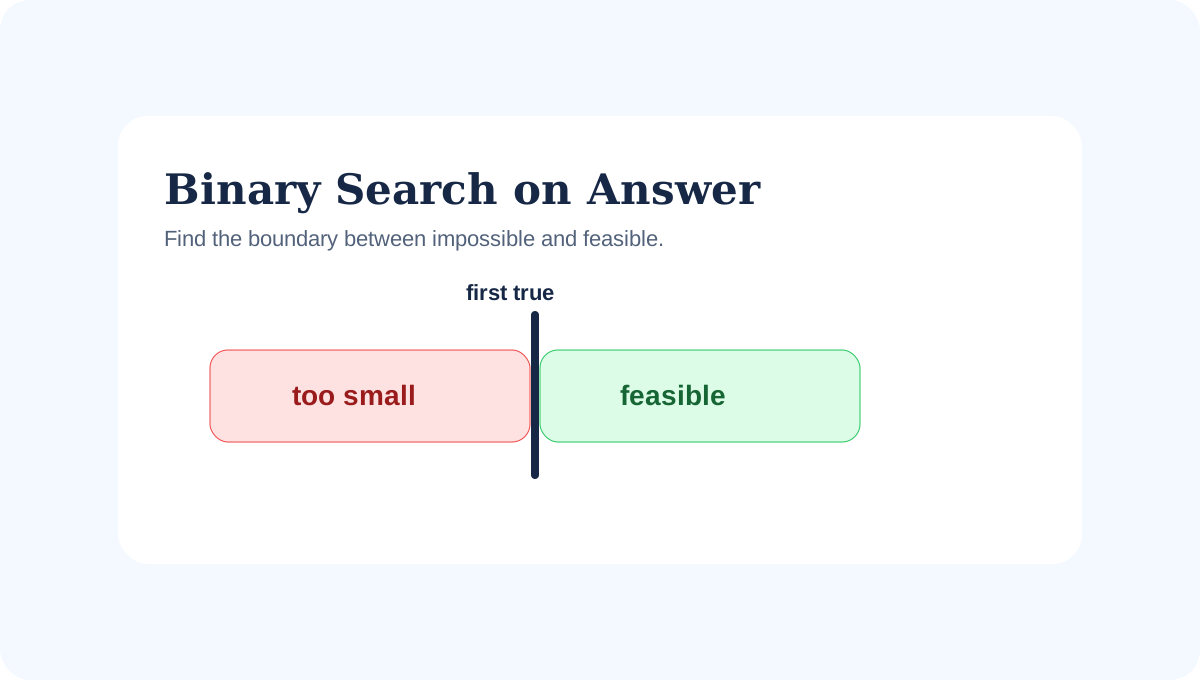
Binary search can search more than arrays. If answers form a monotonic yes/no space, you can search the answer itself: too small fails, large enough succeeds, and the goal is the first feasible value.
The Monotonic Predicate
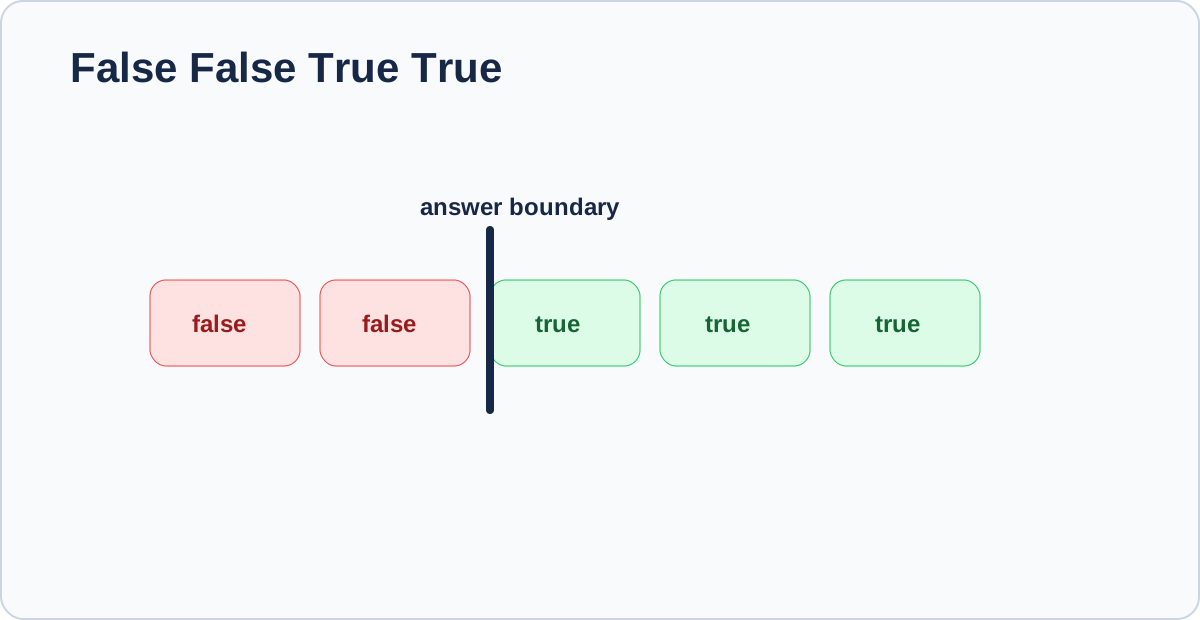
A predicate is a function that answers yes or no for a candidate answer. Binary search on answer works only when the predicate flips once: false false false true true true for minimum feasible problems, or true true false false for maximum feasible problems.
Scenario: Shipping Capacity
A warehouse must ship packages in order within D days. If truck capacity is too small, shipping fails. If capacity is larger, shipping succeeds. That monotonic property lets us search the minimum capacity that works.
| Part | Shipping example | Professional check |
|---|---|---|
| Candidate answer | Truck capacity | Must have numeric bounds. |
| Predicate | Can ship within D days? | Must be monotonic. |
| Lower bound | Max package weight | Capacity cannot be below one package. |
| Upper bound | Sum of all weights | One-day capacity always works. |

Same Pattern in Java, Python, and JavaScript
This implementation returns the minimum capacity that ships packages in order within the required number of days.
class ShipCapacity {
    static int minCapacity(int[] weights, int days) {
        int left = 0, right = 0;
        for (int w : weights) { left = Math.max(left, w); right += w; }
        while (left < right) {
            int mid = left + (right - left) / 2;
            if (canShip(weights, days, mid)) right = mid;
            else left = mid + 1;
        }
        return left;
    }
    static boolean canShip(int[] weights, int days, int capacity) {
        int usedDays = 1, load = 0;
        for (int w : weights) {
            if (load + w > capacity) { usedDays++; load = 0; }
            load += w;
        }
        return usedDays <= days;
    }
}
Predicate Cost Matters
The total cost is not just O(log range). It is O(predicate_cost * log range). If checking feasibility scans n items, the complete complexity is O(n log range).
Assessment trap
Never apply binary search on answer until you prove the yes/no predicate is monotonic.
Interview signalFrequently Asked Interview Questions
These are canonical interview patterns for this topic, phrased as concrete problem statements. They avoid vague theory questions and prepare you for the exact reasoning interviewers expect: invariant, edge cases, complexity, and trade-off.
- Find the minimum capacity to ship packages within D days.
- Find the minimum eating speed to finish all piles within h hours.
- Split nums into at most k non-empty subarrays while minimizing the largest subarray sum.
Production practiceCompany-Style Practice Examples
These are not claimed as exact company-specific questions. They are the interview patterns repeatedly used by product companies to test whether you can move from brute force to a defensible implementation.
| Example | Brute-force approach | Stronger solution | Production notes |
|---|---|---|---|
| Minimum shipping capacity | Try every capacity from 1 upward. | Binary search the first feasible capacity. | Predicate scans packages, so total cost includes predicate work. |
| Minimum processing speed | Guess speed from averages only. | Search speed with a monotonic can-finish predicate. | Bounds must include the true answer. |
| Budget feasibility | Optimize without proving monotonicity. | Define candidate budget and prove feasible stays feasible. | No monotonic proof means no answer search. |
Solved modelInterview Question Solutions
Question 1: Ship Packages Within D Days
Find the minimum capacity to ship packages within D days. Search the first capacity whose feasibility predicate returns true.
class ShipWithinDays {
    static int shipWithinDays(int[] weights, int days) {
        int left = 0, right = 0;
        for (int weight : weights) { left = Math.max(left, weight); right += weight; }
        while (left < right) {
            int mid = left + (right - left) / 2;
            if (canShip(weights, days, mid)) right = mid;
            else left = mid + 1;
        }
        return left;
    }
    static boolean canShip(int[] weights, int days, int capacity) {
        int used = 1, load = 0;
        for (int weight : weights) {
            if (load + weight > capacity) { used++; load = 0; }
            load += weight;
        }
        return used <= days;
    }
}
Question 2: Koko Eating Bananas
Find the minimum eating speed to finish all piles within h hours. Speed is monotonic: if speed k works, any higher speed works. Predicate sums ceil(pile / speed).
class Koko { static int minSpeed(int[] piles, int h) { int l = 1, r = 0; for (int p : piles) r = Math.max(r, p); while (l < r) { int m = l + (r - l) / 2; if (can(piles, h, m)) r = m; else l = m + 1; } return l; } static boolean can(int[] piles, int h, int speed) { long hours = 0; for (int p : piles) hours += (p + speed - 1) / speed; return hours <= h; } }Question 3: Split Array Largest Sum
Split nums into at most k non-empty subarrays while minimizing the largest subarray sum. Candidate answer is max allowed partition sum. If you can split within k partitions, larger answers are also feasible.
class SplitArray { static int split(int[] nums, int k) { int l = 0, r = 0; for (int x : nums) { l = Math.max(l, x); r += x; } while (l < r) { int m = l + (r - l) / 2; if (parts(nums, m) <= k) r = m; else l = m + 1; } return l; } static int parts(int[] nums, int limit) { int count = 1, sum = 0; for (int x : nums) { if (sum + x > limit) { count++; sum = 0; } sum += x; } return count; } }Solved modelWorked Interview Answer
Find the minimum truck capacity needed to ship packages within a fixed number of days. Capacity has a false-to-true feasibility boundary. Too-small capacity fails; larger capacity stays feasible.
class ShipWithinDays {
    static int shipWithinDays(int[] weights, int days) {
        int left = 0, right = 0;
        for (int weight : weights) { left = Math.max(left, weight); right += weight; }
        while (left < right) {
            int mid = left + (right - left) / 2;
            if (canShip(weights, days, mid)) right = mid;
            else left = mid + 1;
        }
        return left;
    }
    static boolean canShip(int[] weights, int days, int capacity) {
        int used = 1, load = 0;
        for (int weight : weights) {
            if (load + weight > capacity) { used++; load = 0; }
            load += weight;
        }
        return used <= days;
    }
}
Hands-on drillTry It Yourself
Practice task
For package weights [3,2,2,4,1,4] and days 3, write the lower bound, upper bound, and predicate result for three candidate capacities.
Failure patternsCommon Mistakes to Avoid
- Using answer search without proving monotonicity.
- Choosing bounds that exclude the correct answer.
- Forgetting predicate cost in complexity.
- Returning the last tested mid instead of the converged boundary.
- Confusing minimum feasible with maximum feasible templates.
Execution guardrailQuick-Start Checklist
- Define candidate answer.
- Write the yes/no predicate.
- Prove false-to-true or true-to-false monotonicity.
- Set safe lower and upper bounds.
- Search for first feasible or last feasible deliberately.
- State O(predicate_cost * log range).
Recall drillKnowledge Check
| Question | Strong answer |
|---|---|
| What is the predicate? | A yes/no feasibility function for a candidate answer. |
| What is first feasible? | The smallest candidate for which the predicate is true. |
| Why does predicate cost matter? | The predicate runs on every binary-search iteration. |
VocabularyKey Terms
| Term | Meaning |
|---|---|
| Monotonic predicate | A yes/no function that changes direction at most once. |
| Feasible | A candidate answer that satisfies constraints. |
| Answer space | The numeric range of possible answers. |
| Predicate cost | The runtime of one feasibility check. |
Next practiceFurther Reading
- Practice ship capacity, Koko bananas, minimum days to make bouquets, and split array largest sum.
- Review lower-bound binary search first.
- Study parametric search as an advanced form later.