Selection and Partial Sorting
Find top-k, kth largest, and partial rankings without sorting everything when full order is unnecessary.
What you will be able to do
If a product asks for the top 10 items, sorting one million items completely may be wasteful. Selection asks for only the part of the order you need: kth largest, top k, or a bounded leaderboard.
Full Order Versus Partial Order
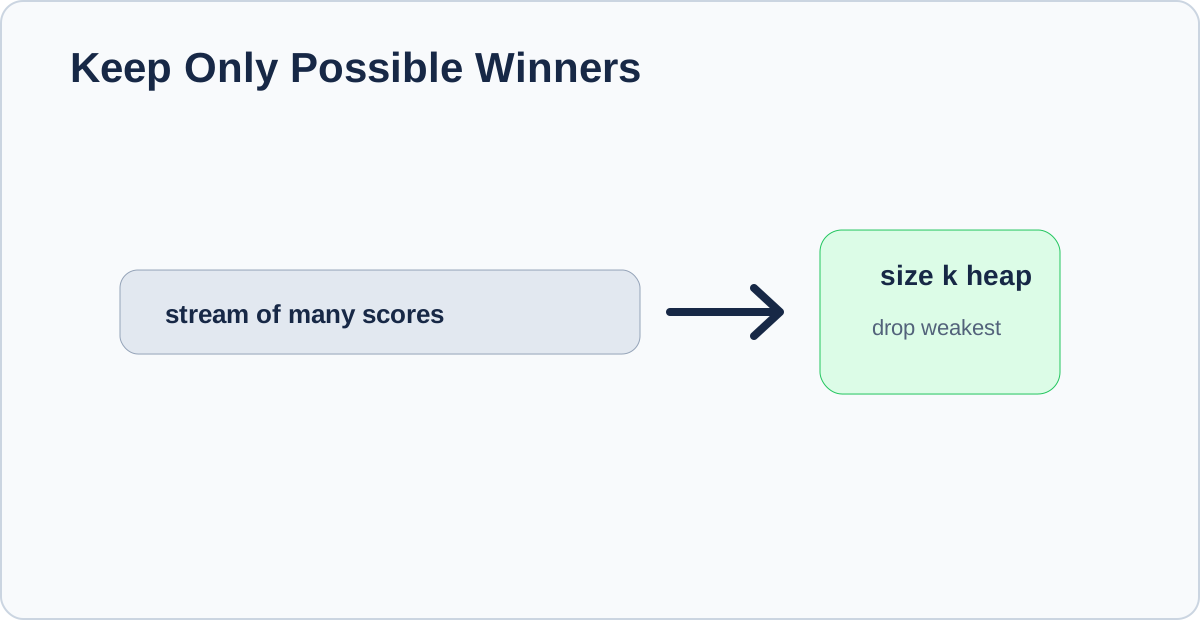
Full sorting gives every item a final rank. Partial sorting only guarantees the requested portion. A heap of size k is often strong when k is small, especially for streaming data where all items cannot be sorted at once.
Scenario: Dashboard Top Errors
An observability dashboard shows the top 20 error signatures in the last hour. Sorting every distinct signature is simple. But if cardinality is high and the dashboard updates continuously, a bounded heap or streaming heavy-hitter design may be better.
| Approach | When it fits | Trade-off |
|---|---|---|
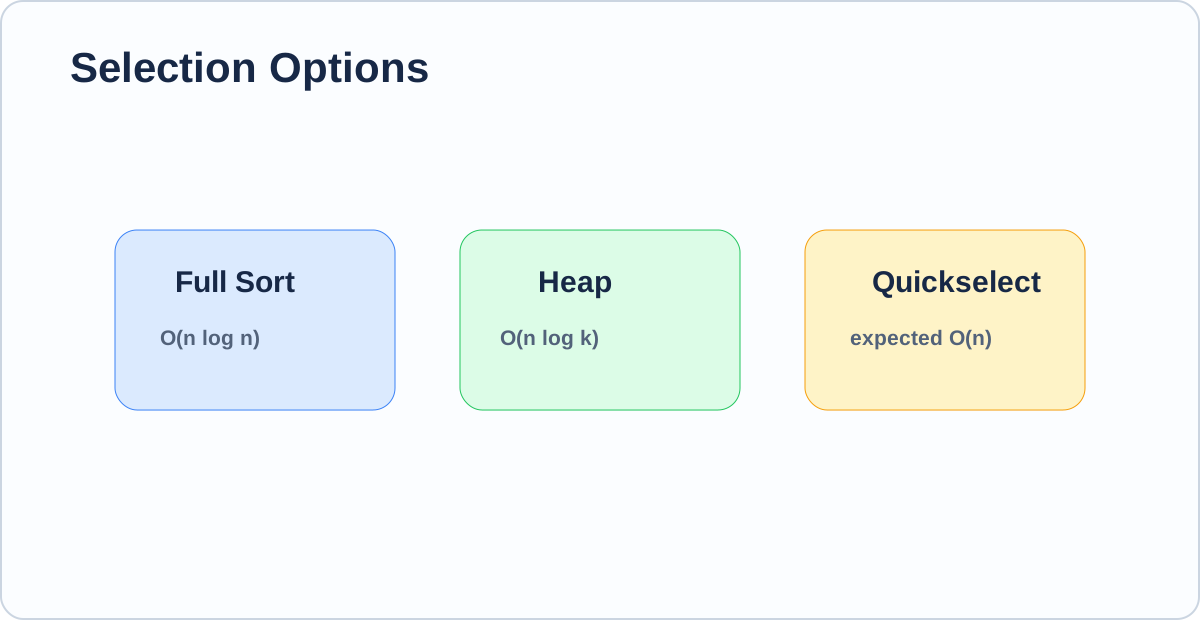
| Full sort | n is moderate or full ranking is needed. | O(n log n), simple and deterministic. |
| Min-heap of size k | k is much smaller than n. | O(n log k), more implementation detail. |
| Quickselect | Need kth or unordered top partition. | Expected O(n), worst-case risk without safeguards. |
| Streaming approximation | Huge streams and approximate answers acceptable. | May have error bounds. |
Same Pattern in Java, Python, and JavaScript
The following examples return the k largest values using a min-heap of size k.
import java.util.*;

class TopK {
    static List<Integer> topK(int[] nums, int k) {
        PriorityQueue<Integer> heap = new PriorityQueue<>();
        for (int value : nums) {
            heap.add(value);
            if (heap.size() > k) heap.poll();
        }
        List<Integer> result = new ArrayList<>(heap);
        result.sort(Comparator.reverseOrder());
        return result;
    }
}
Tie Policy and Determinism
Selection is not complete without tie rules. If two products have the same score, should newer win, older win, lower ID win, or should the order be arbitrary? Production ranking systems need deterministic tie-breaking.
Assessment trap
Do not use top-k heap by reflex. If k is close to n or full ordering is needed, sorting may be simpler and good enough.
Interview signalFrequently Asked Interview Questions
These are canonical interview patterns for this topic, phrased as concrete problem statements. They avoid vague theory questions and prepare you for the exact reasoning interviewers expect: invariant, edge cases, complexity, and trade-off.
- Return the k largest values without fully sorting all values.
- Return the k most frequent numbers.
- Return k points closest to the origin.
Production practiceCompany-Style Practice Examples
These are not claimed as exact company-specific questions. They are the interview patterns repeatedly used by product companies to test whether you can move from brute force to a defensible implementation.
| Example | Brute-force approach | Stronger solution | Production notes |
|---|---|---|---|
| Top 20 dashboard errors | Sort every distinct signature completely. | Use heap of size k when k is small. | Full sort is simpler if cardinality is modest. |
| Kth largest score | Fully sort then index. | Use heap or quickselect. | Quickselect gives partition, not sorted output. |
| Streaming leaderboard | Keep all scores in memory. | Maintain bounded winners plus deterministic tie policy. | Streaming constraints change the structure choice. |
Solved modelInterview Question Solutions
Question 1: Top K Largest
Return the k largest values without fully sorting all values. Maintain a bounded min-heap of size k and sort only the winners if ordered output is required.
import java.util.*;

class TopKAnswer {
    static List<Integer> topK(int[] nums, int k) {
        PriorityQueue<Integer> heap = new PriorityQueue<>();
        for (int value : nums) {
            heap.offer(value);
            if (heap.size() > k) heap.poll();
        }
        List<Integer> result = new ArrayList<>(heap);
        result.sort(Comparator.reverseOrder());
        return result;
    }
}
Question 2: Top K Frequent Elements
Return the k most frequent numbers. Count frequencies, then keep a heap or sort distinct keys. The stronger approach depends on distinct cardinality and k.
import java.util.*;
class TopKFrequent { static List<Integer> topK(int[] nums, int k) { Map<Integer,Integer> count = new HashMap<>(); for (int x : nums) count.put(x, count.getOrDefault(x,0)+1); PriorityQueue<Integer> heap = new PriorityQueue<>(Comparator.comparingInt(count::get)); for (int x : count.keySet()) { heap.offer(x); if (heap.size() > k) heap.poll(); } return new ArrayList<>(heap); } }
Question 3: K Closest Points
Return k points closest to the origin. Rank by squared distance to avoid square roots. Use full sort for simplicity or size-k heap for large n and small k.
import java.util.*;
class KClosest { static int[][] closest(int[][] points, int k) { Arrays.sort(points, Comparator.comparingInt(p -> p[0]*p[0] + p[1]*p[1])); return Arrays.copyOf(points, k); } }
Solved modelWorked Interview Answer
Return the k largest values without fully sorting all values. Maintain a min-heap of size k. The heap root is the weakest winner; any stronger candidate can replace it.
import java.util.*;

class TopKAnswer {
    static List<Integer> topK(int[] nums, int k) {
        PriorityQueue<Integer> heap = new PriorityQueue<>();
        for (int value : nums) {
            heap.offer(value);
            if (heap.size() > k) heap.poll();
        }
        List<Integer> result = new ArrayList<>(heap);
        result.sort(Comparator.reverseOrder());
        return result;
    }
}
Hands-on drillTry It Yourself
Practice task
Given 1 million scores and k = 20, compare full sort and heap of size k. Estimate which operations dominate and what tie-breaker the output needs.
Failure patternsCommon Mistakes to Avoid
- Sorting everything when only k items are required.
- Using a heap without defining tie-breaking.
- Forgetting that heap output may not be sorted.
- Choosing quickselect when deterministic worst-case behavior is required.
- Ignoring k close to n, where full sort may be simpler.
Execution guardrailQuick-Start Checklist
- Ask whether full order is needed.
- Compare n and k.
- Choose sort, heap, or quickselect.
- Define tie policy.
- State output ordering guarantee.
- State runtime and memory.
Recall drillKnowledge Check
| Question | Strong answer |
|---|---|
| When is a size-k heap useful? | When k is much smaller than n or data arrives as a stream. |
| What does quickselect give? | A kth boundary or partition, not necessarily fully sorted output. |
| Why define tie policy? | Ranking output must be deterministic and explainable. |
VocabularyKey Terms
| Term | Meaning |
|---|---|
| Top-k | The k highest or lowest items by a ranking rule. |
| Min-heap | A heap whose root is the smallest item. |
| Quickselect | Partition-based expected O(n) selection. |
| Partial order | Only part of the ranking is guaranteed. |
Next practiceFurther Reading
- Practice kth largest, top k frequent, k closest points, and streaming median later.
- Study heaps before priority queue module.
- Compare exact top-k with approximate heavy-hitter algorithms for streams.