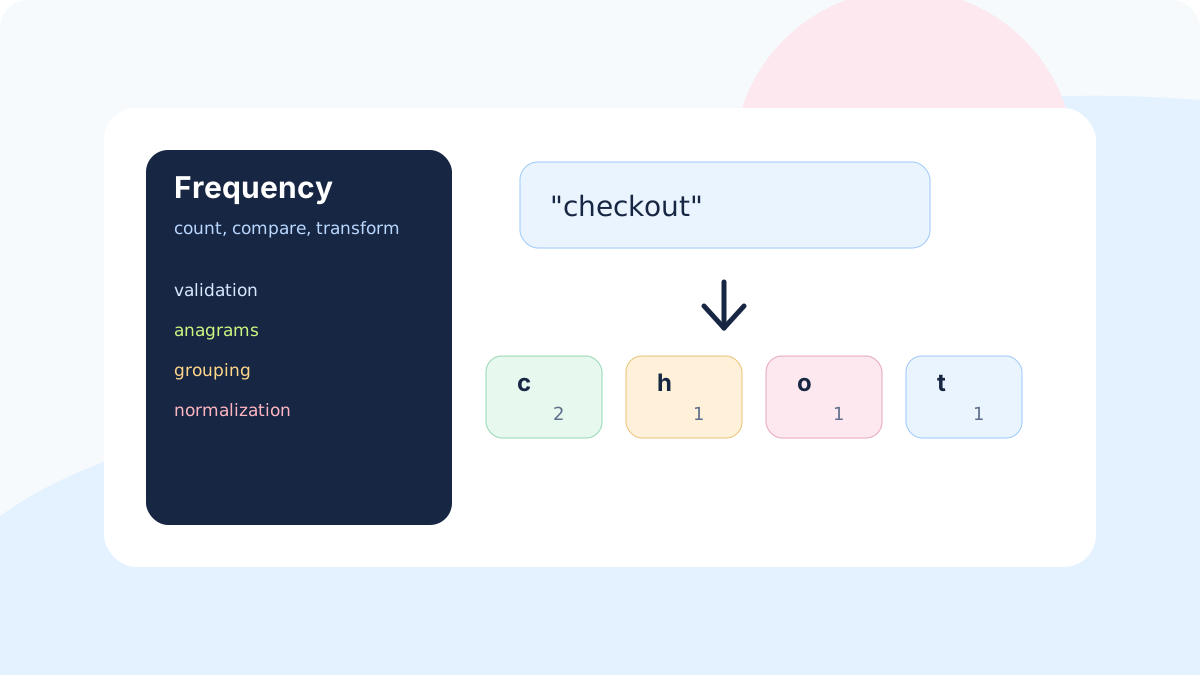
Character Frequency and Transformation
Use counts and transformations for validation, search, normalization, grouping, anomaly detection, and text-heavy product features.
What you will be able to do
Counting is one of the most practical DSA moves in string work. When a feature asks whether two strings contain the same characters, whether input violates a rule, which token appears most often, or how documents should be grouped, a frequency counter often turns repeated scanning into a compact summary.
Frequency Is a Summary
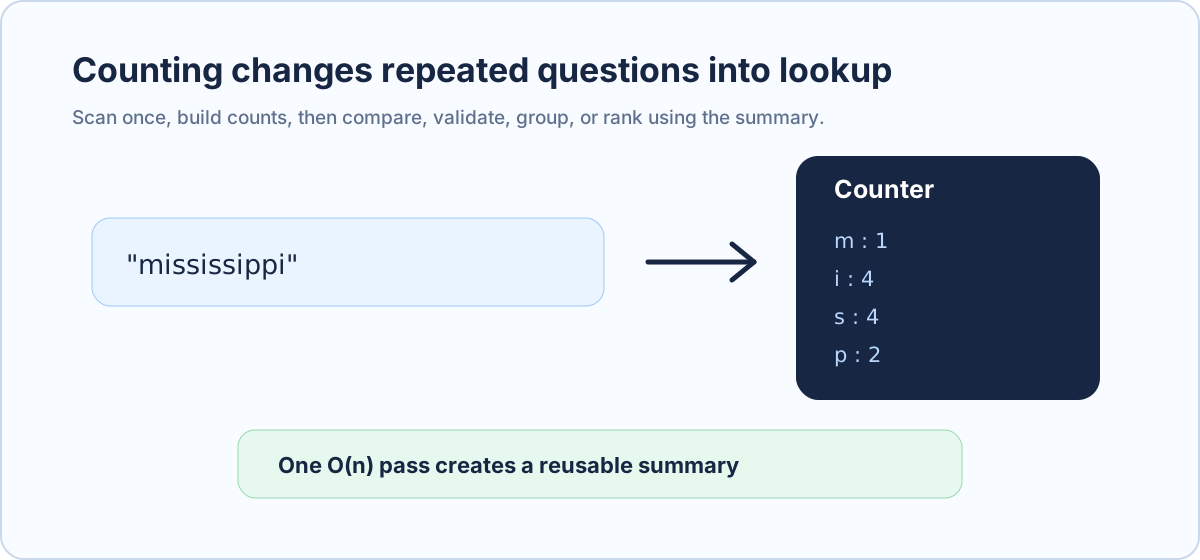
A frequency counter records how many times each unit appears. The unit might be a character, byte, word, normalized token, domain, event type, country code, or error signature. Once the counter exists, the system can answer questions without repeatedly scanning the original sequence.
Professional mental model
Counting is not only an interview trick. It is how production systems summarize logs, validate input, group records, detect anomalies, rank terms, and build indexes.
Choose the Counter Shape
The right counter depends on the possible keys. If the input is guaranteed to be lowercase English letters, a fixed array of length 26 is compact and fast. If the input can contain arbitrary user text, a map is safer. If the stream is massive and approximate answers are acceptable, specialized probabilistic structures may be used later in advanced systems.
| Counter shape | Best fit | Trade-off |
|---|---|---|
| Fixed array | Small known alphabet such as a-z | Fast and compact but inflexible. |
| Hash map/dictionary | Unknown or large key space | Flexible but uses more memory per key. |
| Sorted key signature | Grouping anagrams or normalized tokens | Simple but sorting costs O(k log k). |
| Frequency vector signature | Known alphabet grouping | O(k) build, compact comparison. |
| Approximate counter | Huge streams where exactness is not required | Saves memory but introduces error. |
Transformation Before Counting
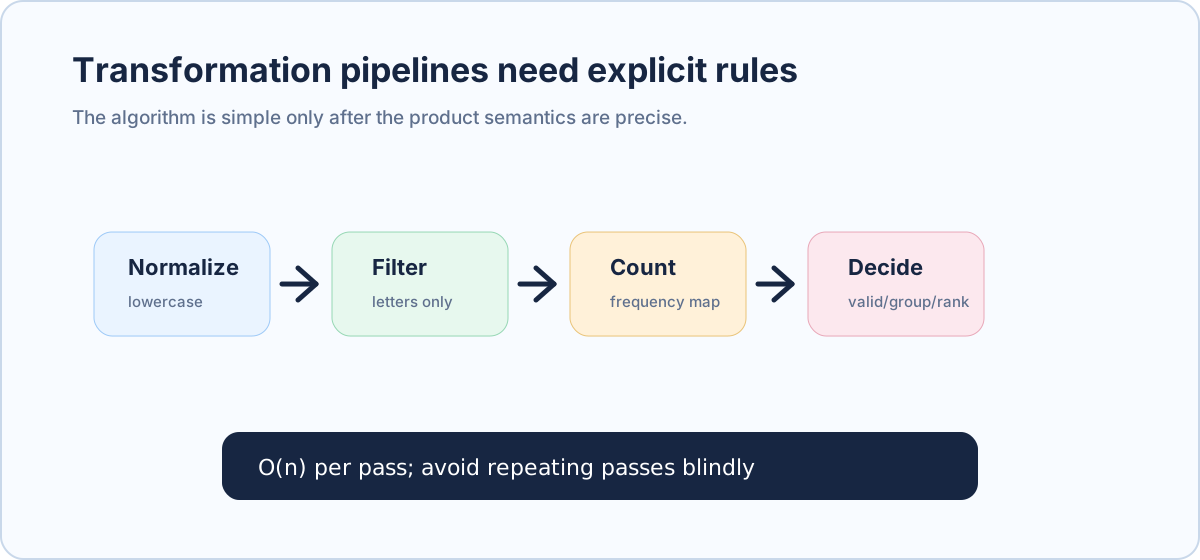
Most production frequency logic begins with transformation. Should casing be ignored? Should spaces count? Should punctuation count? Are accented characters equivalent to unaccented characters? Should words be stemmed? The counter is only correct after the product rule is clear.
Assessment trap
If a prompt says 'ignore spaces and punctuation', your algorithm must transform input before counting. If a prompt is about usernames or search, you must mention normalization rules instead of silently assuming raw characters.
Scenario: Fraud and Abuse Signals
A marketplace wants to detect suspicious seller names. Many abusive accounts use tiny variations of the same phrase: extra spaces, casing differences, repeated letters, or punctuation. A frequency-based feature can summarize normalized characters or tokens and compare accounts that look different but share the same underlying pattern.
This is not enough to build a fraud system by itself. It is one signal. The engineering value is that frequency summaries are cheap to compute, easy to store, and useful for grouping candidates before heavier review. The product value depends on the transformation rules and false-positive handling.
Real-world usage
Frequency counters show up in search indexing, fraud detection, spam filters, analytics dimensions, rate-limit keys, observability error grouping, recommendation features, data quality checks, and import validation.
Same Frequency Check in Java, Python, and JavaScript
An anagram check is a clean way to learn the pattern: normalize two strings, count the characters in one, subtract counts using the other, and ensure the counts balance. In production, the same pattern becomes duplicate detection, grouping, validation, and signature comparison.
import java.util.HashMap;
import java.util.Locale;
import java.util.Map;

class AnagramCheck {
    static boolean sameLetters(String left, String right) {
        String a = normalize(left);
        String b = normalize(right);
        if (a.length() != b.length()) return false;

        Map<Character, Integer> counts = new HashMap<>();
        for (char ch : a.toCharArray()) {
            counts.put(ch, counts.getOrDefault(ch, 0) + 1);
        }
        for (char ch : b.toCharArray()) {
            int next = counts.getOrDefault(ch, 0) - 1;
            if (next < 0) return false;
            counts.put(ch, next);
        }
        return true;
    }

    static String normalize(String value) {
        return value.toLowerCase(Locale.ROOT).replaceAll("[^a-z]", "");
    }
}
The complexity is O(n + m) for the two normalized strings, assuming map operations are expected O(1). The memory is O(u), where u is the number of unique counted characters. If the alphabet is fixed to 26 lowercase letters, u is bounded and a fixed array is possible.
Grouping by Signature
Counting also supports grouping. Suppose an import pipeline receives product tags and wants to group tags that contain the same letters after normalization. One option is to sort each normalized string and use the sorted result as a key. Another option is to build a frequency vector and serialize it as a key.
| Signature | Cost per string | When it fits |
|---|---|---|
| Sorted characters | O(k log k) | Simple implementation, small strings, easy debugging. |
| Frequency vector | O(k + alphabet) | Known alphabet, many strings, faster grouping. |
| Normalized token key | O(k) | Exact normalized equality, not anagram-style grouping. |
Counting at Scale
At small scale, a counter is just a map in memory. At production scale, counting becomes a systems problem. Analytics pipelines count events by key. Search systems count terms per document. Observability tools count error signatures. Rate limiters count requests per identity and time window. The DSA idea stays the same, but storage, expiration, distribution, and approximation become part of the design.
- For bounded keys and local input, use an in-memory array or map.
- For repeated queries, persist or cache the counts instead of rebuilding them every time.
- For streams, decide whether counts need expiration, windowing, or aggregation.
- For distributed systems, define how counts merge and how stale they may be.
- For user-facing text, preserve original input separately from normalized/countable representation.
Practice Before You Continue
Assessment-style answer
A comment moderation service wants to detect repeated banned phrases written with different casing and punctuation. Normalize each comment using the moderation rule, tokenize or count relevant units, then compare against indexed banned signatures. Mention false positives, language support, and whether matching must be exact or approximate.
| Question | Strong answer includes |
|---|---|
| What is counted? | Character, token, phrase, event type, domain key, or normalized signature. |
| What is ignored? | Case, spaces, punctuation, accents, stop words, or nothing. |
| How large is the key space? | Fixed alphabet, user text, arbitrary tokens, or unbounded stream. |
| How often is it queried? | Once per request, repeated lookup, batch analytics, or streaming window. |
| What can go wrong? | False positives, memory growth, stale counts, repeated scans, or wrong normalization. |
Field judgmentEngineering Notes
- Frequency counters summarize sequence data in one pass.
- Choose fixed arrays only when the key space is truly bounded and known.
- Use maps when keys are dynamic or text can contain broader characters.
- Transformation rules must be explicit before counting.
- Assessment answers should state input size, key space, pass count, memory cost, and product semantics.
Interview signalFrequently Asked Interview Questions
These are canonical interview patterns for this topic, phrased as concrete problem statements. They avoid vague theory questions and prepare you for the exact reasoning interviewers expect: invariant, edge cases, complexity, and trade-off.
- Check whether two strings contain the same letters after ignoring case, spaces, and punctuation.
- Group tags that contain the same normalized letters.
- Return the most frequent normalized letter in a string.
Production practiceCompany-Style Practice Examples
These are not claimed as exact company-specific questions. They are the interview patterns repeatedly used by product companies to test whether you can move from brute force to a defensible implementation.
| Example | Brute-force approach | Stronger solution | Production notes |
|---|---|---|---|
| Anagram check | Sort both strings and compare. | Normalize and count frequencies in O(n + m). | Sorting is acceptable but O(k log k); counting needs alphabet assumptions. |
| Tag grouping | Compare every tag with every other tag. | Build a signature: sorted key or frequency vector. | Pick based on alphabet size and debugging needs. |
| Moderation phrase detection | Scan banned phrases repeatedly with raw casing. | Normalize input and compare against normalized/indexed signatures. | Discuss false positives and language support. |
Solved modelInterview Question Solutions
Question 1: Same Letters After Normalization
Check whether two strings contain the same letters after ignoring case, spaces, and punctuation. Normalize first, then count. Use a fixed 26-slot array only if the allowed alphabet is a-z.
import java.util.*;

class SameLetters {
    static boolean sameLetters(String left, String right) {
        String a = left.toLowerCase(Locale.ROOT).replaceAll("[^a-z]", "");
        String b = right.toLowerCase(Locale.ROOT).replaceAll("[^a-z]", "");
        if (a.length() != b.length()) return false;
        int[] counts = new int[26];
        for (char ch : a.toCharArray()) counts[ch - 'a']++;
        for (char ch : b.toCharArray()) {
            if (--counts[ch - 'a'] < 0) return false;
        }
        return true;
    }
}
Question 2: Group Tags by Anagram Signature
Group tags that contain the same normalized letters. For each tag, normalize and sort characters to create a signature. Group by that signature.
import java.util.*;

class GroupTags {
    static Map<String, List<String>> group(List<String> tags) {
        Map<String, List<String>> groups = new HashMap<>();
        for (String tag : tags) {
            char[] chars = tag.toLowerCase(Locale.ROOT).replaceAll("[^a-z]", "").toCharArray();
            Arrays.sort(chars);
            String key = new String(chars);
            groups.computeIfAbsent(key, _k -> new ArrayList<>()).add(tag);
        }
        return groups;
    }
}
Question 3: Most Frequent Character
Return the most frequent normalized letter in a string. Normalize to allowed characters, count frequencies, then scan counts for the maximum.
class MostFrequentChar {
    static char mostFrequent(String text) {
        int[] counts = new int[26];
        for (char raw : text.toLowerCase().toCharArray()) {
            if (raw >= 'a' && raw <= 'z') counts[raw - 'a']++;
        }
        int best = 0;
        for (int i = 1; i < counts.length; i++) {
            if (counts[i] > counts[best]) best = i;
        }
        return (char) ('a' + best);
    }
}
Solved modelWorked Interview Answer
Check whether two strings contain the same letters after ignoring case, spaces, and punctuation. Normalize first, then compare frequency counts. State the alphabet assumption; this version keeps only a-z.
import java.util.*;

class SameLetters {
    static boolean sameLetters(String left, String right) {
        String a = left.toLowerCase(Locale.ROOT).replaceAll("[^a-z]", "");
        String b = right.toLowerCase(Locale.ROOT).replaceAll("[^a-z]", "");
        if (a.length() != b.length()) return false;
        int[] counts = new int[26];
        for (char ch : a.toCharArray()) counts[ch - 'a']++;
        for (char ch : b.toCharArray()) {
            if (--counts[ch - 'a'] < 0) return false;
        }
        return true;
    }
}
Hands-on drillTry It Yourself
Practice task
Implement sameLetters for two strings while ignoring case, spaces, and punctuation. Then state what changes if the input can contain arbitrary Unicode.
Failure patternsCommon Mistakes to Avoid
- Counting before applying required normalization rules.
- Using a fixed 26-slot counter when the alphabet is not actually fixed.
- Forgetting memory growth when keys are dynamic or unbounded.
Execution guardrailQuick-Start Checklist
- Define what unit is counted.
- Define what is ignored.
- Choose fixed array or map.
- State time and memory complexity.
- Mention correctness assumptions.
Recall drillKnowledge Check
| Question | Strong answer |
|---|---|
| Why count frequencies? | To summarize sequence data for comparison, validation, grouping, or ranking. |
| When is a fixed array counter safe? | When the key space is small, fixed, and guaranteed. |
| What is O(u) memory? | Memory proportional to the number of unique counted keys. |
VocabularyKey Terms
| Term | Meaning |
|---|---|
| Frequency counter | A structure mapping each unit to its occurrence count. |
| Key space | The set of possible keys the counter may need to store. |
| Signature | A derived representation used for comparison or grouping. |
Next practiceFurther Reading
- Study hash maps and frequency counting in the next modules.
- Review text normalization before counting.
- Explore observability and analytics counters at scale.