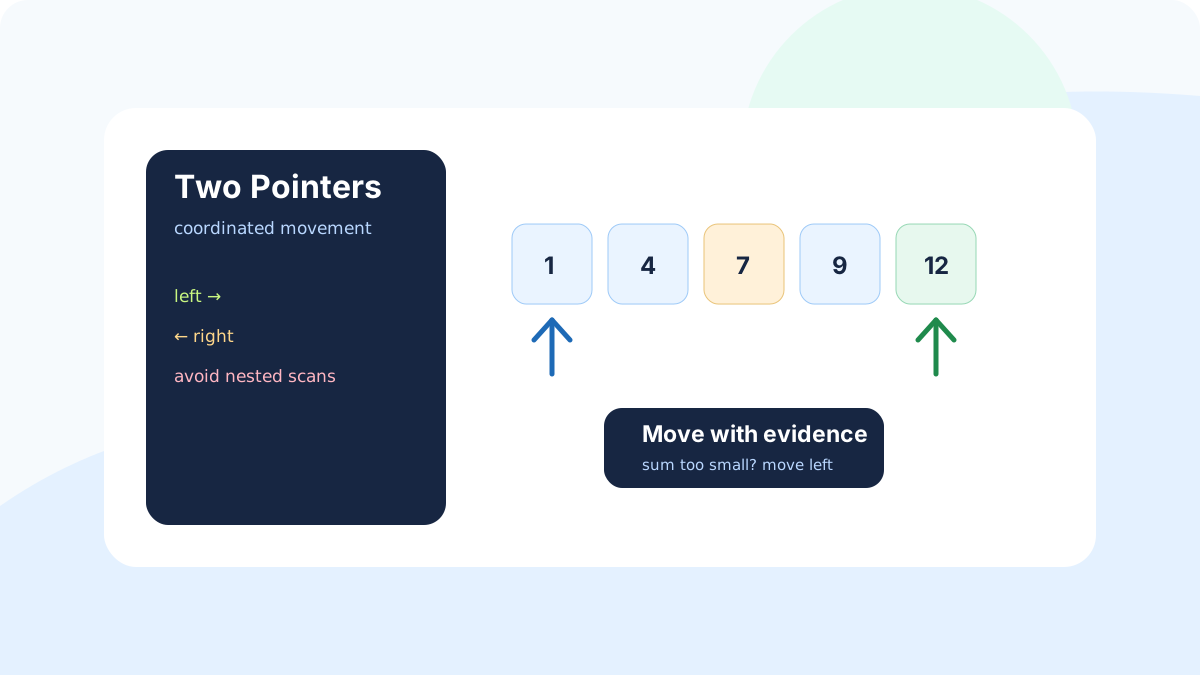
Two Pointers
Use coordinated pointer movement to avoid unnecessary nested loops in sorted arrays, strings, and ordered scans.
What you will be able to do
Two pointers is not a trick for moving two variables. It is a disciplined way to turn a candidate search into a single pass when the input order gives you evidence about what can be safely ignored.
The Core Idea
A brute-force pair search compares every item with every other item. Two pointers asks a sharper question: can one comparison tell us which side cannot contain the answer anymore? If yes, one pointer moves and a whole group of candidates disappears.
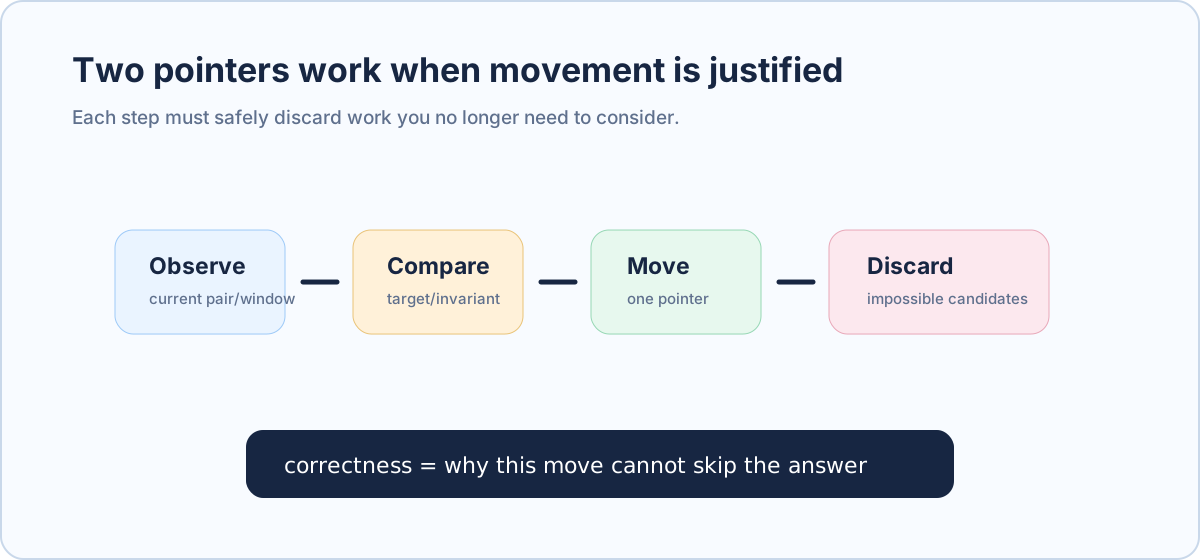
Professional invariant
At every step, the answer is either found or still inside the remaining search region. Pointer movement is correct only because discarded candidates are impossible under the ordering rule.
Scenario: Matching Risk Thresholds
A fraud system has sorted risk scores and needs to find whether two signals combine to a target threshold. A nested loop checks every pair. With millions of signals this is expensive. Because the scores are sorted, the sum of the smallest and largest score tells us which pointer to move.
| Observation | Safe move | Reason |
|---|---|---|
| sum equals target | return pair | The pair is found. |
| sum is too small | move left rightward | The smallest value is too small with even the largest partner. |
| sum is too large | move right leftward | The largest value is too large with even the smallest partner. |
Same Pattern in Java, Python, and JavaScript
class PairSum {
    static boolean hasPair(int[] values, int target) {
        int left = 0;
        int right = values.length - 1;
        while (left < right) {
            int sum = values[left] + values[right];
            if (sum == target) return true;
            if (sum < target) left++;
            else right--;
        }
        return false;
    }
}
The complexity is O(n) time and O(1) extra memory. The sorted input is not decoration; it is the condition that makes movement safe.
Where Two Pointers Shows Up
- Pair search in sorted arrays.
- Deduplicating sorted records.
- Validating palindromes after normalization.
- Merging sorted streams or pages.
- Compacting arrays in place when removing invalid items.
Assessment trap
Do not use two pointers just because a problem mentions an array. You need ordering, monotonic movement, or a clear invariant that proves discarded candidates are impossible.
Field judgmentEngineering Notes
- State what each pointer represents.
- State the invariant before explaining code.
- Every pointer move must discard candidates safely.
- Two pointers often replaces O(n^2) pair checks with O(n).
- If input is unsorted, include sorting cost or choose another approach.
Interview signalFrequently Asked Interview Questions
These are canonical interview patterns for this topic, phrased as concrete problem statements. They avoid vague theory questions and prepare you for the exact reasoning interviewers expect: invariant, edge cases, complexity, and trade-off.
- Given a sorted integer array, return whether any two values sum to a target.
- Return whether a string is a palindrome after ignoring non-alphanumeric characters and case.
- Given a sorted array, compact unique values in place and return the new length.
Production practiceCompany-Style Practice Examples
These are not claimed as exact company-specific questions. They are the interview patterns repeatedly used by product companies to test whether you can move from brute force to a defensible implementation.
| Example | Brute-force approach | Stronger solution | Production notes |
|---|---|---|---|
| Sorted two-sum | Try every pair with nested loops. | Move left/right pointers based on sum compared with target. | Proof depends on sorted order. |
| Valid palindrome | Build all possible reversed substrings. | Use two pointers after normalization. | State what characters are ignored. |
| Remove duplicates from sorted array | Use a set and lose order/extra memory. | Use read/write pointers to compact in place. | Sorted input makes duplicate detection local. |
Solved modelInterview Question Solutions
Question 1: Sorted Two-Sum
Given a sorted integer array, return whether any two values sum to a target. Brute force checks every pair in O(n^2). The optimized answer uses left and right pointers. If the sum is too small, the left value cannot pair with any smaller value, so move left. If the sum is too large, the right value is too large, so move right.
class SortedTwoSum {
    static boolean hasPair(int[] nums, int target) {
        int left = 0;
        int right = nums.length - 1;

        while (left < right) {
            int sum = nums[left] + nums[right];
            if (sum == target) return true;

            // Sorted order tells us which side is impossible.
            if (sum < target) left++;
            else right--;
        }
        return false;
    }
}
Question 2: Valid Palindrome After Normalization
Return whether a string is a palindrome after ignoring non-alphanumeric characters and case. A simple solution builds a normalized string and compares it with its reverse. The two-pointer solution avoids the extra normalized copy by skipping invalid characters at both ends.
class ValidPalindrome {
    static boolean isPalindrome(String text) {
        int left = 0;
        int right = text.length() - 1;

        while (left < right) {
            while (left < right && !Character.isLetterOrDigit(text.charAt(left))) left++;
            while (left < right && !Character.isLetterOrDigit(text.charAt(right))) right--;

            char a = Character.toLowerCase(text.charAt(left));
            char b = Character.toLowerCase(text.charAt(right));
            if (a != b) return false;

            left++;
            right--;
        }
        return true;
    }
}
Question 3: Remove Duplicates From Sorted Array
Given a sorted array, compact unique values in place and return the new length. A set-based solution uses extra memory and ignores that duplicates are adjacent. The read/write pointer solution keeps one write position for the next unique value.
class RemoveDuplicates {
    static int compact(int[] nums) {
        if (nums.length == 0) return 0;

        int write = 1;
        for (int read = 1; read < nums.length; read++) {
            // Sorted input means a new value differs from the previous value.
            if (nums[read] != nums[read - 1]) {
                nums[write] = nums[read];
                write++;
            }
        }
        return write;
    }
}
Solved modelWorked Interview Answer
Given a sorted array, return whether two numbers sum to a target. Because the array is sorted, a sum that is too small proves the left value is too small; a sum that is too large proves the right value is too large.
class TwoSumSorted {
    static boolean hasPair(int[] values, int target) {
        int left = 0, right = values.length - 1;
        while (left < right) {
            int sum = values[left] + values[right];
            if (sum == target) return true;
            if (sum < target) left++;
            else right--;
        }
        return false;
    }
}
Hands-on drillTry It Yourself
Practice task
Solve pair sum on a sorted array. For every pointer move, write one sentence explaining why the discarded candidate cannot be the answer.
Failure patternsCommon Mistakes to Avoid
- Moving a pointer without proving the move is safe.
- Using two pointers on unsorted data without accounting for sorting cost.
- Forgetting edge cases such as empty arrays, one item, duplicates, or negative values.
Execution guardrailQuick-Start Checklist
- Identify what each pointer means.
- Confirm ordering or monotonic movement exists.
- Define the invariant.
- Prove each move cannot skip the answer.
- State time and space complexity.
Recall drillKnowledge Check
| Question | Strong answer |
|---|---|
| Why does pair sum need sorted input? | The sorted order tells us which pointer to move when the sum is too small or too large. |
| What is the invariant? | The answer, if it exists, remains inside the active search region. |
| What is the typical complexity? | O(n) time and O(1) extra memory after any required sorting. |
VocabularyKey Terms
| Term | Meaning |
|---|---|
| Left pointer | The lower boundary or earlier position in the active region. |
| Right pointer | The upper boundary or later position in the active region. |
| Invariant | A condition that remains true throughout the algorithm. |
Next practiceFurther Reading
- Practice sorted two-sum, valid palindrome, and remove duplicates.
- Compare two pointers with hash-map lookup for pair problems.
- Review sorting cost before applying two pointers to unsorted input.