Non-Functional Requirements
Learn how latency, throughput, availability, durability, consistency, security, cost, and observability become measurable system design targets.
What you will be able to do
Functional requirements say what the system does. Non-functional requirements say how well the system must do it. In production, these quality targets often decide the architecture more than the feature itself.
Why NFRs Matter
Two systems can support the same feature but require very different designs. A private admin tool that can be slow, a payment service that must be correct, and a live chat product that must feel instant all have different non-functional requirements.
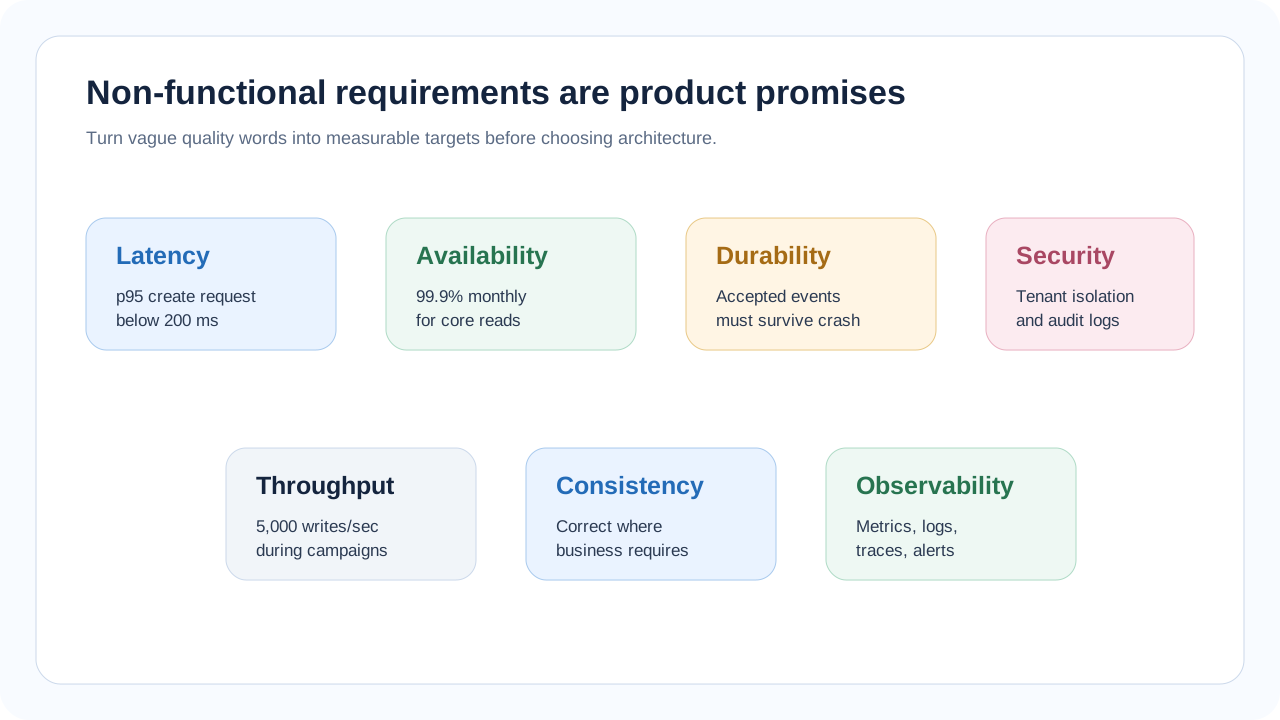
| Vague phrase | Better NFR | Why it is better |
|---|---|---|
| Fast | p95 API latency below 200 ms for create requests | Names the operation, percentile, and target. |
| Highly available | 99.9% monthly availability for order status reads | Defines the user-facing flow and time window. |
| Never lose data | Accepted payment events must be durably stored before acknowledgement | Defines when durability is required. |
| Scalable | Handle 5,000 writes/sec for 30 minutes during campaign peaks | States load and duration. |
| Secure | Tenant data must be isolated and all privileged actions audited | Connects security to real access rules. |
Latency and Percentiles
Latency is how long an operation takes. In system design, average latency is often misleading because users feel the slow requests. That is why teams commonly discuss p95 or p99 latency: the request time below which 95% or 99% of requests complete.
| Metric | Beginner meaning | Example |
|---|---|---|
| Average latency | Typical time across all requests | Average status read is 80 ms. |
| p95 latency | 95 out of 100 requests are this fast or faster | p95 status read is below 250 ms. |
| p99 latency | 99 out of 100 requests are this fast or faster | p99 status read is below 800 ms. |
| Tail latency | The slowest slice of user experience | Some users see multi-second delays during cache misses. |
Design principle
Do not say the system should be fast. Say which operation should be fast, for whom, at which percentile, under what traffic level.
Availability, Durability, and Recovery
Availability means users can successfully use a system when they need it. Durability means accepted data is not lost. Recovery defines how quickly the system should return after failure and how much data loss is acceptable.
| Target | Question it answers | Example |
|---|---|---|
| Availability | Can users use it? | Order status reads should be available 99.9% monthly. |
| Durability | Can accepted data be lost? | Confirmed order transitions must survive process crashes. |
| RTO | How long can recovery take? | Restore service within 30 minutes after region-level incident. |
| RPO | How much data loss is acceptable? | At most 1 minute of analytics events may be replayed or delayed. |
Scenario: Payment Receipt Service
A payment receipt service receives a payment event, stores the receipt, emails the customer, and exposes receipt history. The feature sounds small, but the NFRs decide the design.
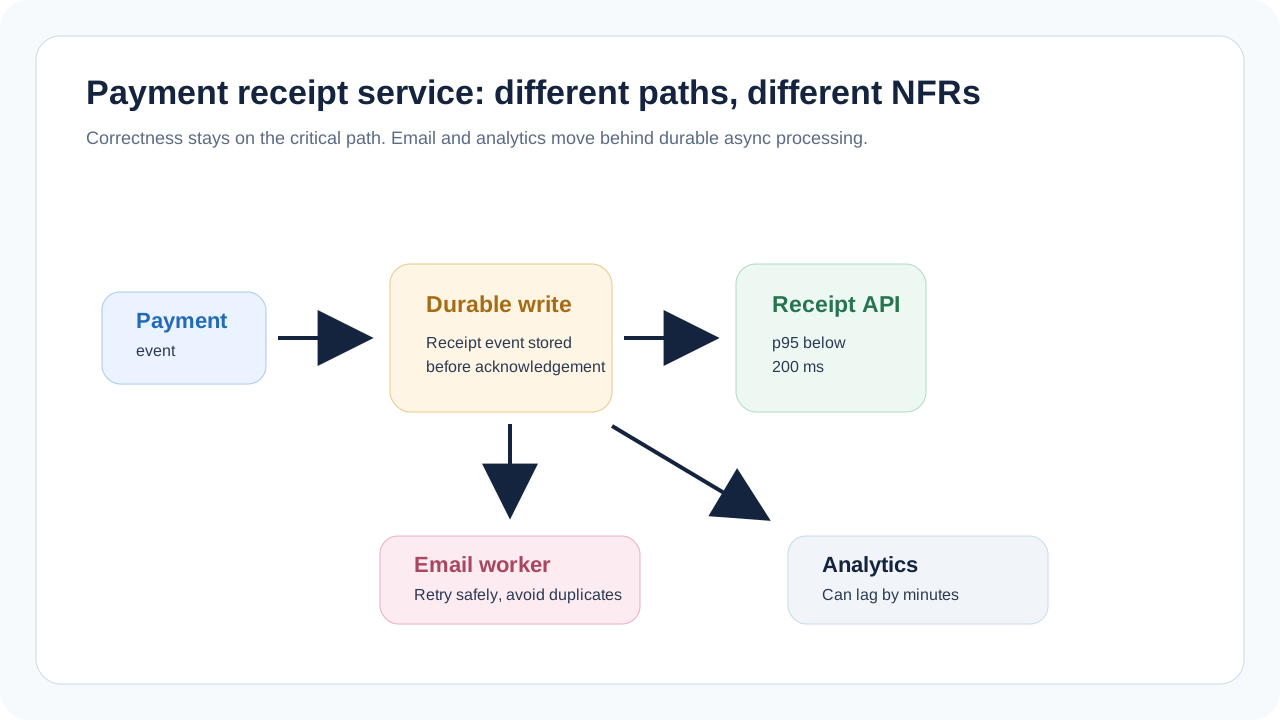
| Part of system | NFR | Architecture implication |
|---|---|---|
| Payment event ingestion | Do not acknowledge until receipt event is durably stored | Durable database or log before response. |
| Receipt read API | p95 below 200 ms for recent receipts | Indexes, cache, and small read model. |
| Email delivery | Can be delayed, must retry safely | Queue plus idempotent worker. |
| Audit history | Immutable records for compliance | Append-only records and access logs. |
| Analytics dashboard | Can lag by minutes | Async pipeline instead of slowing the payment path. |
Consistency as an NFR
Consistency is not one universal setting. Ask what must be correct immediately and what can become correct after a short delay. A payment confirmation and a dashboard counter do not need the same consistency.
| Data | Consistency need | Reason |
|---|---|---|
| Payment receipt | Strong enough to prevent missing confirmed receipts | User trust and compliance. |
| Unread notification count | Can be eventually consistent | Small delay is acceptable. |
| Inventory checkout | Must prevent overselling for scarce items | Business correctness. |
| Analytics chart | Can lag by minutes | Reporting is not on the critical user path. |
Cloud Mapping for NFRs
Once NFRs are clear, cloud choices become easier. Managed services can reduce operational load, but they still must satisfy latency, durability, availability, compliance, cost, and team constraints.
| NFR pressure | AWS examples | GCP examples | Azure examples |
|---|---|---|---|
| High availability compute | ECS/EKS across AZs, Lambda | Cloud Run/GKE across zones | Container Apps/AKS across zones |
| Durable relational data | RDS/Aurora Multi-AZ | Cloud SQL HA/Spanner | Azure SQL zone redundancy |
| Async retryable work | SQS + DLQ | Pub/Sub + dead-letter topic | Service Bus + dead-letter queue |
| Low-latency cache | ElastiCache | Memorystore | Azure Cache for Redis |
| Observability | CloudWatch/X-Ray | Cloud Monitoring/Trace | Azure Monitor/Application Insights |
NFR Brief Template
For each important user flow, define a small set of measurable quality targets. Avoid trying to make every part of the system perfect.
| Flow | Latency | Availability | Durability/consistency | Notes |
|---|---|---|---|---|
| Create payment receipt | p95 below 300 ms | 99.95% | Durable before ack | Critical path. |
| Send receipt email | Within 2 minutes | 99.9% | Retry without duplicates | Async path. |
| View receipt history | p95 below 250 ms | 99.9% | Read-your-own receipt preferred | Indexes/cache may help. |
| Analytics dashboard | Can lag 5 minutes | 99% | Eventually consistent | Do not slow critical path. |
Beginner Mistakes
- Saying reliable without defining availability, durability, or recovery.
- Using average latency when p95 or p99 matters more to users.
- Making every operation strongly consistent without asking if the product needs it.
- Adding queues and caches before identifying the slow or failure-prone path.
- Ignoring cost and team support capacity as real non-functional requirements.
Guided Practice
Practice task
Pick a ride-sharing app. Define one latency target, one durability target, one availability target, one consistency target, and one cost or team constraint.
Sample Answer
| NFR | Example answer |
|---|---|
| Latency | Driver location on the customer map should refresh within 5 seconds for active trips. |
| Durability | Trip start, trip end, fare, and payment events must not be lost after acknowledgement. |
| Availability | Customers should be able to view active trip status with 99.9% monthly availability. |
| Consistency | Fare and payment state must be correct; map location can be eventually consistent. |
| Cost/team | Use managed queues and databases for launch because the team cannot operate custom distributed infrastructure yet. |
Before You Continue
- You should be able to turn vague quality words into measurable targets.
- You should understand why p95 and p99 latency matter.
- You should know the difference between availability and durability.
- You should understand that consistency depends on the product flow.
- You should be ready to estimate traffic and storage in the next lesson.