Stack and LIFO Thinking
Use last-in-first-out behavior for parsing, undo, browser history, execution state, and monotonic-stack interview patterns.
What you will be able to do
A stack is the data structure for unfinished work where the most recent item must be handled first. That one rule explains function calls, undo stacks, browser back buttons, syntax parsing, expression evaluation, and many interview problems that look unrelated at first.
The LIFO Mental Model
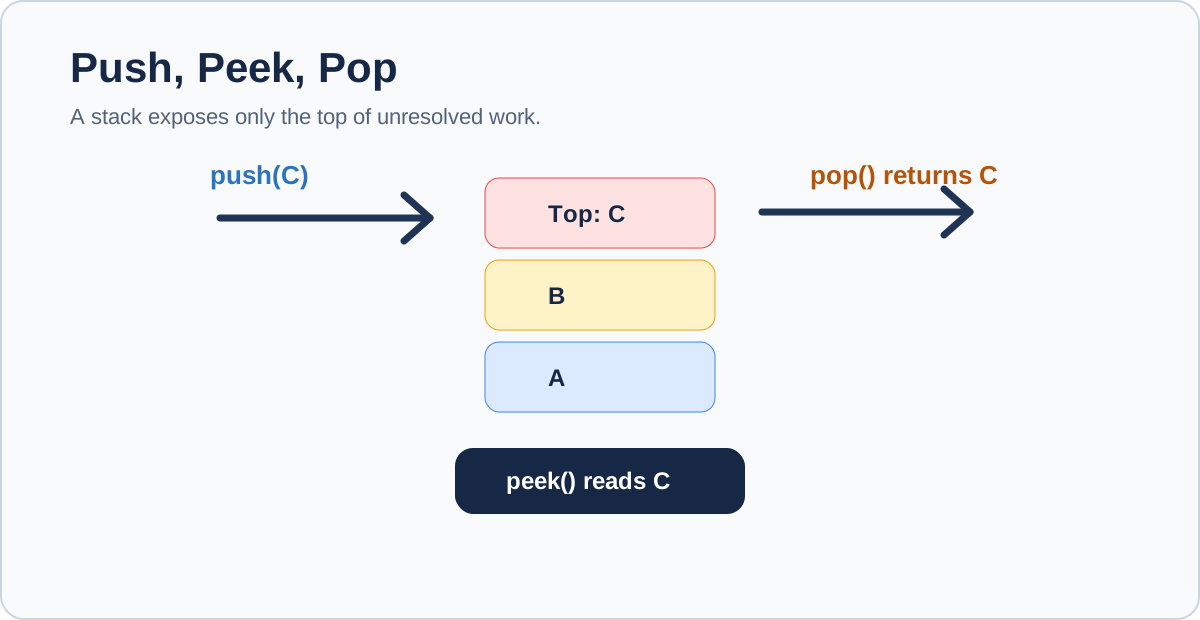
LIFO means last in, first out. Push adds work to the top. Pop removes the most recent work. Peek reads the next item without removing it. The key question is whether the most recent unresolved item is the one you must compare, close, undo, or continue.
SkillSkore principle
Use a stack when the latest unresolved item must be processed before older unresolved items.
Scenario: Editor Undo and Nested UI State
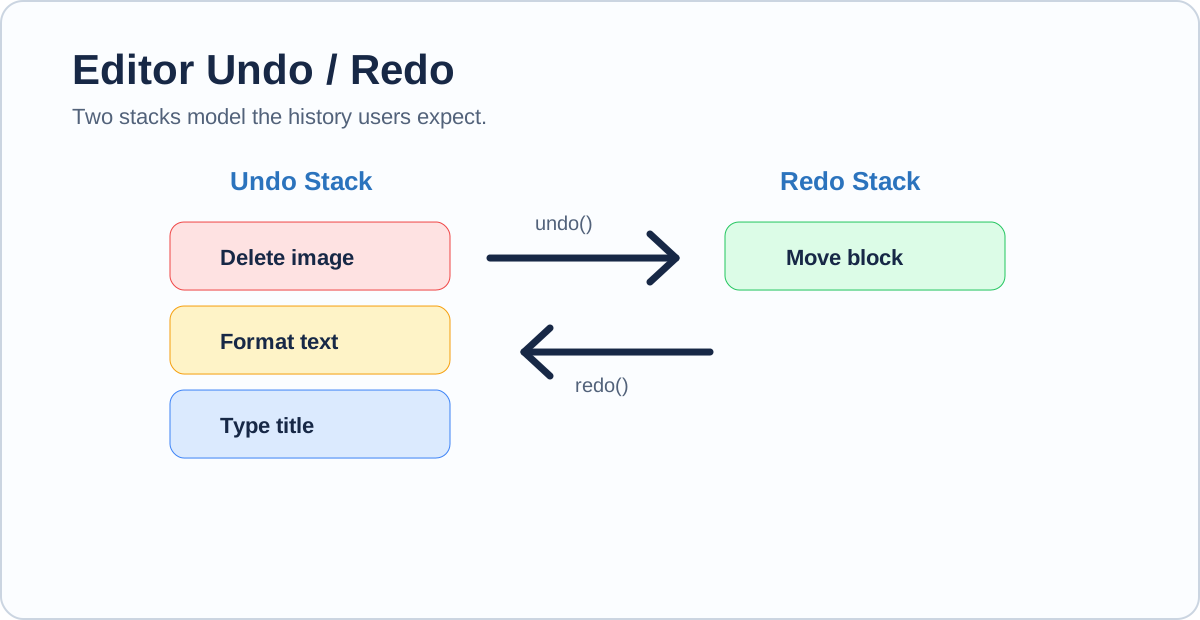
A document editor records user actions: type text, format paragraph, move block, delete image. Undo must reverse the most recent action first. Redo must reapply the most recently undone action first. Two stacks model this cleanly: an undo stack and a redo stack.
| Product behavior | Stack role | Risk to mention |
|---|---|---|
| Undo latest action | Pop from undo stack | Every action needs an inverse or snapshot. |
| Redo after undo | Pop from redo stack | New actions usually clear redo history. |
| Nested modal close | Pop latest modal | Closing older layers first breaks UI state. |
| Parser closing bracket | Compare with latest opening bracket | Most recent opener must match first. |
Same Pattern in Java, Python, and JavaScript
Balanced bracket validation is the canonical stack example. Every closing bracket must match the latest unmatched opening bracket.
import java.util.*;

class ValidBrackets {
    static boolean isValid(String text) {
        Map<Character, Character> closeToOpen = Map.of(')', '(', ']', '[', '}', '{');
        Deque<Character> stack = new ArrayDeque<>();
        for (char ch : text.toCharArray()) {
            if (ch == '(' || ch == '[' || ch == '{') stack.push(ch);
            else if (closeToOpen.containsKey(ch)) {
                if (stack.isEmpty() || stack.pop() != closeToOpen.get(ch)) return false;
            }
        }
        return stack.isEmpty();
    }
}
Monotonic Stack Preview
A monotonic stack keeps values in increasing or decreasing order while scanning. It is useful when each new item resolves previous unresolved items, such as next greater element, daily temperatures, stock span, and histogram area. The invariant matters more than the syntax.
Assessment trap
Do not use a stack just because the word nested appears. Use it when the latest unresolved item is the correct one to inspect next.
Interview signalFrequently Asked Interview Questions
These are canonical interview patterns for this topic, phrased as concrete problem statements. They avoid vague theory questions and prepare you for the exact reasoning interviewers expect: invariant, edge cases, complexity, and trade-off.
- Given a string containing brackets, return whether every closer matches the latest unmatched opener.
- Implement a stack that supports push, pop, top, and getMin in O(1).
- For each day, return how many days until a warmer temperature.
Production practiceCompany-Style Practice Examples
These are not claimed as exact company-specific questions. They are the interview patterns repeatedly used by product companies to test whether you can move from brute force to a defensible implementation.
| Example | Brute-force approach | Stronger solution | Production notes |
|---|---|---|---|
| Valid parentheses | Scan without remembering openers. | Use a stack of unmatched open brackets. | Top of stack is the only opener a closer can match. |
| Min stack | Recompute minimum by scanning on every getMin. | Maintain a second stack of running minimums. | Trading memory for O(1) minimum lookup. |
| Daily temperatures | Compare every future day. | Use a monotonic stack of unresolved indexes. | Each index is pushed and popped at most once. |
Solved modelInterview Question Solutions
Question 1: Valid Parentheses
Given a string containing brackets, return whether every closer matches the latest unmatched opener. Use a stack of opening brackets. A closer must match the top; at the end no openers may remain.
import java.util.*;

class Brackets {
    static boolean valid(String s) {
        Map<Character, Character> pairs = Map.of(')', '(', ']', '[', '}', '{');
        Deque<Character> stack = new ArrayDeque<>();
        for (char ch : s.toCharArray()) {
            if (ch == '(' || ch == '[' || ch == '{') stack.push(ch);
            else if (pairs.containsKey(ch) && (stack.isEmpty() || stack.pop() != pairs.get(ch))) return false;
        }
        return stack.isEmpty();
    }
}
Question 2: Min Stack
Implement a stack that supports push, pop, top, and getMin in O(1). Maintain the normal stack plus a second stack of running minimums. Push to min stack when the new value is less than or equal to current min.
import java.util.*;

class MinStack {
    private final Deque<Integer> values = new ArrayDeque<>();
    private final Deque<Integer> mins = new ArrayDeque<>();
    void push(int value) { values.push(value); if (mins.isEmpty() || value <= mins.peek()) mins.push(value); }
    void pop() { int removed = values.pop(); if (removed == mins.peek()) mins.pop(); }
    int top() { return values.peek(); }
    int getMin() { return mins.peek(); }
}
Question 3: Daily Temperatures
For each day, return how many days until a warmer temperature. Keep a monotonic decreasing stack of unresolved day indexes. A warmer day resolves colder previous days.
import java.util.*;

class DailyTemperatures {
    static int[] solve(int[] t) {
        int[] ans = new int[t.length];
        Deque<Integer> stack = new ArrayDeque<>();
        for (int i = 0; i < t.length; i++) {
            while (!stack.isEmpty() && t[i] > t[stack.peek()]) { int prev = stack.pop(); ans[prev] = i - prev; }
            stack.push(i);
        }
        return ans;
    }
}
Solved modelWorked Interview Answer
Validate bracket pairs using the latest unmatched opener. A closing bracket must match the most recent unresolved opening bracket, which is exactly stack behavior.
import java.util.*;

class Brackets {
    static boolean valid(String s) {
        Map<Character, Character> pairs = Map.of(')', '(', ']', '[', '}', '{');
        Deque<Character> stack = new ArrayDeque<>();
        for (char ch : s.toCharArray()) {
            if (ch == '(' || ch == '[' || ch == '{') stack.push(ch);
            else if (pairs.containsKey(ch) && (stack.isEmpty() || stack.pop() != pairs.get(ch))) return false;
        }
        return stack.isEmpty();
    }
}
Hands-on drillTry It Yourself
Practice task
Trace a bracket string by hand. After every character, write the stack contents and explain why the top is the only item that matters.
Failure patternsCommon Mistakes to Avoid
- Using a stack without proving latest-unresolved behavior.
- Forgetting to check empty stack before pop.
- Returning true while unmatched openers remain.
- Using recursion accidentally when explicit stack depth should be controlled.
Execution guardrailQuick-Start Checklist
- Define what each stack item represents.
- Push unresolved work.
- Compare or resolve only against the top.
- Pop exactly when work is completed.
- State time and maximum stack size.
Recall drillKnowledge Check
| Question | Strong answer |
|---|---|
| What does LIFO mean? | The most recently added item is removed first. |
| Why do brackets use a stack? | A closing bracket must match the latest unmatched opener. |
| What is a monotonic stack invariant? | The stack maintains increasing or decreasing order while unresolved items wait. |
VocabularyKey Terms
| Term | Meaning |
|---|---|
| Push | Add an item to the top of a stack. |
| Pop | Remove the top item. |
| Peek | Read the top item without removing it. |
| Monotonic stack | A stack that preserves sorted order to resolve next-greater or next-smaller relationships. |
Next practiceFurther Reading
- Practice valid parentheses, min stack, next greater element, and daily temperatures.
- Review browser history and undo stacks as product examples.
- Study monotonic stack patterns before histogram problems.