Hashing Trade-offs, Collisions, and Memory
Understand why hash maps and sets are powerful but not free: expected cost, collisions, resizing, memory, and production failure modes.
What you will be able to do
Hashing is one of the most useful ideas in software engineering, but it is also one of the easiest to misuse. Hash maps, sets, and counters feel simple because their APIs are simple. Under the API, they spend memory, compute hashes, handle collisions, resize storage, and depend on correct key equality.
Expected O(1) Does Not Mean Free
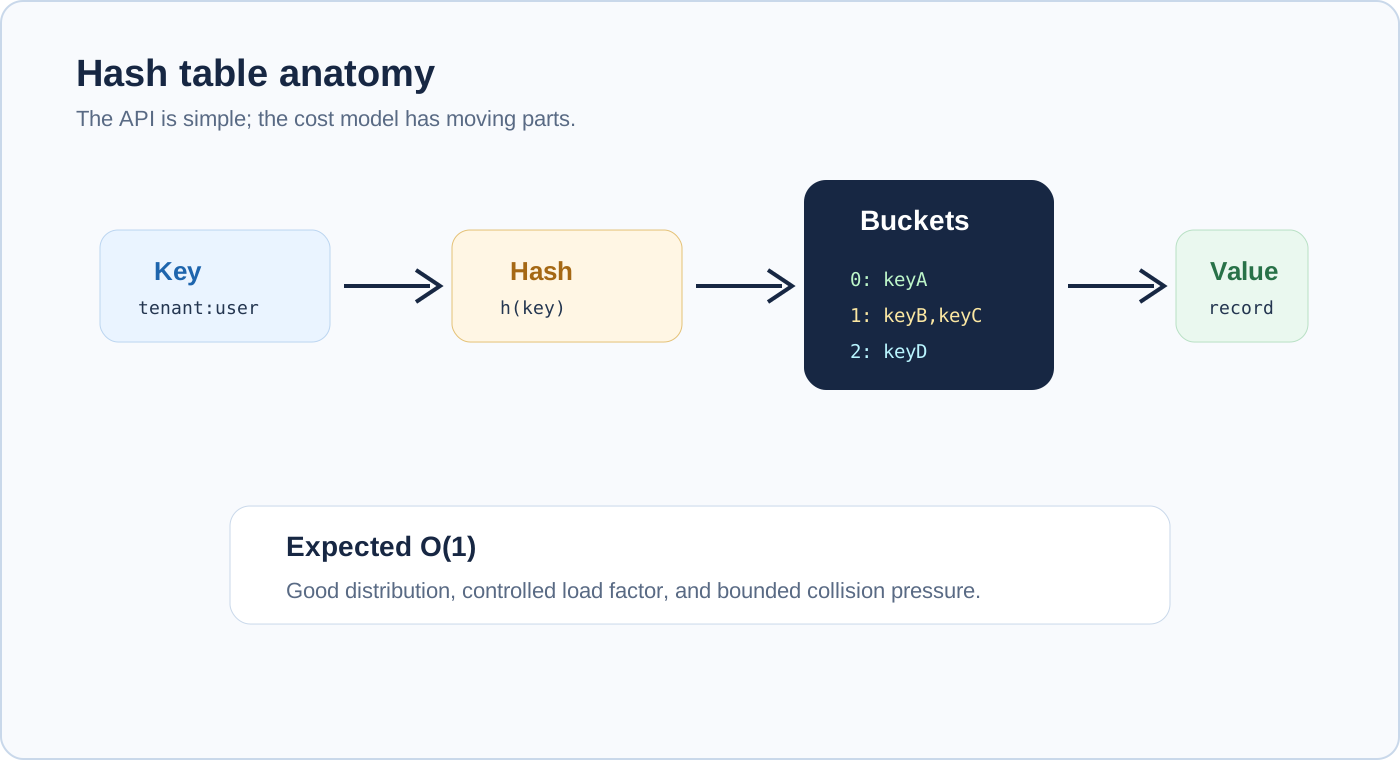
When engineers say hash lookup is O(1), they usually mean expected O(1) under a reasonable hash function, controlled load factor, and normal collision behavior. That expectation is useful, but it is not a license to ignore memory, key size, construction cost, or pathological inputs.
SkillSkore principle
A professional hash-table answer says expected cost, key design, memory cost, and failure mode. A weak answer says only O(1).
Collisions Are Normal
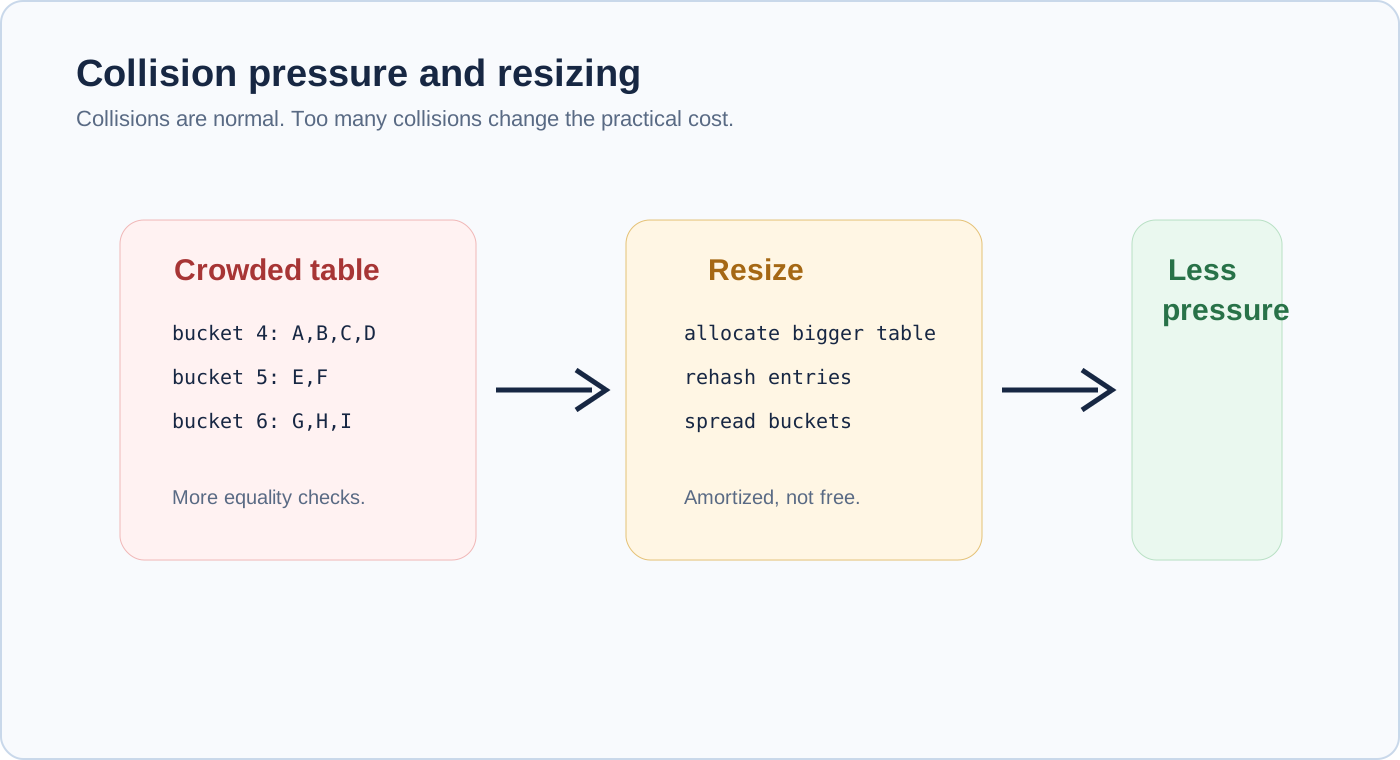
A collision happens when two different keys land in the same internal bucket or probing path. Collisions are not automatically bugs; hash tables are designed to handle them. The problem is collision pressure: too many keys competing for the same space makes lookup slower and resizing more likely.
| Concept | Meaning | Engineering implication |
|---|---|---|
| Hash function | Turns a key into a numeric hash | Bad distribution creates clustering. |
| Bucket | Internal location derived from the hash | Multiple keys may compete for nearby slots. |
| Collision | Different keys map to the same bucket/probe path | Handled internally, but too many degrade performance. |
| Load factor | How full the table is | High load increases collision pressure. |
| Resize | Allocate bigger table and re-place entries | Usually amortized, but the resize event can be expensive. |
Scenario: Cache Key Incident
A team caches account settings by user ID. It works until enterprise customers report seeing wrong settings. The bug is not hash-table performance; it is key design. The cache key should have included tenant ID. Hashing makes lookup fast, but it cannot fix an identity model that collapses different records into the same logical key.
| Bad key | Problem | Safer key |
|---|---|---|
| userId | Same user ID format may exist in multiple tenants | tenantId:userId |
| Case and aliases may behave differently by product rule | normalizedEmail with explicit rule | |
| resourceId | Action and tenant are missing | tenantId:resourceId:action |
| query text | Whitespace/case variants fragment counts | normalizedQuery |
Memory Cost Is the Price of Fast Lookup
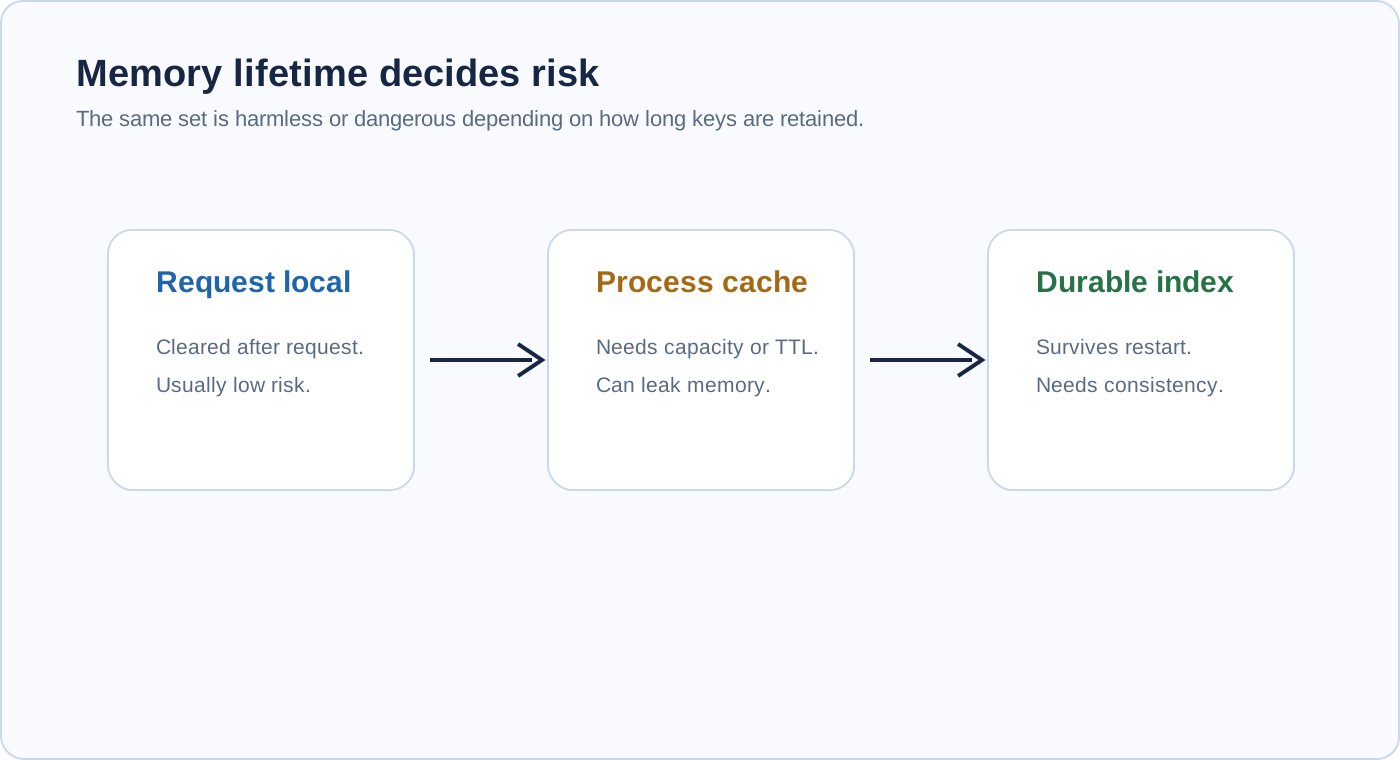
Hash structures store keys, values, buckets, metadata, and object overhead. A set of 1,000 IDs is easy. A set of 200 million IDs retained forever is an architecture decision. Production answers should name the lifetime of keys and whether eviction, TTL, partitioning, persistence, or approximate membership is needed.
Same Trade-off in Java, Python, and JavaScript
This example builds a bounded deduplication cache. It is not a perfect distributed design, but it shows a core production trade-off: keep recent keys for fast duplicate suppression, and evict old keys so memory does not grow forever.
import java.util.*;

class RecentDedup {
    private final int capacity;
    private final LinkedHashMap<String, Boolean> seen;

    RecentDedup(int capacity) {
        this.capacity = capacity;
        this.seen = new LinkedHashMap<>(capacity, 0.75f, true);
    }

    boolean firstTime(String key) {
        if (seen.containsKey(key)) return false;
        seen.put(key, true);
        if (seen.size() > capacity) {
            String oldest = seen.keySet().iterator().next();
            seen.remove(oldest);
        }
        return true;
    }
}
When Hashing Is the Wrong Tool
- You need sorted order or range queries.
- You need prefix lookup such as autocomplete.
- You need stable memory below a strict cap and exact membership is too expensive.
- You need to process every item anyway, so lookup is not the bottleneck.
- You cannot define a correct stable key.
- Your key values are huge and hashing/comparison dominates runtime.
Assessment trap
Hashing is often the right first optimization for repeated lookup, but not for ordering, range search, prefix search, or unclear identity. Strong answers know when to stop using it.
How This Module Fits Together
| Need | Structure | Main trade-off |
|---|---|---|
| Find value by key | Hash map | Memory and key consistency for fast lookup. |
| Know whether key exists | Set | Uniqueness without counts or metadata. |
| Know how often key appears | Counter map | Cardinality and count lifecycle. |
| Bound recent duplicates | Set/map plus eviction | Possible false negative after eviction. |
| Massive approximate membership | Bloom filter later | Memory savings with false positives. |
Interview signalFrequently Asked Interview Questions
These are canonical interview patterns for this topic, phrased as concrete problem statements. They avoid vague theory questions and prepare you for the exact reasoning interviewers expect: invariant, edge cases, complexity, and trade-off.
- Design a recent duplicate detector for event IDs that does not keep every event ID forever.
- A cache stores user settings by userId only. In a multi-tenant product, users sometimes see settings from another tenant. Fix the key design.
- Choose the right structure for exact membership, sorted range queries, prefix autocomplete, and memory-constrained approximate membership.
Production practiceCompany-Style Practice Examples
These are not claimed as exact company-specific questions. They are the interview patterns repeatedly used by product companies to test whether you can move from brute force to a defensible implementation.
| Example | Brute-force approach | Stronger solution | Production notes |
|---|---|---|---|
| Bounded duplicate detector | Keep every seen ID forever. | Use a bounded set/map with eviction or TTL. | Mention old duplicates may pass after eviction. |
| Multi-tenant cache key | Cache settings by userId only. | Include tenantId and normalized identity in the key. | Correctness bug, not performance bug. |
| Wrong structure choice | Use hash set for autocomplete/range queries. | Use trie for prefix search or sorted/tree structures for range behavior. | Hashing removes ordering information. |
Solved modelInterview Question Solutions
Question 1: Bounded Recent Duplicate Detector
Design a recent duplicate detector for event IDs that does not keep every event ID forever. Use a set for membership and an order structure for eviction. This bounds memory but only remembers recent keys, so old duplicates can be accepted after eviction.
import java.util.*;

class BoundedSeen {
    private final int capacity;
    private final Deque<String> order = new ArrayDeque<>();
    private final Set<String> seen = new HashSet<>();

    BoundedSeen(int capacity) {
        this.capacity = capacity;
    }

    boolean firstTime(String key) {
        if (seen.contains(key)) return false;
        seen.add(key);
        order.addLast(key);
        while (seen.size() > capacity) {
            seen.remove(order.removeFirst());
        }
        return true;
    }
}
Question 2: Multi-Tenant Cache Key Bug
A cache stores user settings by userId only. In a multi-tenant product, users sometimes see settings from another tenant. Fix the key design. This is an identity bug, not a hash-table bug. Include every field needed to identify the cached value: tenantId plus userId, and normalize any user-controlled parts by product rule.
import java.util.*;

record Settings(String theme) {}
record CacheKey(String tenantId, String userId) {}

class SettingsCache {
    private final Map<CacheKey, Settings> cache = new HashMap<>();

    Settings get(String tenantId, String userId) {
        CacheKey key = new CacheKey(tenantId, userId);
        return cache.get(key);
    }

    void put(String tenantId, String userId, Settings settings) {
        cache.put(new CacheKey(tenantId, userId), settings);
    }
}
Question 3: Pick the Right Lookup Structure
Choose the right structure for exact membership, sorted range queries, prefix autocomplete, and memory-constrained approximate membership. Hashing is strong for exact membership and direct lookup. Sorted structures support ranges, tries support prefixes, and Bloom filters trade exactness for compact approximate membership.
import java.util.*;

class LookupChoice {
    static String choose(String workload) {
        return switch (workload) {
            case "exact-membership" -> "HashSet";
            case "key-to-value" -> "HashMap";
            case "sorted-range" -> "TreeMap or database index";
            case "prefix-search" -> "Trie or search index";
            case "approx-membership" -> "Bloom filter";
            default -> "Clarify operations and constraints first";
        };
    }
}
Solved modelWorked Interview Answer
Build a bounded recent-key deduplication helper so a stream does not retain every key forever. Use a set/map plus eviction. The core trade-off is memory boundedness versus remembering only recent keys; duplicates older than the capacity/window may be accepted again.
import java.util.*;

class BoundedSeen {
    private final int capacity;
    private final Deque<String> order = new ArrayDeque<>();
    private final Set<String> seen = new HashSet<>();

    BoundedSeen(int capacity) {
        this.capacity = capacity;
    }

    boolean firstTime(String key) {
        if (seen.contains(key)) return false;
        seen.add(key);
        order.addLast(key);
        while (seen.size() > capacity) {
            seen.remove(order.removeFirst());
        }
        return true;
    }
}
Hands-on drillTry It Yourself
Practice task
Take one map or set from Lessons 13-15. Write down its key, value, expected operations, memory lifetime, eviction strategy, and what breaks if the key is wrong.
Failure patternsCommon Mistakes to Avoid
- Saying hash lookup is guaranteed O(1) without expected-case caveats.
- Ignoring collision behavior, equality checks, resizing, and key hashing cost.
- Using hash maps for sorted order, range queries, or prefix search.
- Letting sets or maps grow forever in streams and caches.
- Choosing keys that collapse different tenants, users, actions, or resources.
Execution guardrailQuick-Start Checklist
- State expected O(1), not magic O(1).
- Define key identity and normalization.
- State memory growth in distinct keys.
- Mention collision and resize behavior when relevant.
- Explain lifecycle: request-local, cache, persisted index, TTL, or eviction.
Recall drillKnowledge Check
| Question | Strong answer |
|---|---|
| Why is hash lookup usually called expected O(1)? | It assumes reasonable hash distribution, controlled load factor, and manageable collisions. |
| What does memory grow with? | Usually the number of distinct retained keys plus values, buckets, and metadata. |
| When is hashing the wrong structure? | When sorted order, range queries, prefix lookup, or exact key identity cannot be supported well. |
VocabularyKey Terms
| Term | Meaning |
|---|---|
| Collision | Different keys competing for the same bucket or probe path. |
| Load factor | How full a hash table is relative to capacity. |
| Resize | Allocating a larger table and redistributing entries. |
| Eviction | Removing entries based on capacity, age, or policy. |
| Key identity | The exact product meaning represented by a lookup key. |
Next practiceFurther Reading
- Review Java HashMap, Python dict, and JavaScript Map behavior at a high level.
- Study cache invalidation, TTL, LRU caches, and idempotency-key storage.
- Later, compare hash sets with tries, balanced trees, Bloom filters, and database indexes.