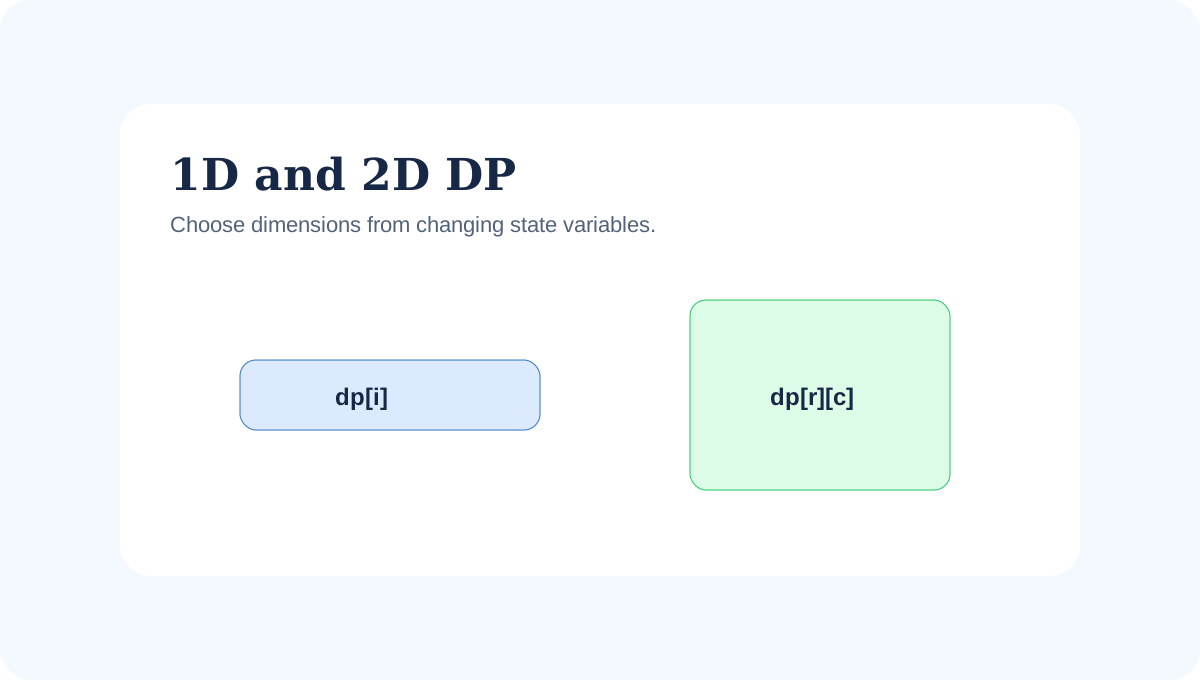
1D and 2D DP
Build table-based solutions for sequences, grids, subsequences, and constraint pairs.
What you will be able to do
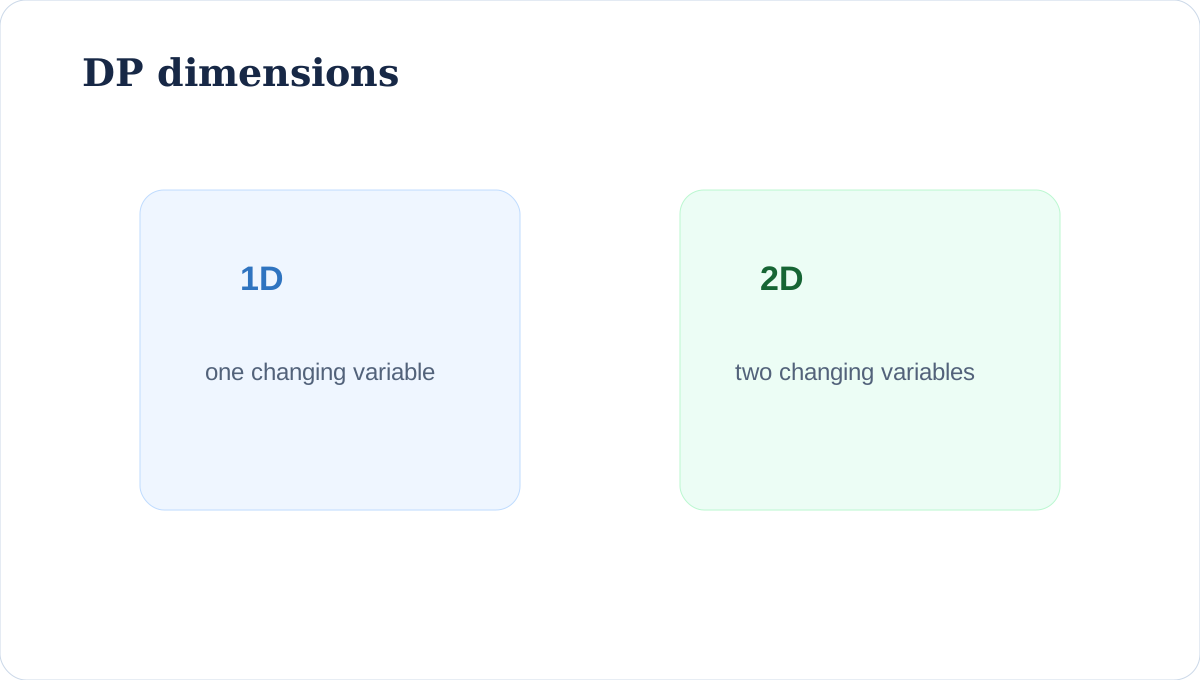
The dimension of DP is not about difficulty. It is about how many pieces of information must change to describe a subproblem.
Choosing Dimensions
A 1D state usually answers a prefix or position question. A 2D state usually tracks two positions, a grid coordinate, or one position plus a remaining constraint.
Scenario: Checkout Path Risk
A commerce team models a checkout flow as a grid of decisions and risk scores. The lowest-risk path to each cell depends on the cell above and left. That is 2D DP because row and column both define the subproblem.
| Pattern | State | Examples |
|---|---|---|
| 1D sequence | dp[i] | climb stairs, house robber, min cost climbing |
| 2D grid | dp[r][c] | unique paths, min path sum |
| Two strings | dp[i][j] | LCS, edit distance |
| Index + constraint | dp[i][budget] | knapsack, target sum variants |
Same Pattern in Java, Python, and JavaScript
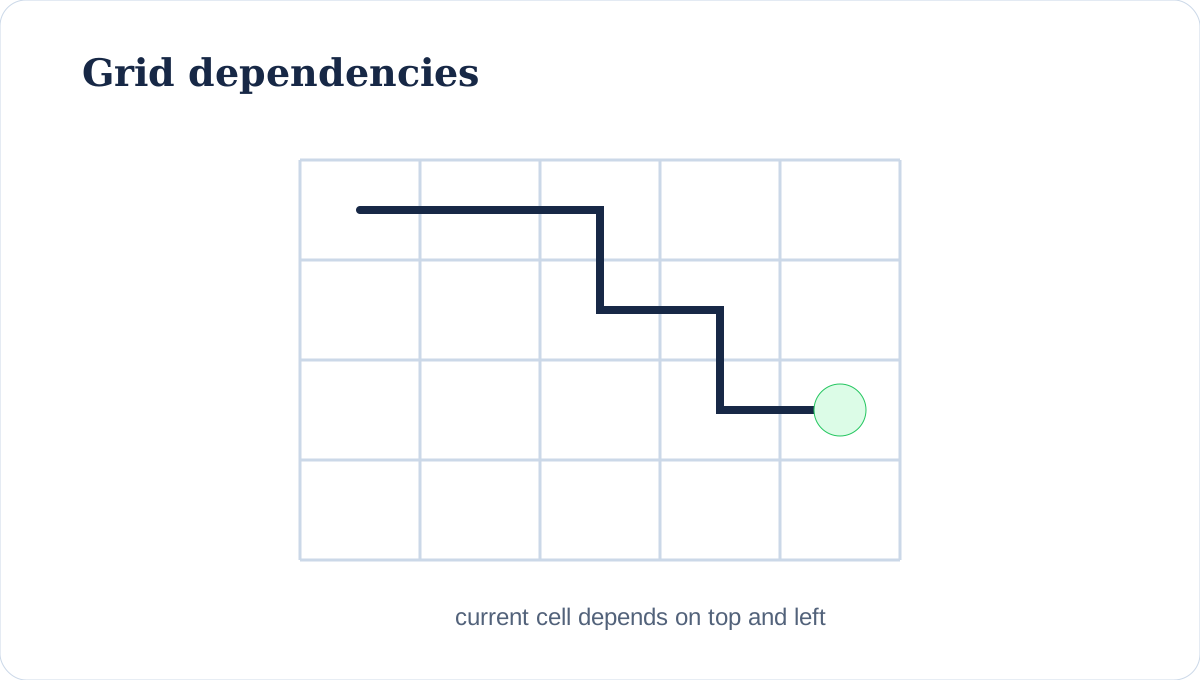
Minimum path sum is a clean 2D DP: each cell depends on the cheaper of top or left.
class MinPathSum {
    static int minPathSum(int[][] grid) {
        int rows = grid.length, cols = grid[0].length;
        int[][] dp = new int[rows][cols];
        for (int r = 0; r < rows; r++) {
            for (int c = 0; c < cols; c++) {
                if (r == 0 && c == 0) dp[r][c] = grid[r][c];
                else {
                    int up = r > 0 ? dp[r - 1][c] : Integer.MAX_VALUE / 2;
                    int left = c > 0 ? dp[r][c - 1] : Integer.MAX_VALUE / 2;
                    dp[r][c] = grid[r][c] + Math.min(up, left);
                }
            }
        }
        return dp[rows - 1][cols - 1];
    }
}
Assessment trap
Do not optimize a 2D table to 1D until you can prove which previous values are still needed.
Interview signalFrequently Asked Interview Questions
These are canonical interview patterns for this topic, phrased as concrete problem statements. They avoid vague theory questions and prepare you for the exact reasoning interviewers expect: invariant, edge cases, complexity, and trade-off.
- Return the minimum path sum from top-left to bottom-right moving only down or right.
- Return max money without robbing adjacent houses.
- Return the length of the longest subsequence shared by two strings.
Production practiceCompany-Style Practice Examples
These are not claimed as exact company-specific questions. They are the interview patterns repeatedly used by product companies to test whether you can move from brute force to a defensible implementation.
| Example | Brute-force approach | Stronger solution | Production notes |
|---|---|---|---|
| Checkout risk grid | Run path search repeatedly for every cell. | Fill dp[row][col] from top and left. | Table order follows movement constraints. |
| Sequence scoring | Use nested brute force for every prefix. | Use dp[i] if one index summarizes the prefix. | State dimension should match changing variables. |
| Text comparison | Compare all subsequences directly. | Use dp[i][j] for two-string prefix comparison. | Subsequence problems often need two coordinates. |
Solved modelInterview Question Solutions
Question 1: Minimum Path Sum
Return the minimum path sum from top-left to bottom-right moving only down or right. Use 2D grid DP where each cell depends on top and left.
class MinPathSum {
    static int minPathSum(int[][] grid) {
        int rows = grid.length, cols = grid[0].length;
        int[][] dp = new int[rows][cols];
        for (int r = 0; r < rows; r++) {
            for (int c = 0; c < cols; c++) {
                if (r == 0 && c == 0) dp[r][c] = grid[r][c];
                else {
                    int up = r > 0 ? dp[r - 1][c] : Integer.MAX_VALUE / 2;
                    int left = c > 0 ? dp[r][c - 1] : Integer.MAX_VALUE / 2;
                    dp[r][c] = grid[r][c] + Math.min(up, left);
                }
            }
        }
        return dp[rows - 1][cols - 1];
    }
}
Question 2: House Robber
Return max money without robbing adjacent houses. 1D DP with recurrence max(skip current, rob current plus best two back).
class HouseRobber {
    static int rob(int[] nums) {
        int twoBack = 0, oneBack = 0;
        for (int value : nums) {
            int current = Math.max(oneBack, twoBack + value);
            twoBack = oneBack;
            oneBack = current;
        }
        return oneBack;
    }
}
Question 3: Longest Common Subsequence
Return the length of the longest subsequence shared by two strings. Use dp[i][j] for prefixes. If chars match, extend diagonal; otherwise take best of dropping one char.
class LCS { static int lcs(String a,String b){ int[][] dp=new int[a.length()+1][b.length()+1]; for(int i=1;i<=a.length();i++) for(int j=1;j<=b.length();j++) dp[i][j]=a.charAt(i-1)==b.charAt(j-1)?1+dp[i-1][j-1]:Math.max(dp[i-1][j],dp[i][j-1]); return dp[a.length()][b.length()]; } }Solved modelWorked Interview Answer
Compute minimum path sum in a grid using 2D DP. Each cell depends only on the cheapest cost from top or left, so row-major fill order makes dependencies available.
class MinPathSum {
    static int minPathSum(int[][] grid) {
        int rows = grid.length, cols = grid[0].length;
        int[][] dp = new int[rows][cols];
        for (int r = 0; r < rows; r++) {
            for (int c = 0; c < cols; c++) {
                if (r == 0 && c == 0) dp[r][c] = grid[r][c];
                else {
                    int up = r > 0 ? dp[r - 1][c] : Integer.MAX_VALUE / 2;
                    int left = c > 0 ? dp[r][c - 1] : Integer.MAX_VALUE / 2;
                    dp[r][c] = grid[r][c] + Math.min(up, left);
                }
            }
        }
        return dp[rows - 1][cols - 1];
    }
}
Hands-on drillTry It Yourself
Practice task
For a 3x3 grid, fill min path sum by hand. Mark which previous cells each answer depends on.
Failure patternsCommon Mistakes to Avoid
- Wrong fill order.
- Mixing row and column boundaries.
- Optimizing space before proving dependencies.
- Forgetting first row/column base cases.
- Confusing subsequence with substring.
Execution guardrailQuick-Start Checklist
- Identify changing variables.
- Choose 1D or 2D state.
- Initialize boundaries.
- Fill in dependency-safe order.
- State table size.
- Optimize only after correctness.
Recall drillKnowledge Check
| Question | Strong answer |
|---|---|
| When is DP 2D? | Two changing variables are needed. |
| What does fill order protect? | Dependencies are computed before they are read. |
| What is rolling array optimization? | Keeping only needed previous row/state. |
VocabularyKey Terms
| Term | Meaning |
|---|---|
| 1D DP | State with one changing coordinate. |
| 2D DP | State with two changing coordinates. |
| Grid DP | DP over row and column. |
| LCS | Longest common subsequence. |
Next practiceFurther Reading
- Practice min path sum, unique paths, LCS, and edit distance.
- Review table visualization.
- Compare substring and subsequence DP.