DP State Design
Define state, transition, base cases, answer extraction, and iteration order before writing code.
What you will be able to do
Most DP failures are state-design failures. Before code, write one sentence: dp[state] means exactly this. If that sentence is vague, the implementation will be fragile.
State, Transition, Answer
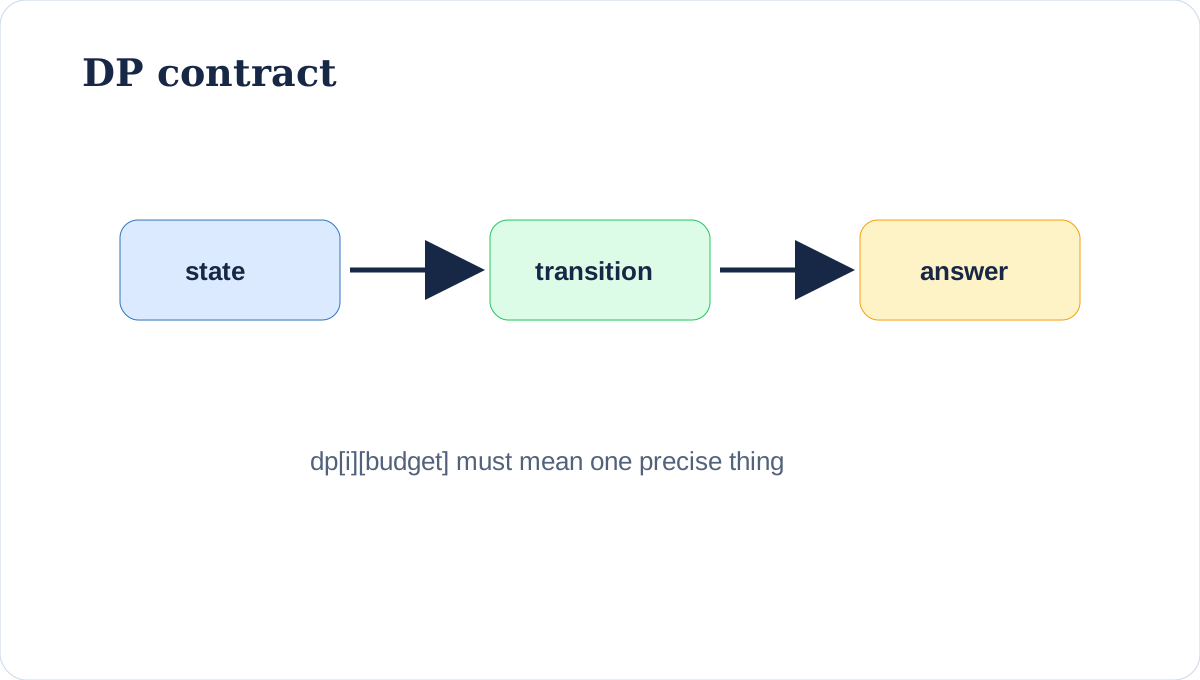
State captures the subproblem. Transition describes how smaller answers combine. Base cases stop the recurrence. Answer extraction says which state or aggregate gives the final product answer.
Scenario: Campaign Budget Allocation
A growth team chooses campaigns under a budget. Each campaign has cost and expected value. The state can be (campaignIndex, remainingBudget). The transition chooses skip or take. The base case is no campaigns or no budget.
| Design part | Campaign example | Why it matters |
|---|---|---|
| State | dp[i][budget] | Best value using first i campaigns. |
| Transition | skip or take campaign i | Models the decision. |
| Base | 0 campaigns or 0 budget | No value can be added. |
| Answer | dp[n][budget] | All campaigns considered. |
Same Pattern in Java, Python, and JavaScript
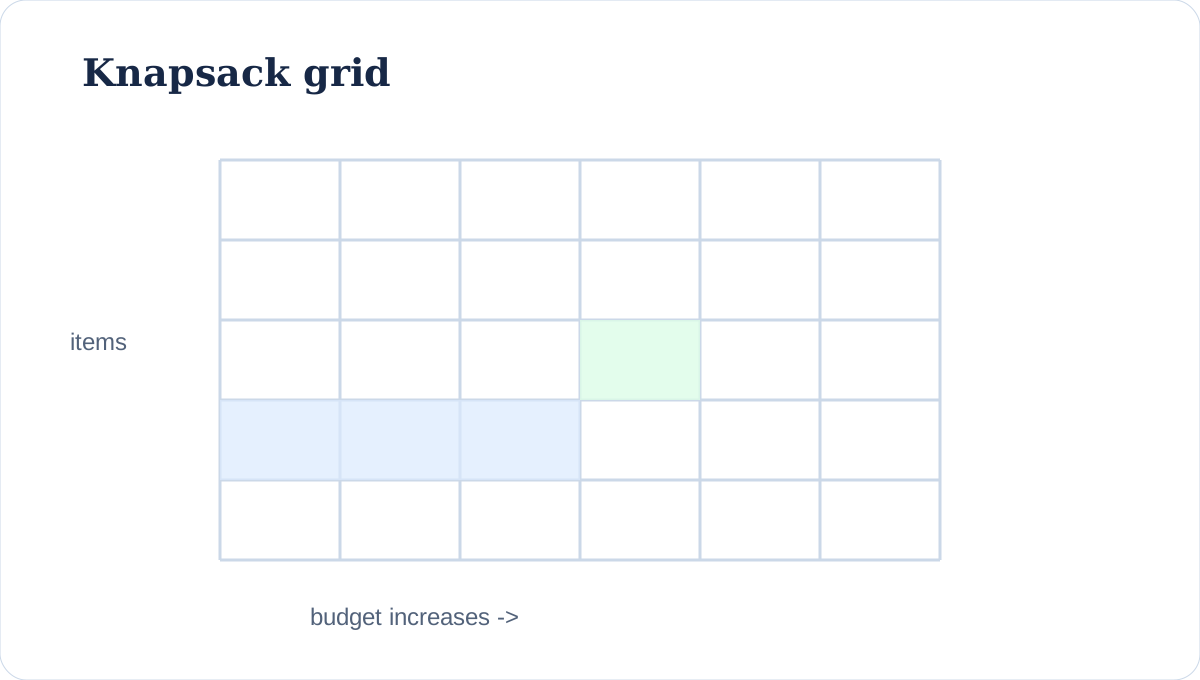
0/1 knapsack is the classic state-design exercise: each item is either skipped or taken once.
class Knapsack {
    static int bestValue(int[] cost, int[] value, int budget) {
        int n = cost.length;
        int[][] dp = new int[n + 1][budget + 1];
        for (int i = 1; i <= n; i++) {
            for (int b = 0; b <= budget; b++) {
                dp[i][b] = dp[i - 1][b];
                if (cost[i - 1] <= b) {
                    dp[i][b] = Math.max(dp[i][b], dp[i - 1][b - cost[i - 1]] + value[i - 1]);
                }
            }
        }
        return dp[n][budget];
    }
}
Assessment trap
If you cannot explain what dp[i][j] means in one precise sentence, the state is not ready.
Interview signalFrequently Asked Interview Questions
These are canonical interview patterns for this topic, phrased as concrete problem statements. They avoid vague theory questions and prepare you for the exact reasoning interviewers expect: invariant, edge cases, complexity, and trade-off.
- Maximize value under budget where each item can be used at most once.
- Return whether nums can be split into two subsets with equal sum.
- Count ways to assign + or - signs to reach target.
Production practiceCompany-Style Practice Examples
These are not claimed as exact company-specific questions. They are the interview patterns repeatedly used by product companies to test whether you can move from brute force to a defensible implementation.
| Example | Brute-force approach | Stronger solution | Production notes |
|---|---|---|---|
| Budget allocation | Greedily choose highest value campaign. | Use dp[item][budget] to compare take/skip decisions. | Greedy can fail when costs block better combinations. |
| Feature rollout constraints | Track only current feature index. | Include remaining capacity/risk budget in state. | Missing constraints create invalid recommendations. |
| Inventory packaging | Return any combination that fits. | Define objective and state before recurrence. | DP needs precise answer semantics. |
Solved modelInterview Question Solutions
Question 1: 0/1 Knapsack
Maximize value under budget where each item can be used at most once. State is item prefix plus budget. Transition compares skip versus take.
class Knapsack {
    static int bestValue(int[] cost, int[] value, int budget) {
        int n = cost.length;
        int[][] dp = new int[n + 1][budget + 1];
        for (int i = 1; i <= n; i++) {
            for (int b = 0; b <= budget; b++) {
                dp[i][b] = dp[i - 1][b];
                if (cost[i - 1] <= b) {
                    dp[i][b] = Math.max(dp[i][b], dp[i - 1][b - cost[i - 1]] + value[i - 1]);
                }
            }
        }
        return dp[n][budget];
    }
}
Question 2: Partition Equal Subset Sum
Return whether nums can be split into two subsets with equal sum. Target is total/2. Use subset-sum DP to decide if target is reachable.
class Partition { static boolean can(int[] nums) { int sum=0; for(int x:nums) sum+=x; if(sum%2==1) return false; int target=sum/2; boolean[] dp=new boolean[target+1]; dp[0]=true; for(int x:nums) for(int s=target;s>=x;s--) dp[s]|=dp[s-x]; return dp[target]; } }Question 3: Target Sum
Count ways to assign + or - signs to reach target. State is index and current sum, or transform to subset sum when constraints allow.
import java.util.*;
class TargetSum { static int ways(int[] nums,int target){ return dfs(nums,0,0,target,new HashMap<>()); } static int dfs(int[] a,int i,int sum,int t,Map<String,Integer> memo){ if(i==a.length) return sum==t?1:0; String k=i+":"+sum; if(memo.containsKey(k)) return memo.get(k); int ans=dfs(a,i+1,sum+a[i],t,memo)+dfs(a,i+1,sum-a[i],t,memo); memo.put(k,ans); return ans; } }
Solved modelWorked Interview Answer
Solve 0/1 knapsack by defining dp[i][budget]. The state uses item prefix and remaining budget. The transition compares skipping the item with taking it once if budget allows.
class Knapsack {
    static int bestValue(int[] cost, int[] value, int budget) {
        int n = cost.length;
        int[][] dp = new int[n + 1][budget + 1];
        for (int i = 1; i <= n; i++) {
            for (int b = 0; b <= budget; b++) {
                dp[i][b] = dp[i - 1][b];
                if (cost[i - 1] <= b) {
                    dp[i][b] = Math.max(dp[i][b], dp[i - 1][b - cost[i - 1]] + value[i - 1]);
                }
            }
        }
        return dp[n][budget];
    }
}
Hands-on drillTry It Yourself
Practice task
For 0/1 knapsack with three items, write the exact meaning of dp[i][b], then fill the first two rows by hand.
Failure patternsCommon Mistakes to Avoid
- Using too much history in state.
- Using too little state and losing constraints.
- Wrong base cases.
- Reading current row when previous row is required.
- Returning the wrong cell.
Execution guardrailQuick-Start Checklist
- Write dp meaning.
- List state dimensions.
- Write transition.
- Set base cases.
- Choose fill order.
- Extract answer.
- State O(states * transition).
Recall drillKnowledge Check
| Question | Strong answer |
|---|---|
| What does dp[i][b] mean? | Best answer using a prefix of items under budget b. |
| Why include budget in state? | Remaining capacity changes future choices. |
| What is answer extraction? | Choosing the state that represents the original problem. |
VocabularyKey Terms
| Term | Meaning |
|---|---|
| State dimension | One changing coordinate in the subproblem. |
| Transition | How a state is computed. |
| Invalid state | A state that violates constraints. |
| Answer extraction | Where final result lives. |
Next practiceFurther Reading
- Practice knapsack, subset sum, and target sum.
- Write state definitions before code.
- Study state compression after 2D correctness.