Vertical vs Horizontal Scaling
Learn when to make one machine bigger, when to add more machines, and what scaling changes about state, cost, reliability, and operations.
What you will be able to do
Scaling means increasing a system's ability to handle load. The professional question is not how do we scale everything, but what exactly is saturated and what is the simplest safe way to relieve it.
Two Ways to Scale
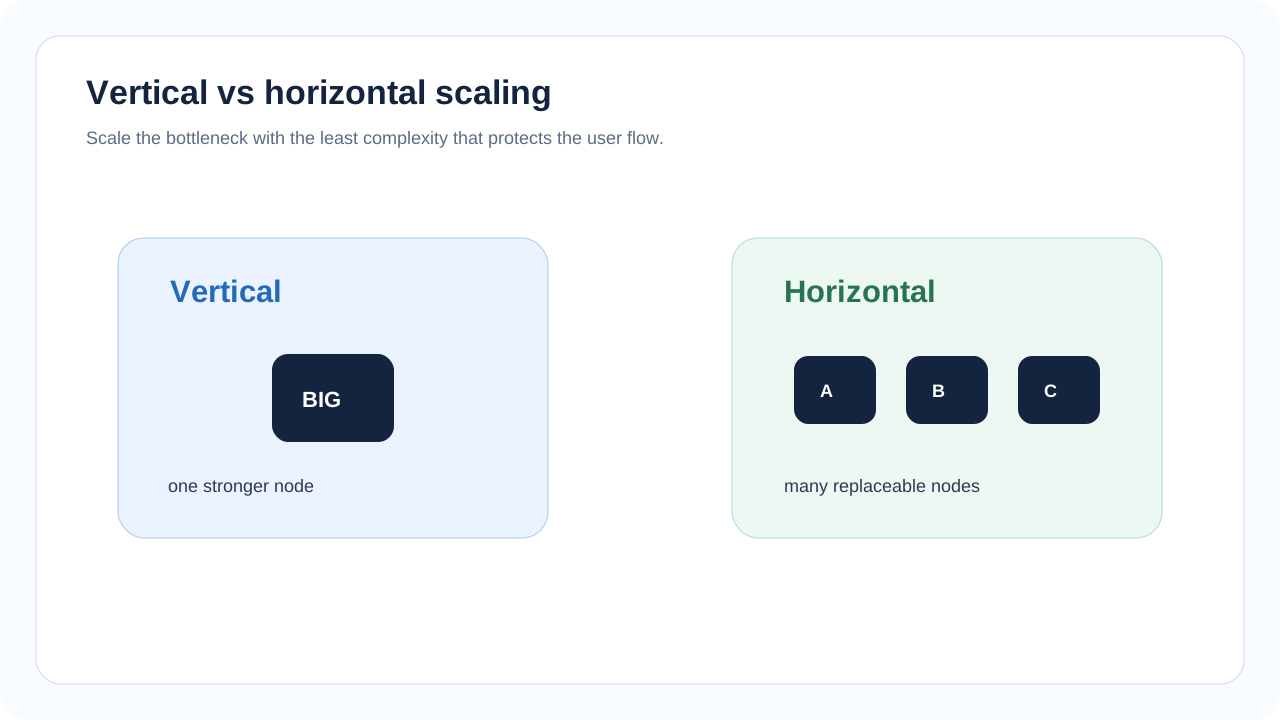
Vertical scaling makes one machine bigger. Horizontal scaling adds more machines or instances. Vertical scaling is often simpler; horizontal scaling usually gives better availability and growth headroom but requires better architecture discipline.
| Approach | How it works | Use when | Risk |
|---|---|---|---|
| Vertical scaling | More CPU, memory, disk, or network on one node | Early stage, simple bottleneck, database needs quick relief | Hard limit, bigger failure blast radius, cost jumps. |
| Horizontal scaling | Add more instances behind routing/load balancing | Stateless services, read-heavy traffic, high availability | Requires load balancing, deployment automation, shared state design. |
| Specialized scaling | Scale a bottleneck layer only | Database, cache, workers, CDN, queue, search layer is saturated | Wrong bottleneck diagnosis wastes money. |
Scenario: Ticket Launch
A ticketing site launches concert tickets at 10 AM. Traffic jumps from 100 requests/sec to 20,000 requests/sec. Scaling the web server alone will not save the system if inventory locking, payment calls, or database writes are the actual bottleneck.
| Pressure | Symptom | Scaling response |
|---|---|---|
| CPU on API servers | High CPU, low dependency latency | Add API instances or bigger instances. |
| Database writes | Slow commits and lock waits | Reduce write contention, queue non-critical work, partition carefully. |
| Hot product page reads | Same page read repeatedly | Cache page/data and use CDN. |
| Payment provider latency | Threads blocked waiting outside system | Timeouts, bulkheads, async confirmation where product allows. |
| Traffic spike fairness | Some clients overwhelm others | Rate limiting, waiting room, queueing, backpressure. |
Autoscaling Is Not Magic
Autoscaling reacts to signals such as CPU, memory, request count, queue depth, or custom metrics. It still needs safe deployments, warm-up time, capacity limits, and bottleneck-aware metrics.
| Signal | Good for | Caution |
|---|---|---|
| CPU | CPU-bound services | May miss database or network bottlenecks. |
| Request count | Web/API scaling | Not all requests cost the same. |
| Queue depth | Worker scaling | Needs max concurrency and DLQ monitoring. |
| Memory | Memory-heavy services | Memory leaks can cause runaway scaling. |
| Latency | User experience pressure | Scaling may not fix slow dependency. |
Design principle
Scale the bottleneck, not the diagram. Measure saturation, identify the constrained resource, then choose the least complex scaling move that protects the user flow.
Cloud Scaling Mapping
| Need | AWS | GCP | Azure |
|---|---|---|---|
| VM autoscaling | EC2 Auto Scaling | Managed Instance Groups | Virtual Machine Scale Sets |
| Container autoscaling | ECS Service Auto Scaling/EKS HPA | Cloud Run autoscaling/GKE HPA | Container Apps scaling/AKS HPA |
| Serverless scaling | Lambda concurrency | Cloud Functions/Cloud Run concurrency | Azure Functions scale controller |
| Database scaling | RDS/Aurora read replicas, DynamoDB capacity | Cloud SQL replicas, Spanner, Firestore | Azure SQL replicas, Cosmos DB RU/s |
| Queue-based worker scaling | SQS depth + ECS/Lambda | Pub/Sub/Cloud Tasks + Cloud Run | Service Bus + Functions/Container Apps |
Beginner Mistakes
- Scaling every service instead of finding the bottleneck.
- Adding more API servers when the database is saturated.
- Assuming autoscaling is instant.
- Ignoring connection pools and dependency limits.
- Scaling horizontally while keeping session state inside one server.
Guided Practice
Practice task
A course platform becomes slow during assessment submission. Name five possible bottlenecks and one metric that would confirm each.
Sample Answer
| Possible bottleneck | Confirming metric |
|---|---|
| API CPU | High CPU and request queueing on API instances. |
| Database writes | High write latency, lock wait, or connection saturation. |
| Scoring worker | Growing queue depth and oldest message age. |
| External plagiarism provider | High dependency latency and timeout rate. |
| Cache/session store | High Redis latency or connection count. |
Before You Continue
- You should know vertical vs horizontal scaling.
- You should identify bottlenecks before scaling.
- You should understand autoscaling signals and limits.
- You are ready to learn how load balancers distribute traffic across scaled services.