Segment Tree and Range Queries
Answer repeated range queries and point updates without recomputing whole ranges.
What you will be able to do
Prefix sums are excellent when data is static. Segment trees exist when the data changes and range answers must stay fast.
Ranges as a Tree
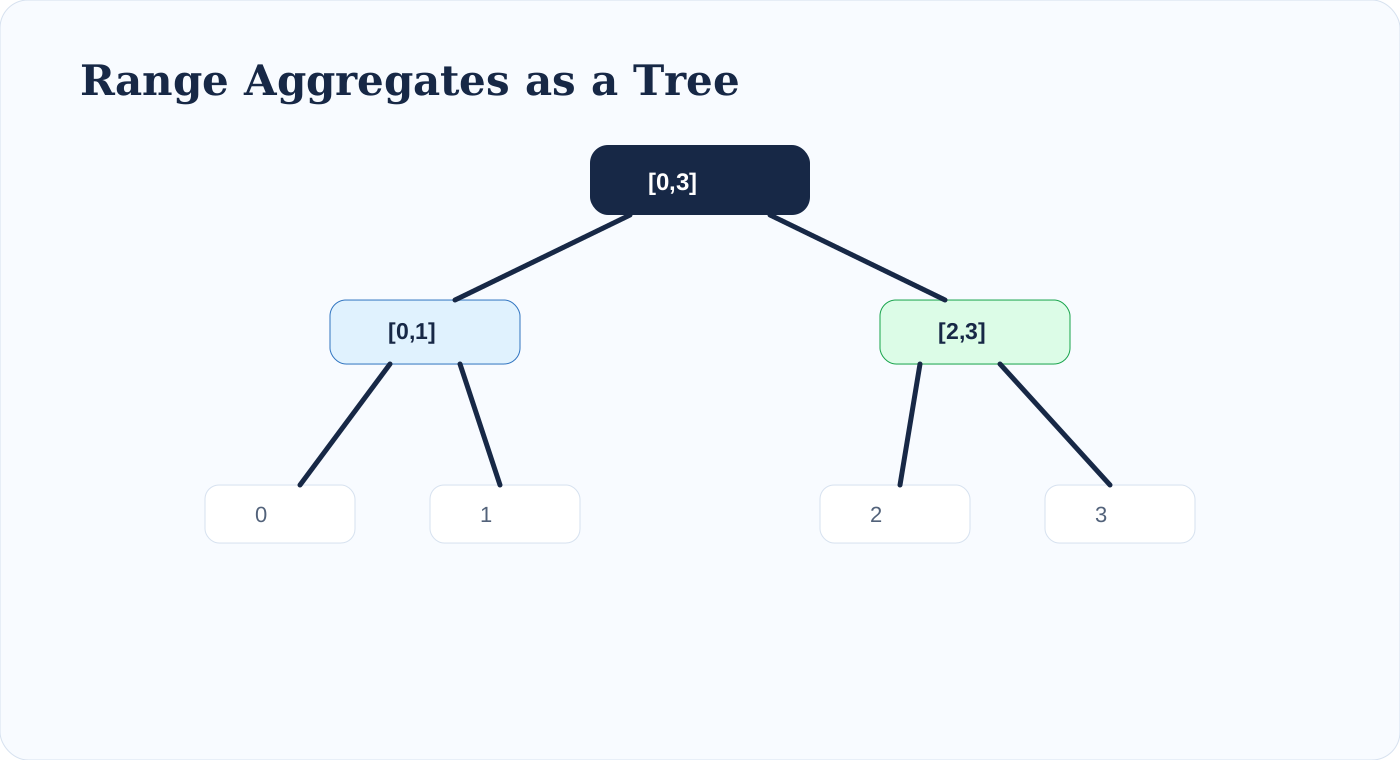
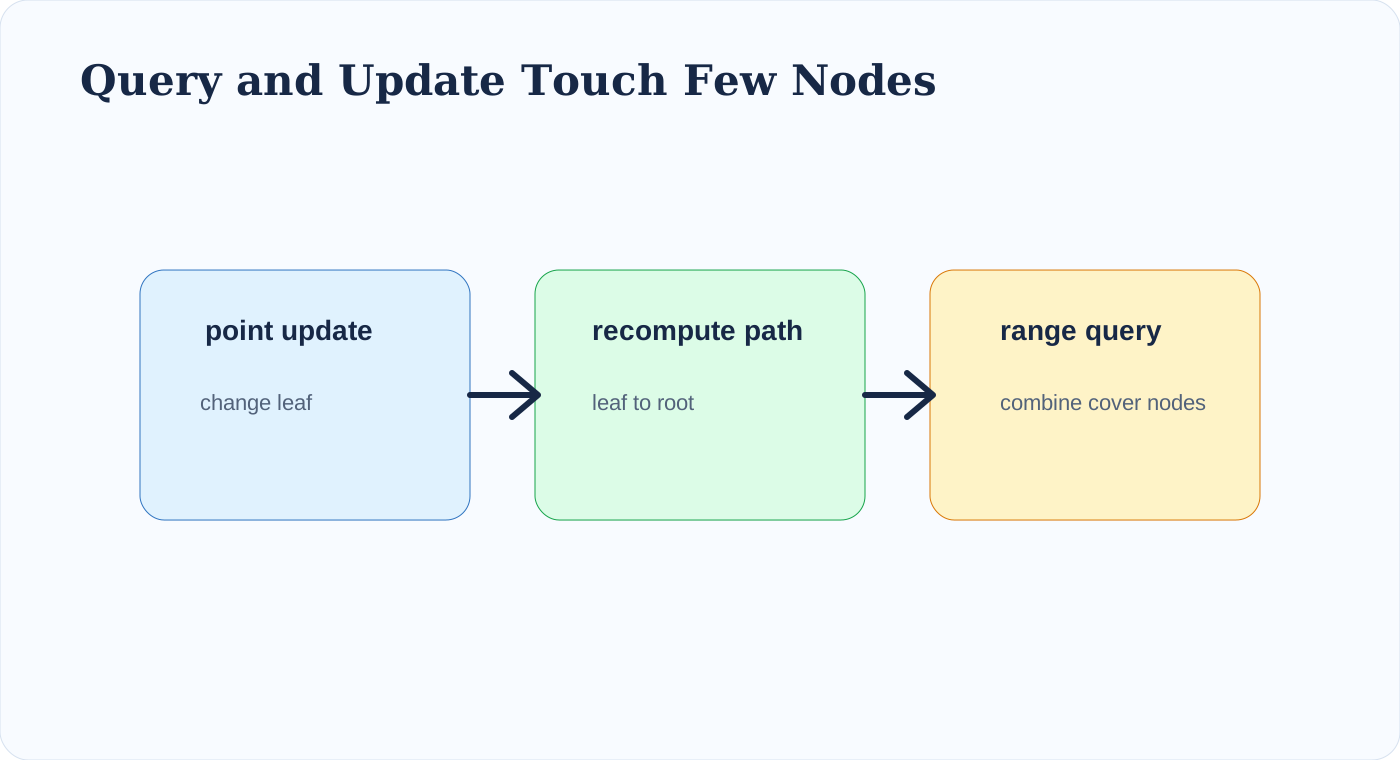
A segment tree stores an aggregate for a range at each node. Query combines only the nodes that exactly cover the requested range. Update changes one leaf and recomputes ancestors.
Scenario: Metrics Dashboard
A usage dashboard must show revenue between arbitrary dates while corrections arrive throughout the day. Recomputing every requested date range is too slow; static prefix sums become stale after updates. A segment tree supports both.
| Structure | Range query | Update | Best fit |
|---|---|---|---|
| Raw array | O(n) | O(1) | Rare queries. |
| Prefix sum | O(1) | O(n) | Static data. |
| Segment tree | O(log n) | O(log n) | Frequent queries and updates. |
| Fenwick tree | O(log n) | O(log n) | Prefix-friendly sums. |
Same Pattern in Java, Python, and JavaScript
Range sum query with point update is the baseline segment tree implementation.
class NumArray {
    private final int n;
    private final int[] tree;
    NumArray(int[] nums) { n = nums.length; tree = new int[2 * n]; for (int i = 0; i < n; i++) tree[n + i] = nums[i]; for (int i = n - 1; i > 0; i--) tree[i] = tree[i * 2] + tree[i * 2 + 1]; }
    void update(int index, int value) { int i = index + n; tree[i] = value; for (i /= 2; i > 0; i /= 2) tree[i] = tree[i * 2] + tree[i * 2 + 1]; }
    int sumRange(int left, int right) { int sum = 0; for (int l = left + n, r = right + n; l <= r; l /= 2, r /= 2) { if ((l & 1) == 1) sum += tree[l++]; if ((r & 1) == 0) sum += tree[r--]; } return sum; }
}
Assessment trap
Do not use a segment tree when the data is static and prefix sums answer the product need more simply.
Interview signalFrequently Asked Interview Questions
These are canonical interview patterns for this topic, phrased as concrete problem statements. They avoid vague theory questions and prepare you for the exact reasoning interviewers expect: invariant, edge cases, complexity, and trade-off.
- Support sumRange and update on an integer array.
- For each number, count smaller numbers to its right.
- Build a structure to return minimum value in a range with point updates.
Production practiceCompany-Style Practice Examples
These are not claimed as exact company-specific questions. They are the interview patterns repeatedly used by product companies to test whether you can move from brute force to a defensible implementation.
| Example | Brute-force approach | Stronger solution | Production notes |
|---|---|---|---|
| Revenue dashboard | Sum every row for each date range. | Segment tree supports range query and correction updates. | Prefix sums may be simpler if data is immutable. |
| Inventory correction | Recompute warehouse totals after every correction. | Point update plus range aggregate avoids full recompute. | Validate inclusive range semantics. |
| SLA heatmap | Materialize every possible range. | Store aggregates by segment and combine cover nodes. | Memory and implementation complexity must be justified. |
Solved modelInterview Question Solutions
Question 1: Range Sum Query Mutable
Support sumRange and update on an integer array. Segment tree stores range sums, so both point update and range query touch O(log n) tree nodes.
class NumArray {
    private final int n;
    private final int[] tree;
    NumArray(int[] nums) { n = nums.length; tree = new int[2 * n]; for (int i = 0; i < n; i++) tree[n + i] = nums[i]; for (int i = n - 1; i > 0; i--) tree[i] = tree[i * 2] + tree[i * 2 + 1]; }
    void update(int index, int value) { int i = index + n; tree[i] = value; for (i /= 2; i > 0; i /= 2) tree[i] = tree[i * 2] + tree[i * 2 + 1]; }
    int sumRange(int left, int right) { int sum = 0; for (int l = left + n, r = right + n; l <= r; l /= 2, r /= 2) { if ((l & 1) == 1) sum += tree[l++]; if ((r & 1) == 0) sum += tree[r--]; } return sum; }
}
Question 2: Count of Smaller Numbers After Self
For each number, count smaller numbers to its right. Coordinate-compress values, scan from right, query count below current rank, then update current rank.
import java.util.*;
class CountSmaller { int[] bit; List<Integer> countSmaller(int[] nums) { int[] sorted = nums.clone(); Arrays.sort(sorted); bit = new int[sorted.length + 2]; LinkedList<Integer> ans = new LinkedList<>(); for (int i = nums.length - 1; i >= 0; i--) { int rank = Arrays.binarySearch(sorted, nums[i]) + 1; ans.addFirst(sum(rank - 1)); add(rank, 1); } return ans; } void add(int i,int v){ for(;i<bit.length;i+=i&-i) bit[i]+=v; } int sum(int i){ int s=0; for(;i>0;i-=i&-i) s+=bit[i]; return s; } }
Question 3: Range Minimum Query
Build a structure to return minimum value in a range with point updates. Use the same segment tree shape but change the aggregate from sum to min and identity to infinity.
class RangeMin { int n; int[] tree; RangeMin(int[] a){ n=a.length; tree=new int[2*n]; java.util.Arrays.fill(tree,Integer.MAX_VALUE); for(int i=0;i<n;i++) tree[n+i]=a[i]; for(int i=n-1;i>0;i--) tree[i]=Math.min(tree[2*i],tree[2*i+1]); } int min(int l,int r){ int ans=Integer.MAX_VALUE; for(l+=n,r+=n;l<=r;l/=2,r/=2){ if((l&1)==1) ans=Math.min(ans,tree[l++]); if((r&1)==0) ans=Math.min(ans,tree[r--]); } return ans; } }Solved modelWorked Interview Answer
Implement mutable range sum query with point updates. The segment tree stores range aggregates. Point updates rewrite one leaf and recompute ancestors; range queries combine logarithmic cover nodes.
class NumArray {
    private final int n;
    private final int[] tree;
    NumArray(int[] nums) { n = nums.length; tree = new int[2 * n]; for (int i = 0; i < n; i++) tree[n + i] = nums[i]; for (int i = n - 1; i > 0; i--) tree[i] = tree[i * 2] + tree[i * 2 + 1]; }
    void update(int index, int value) { int i = index + n; tree[i] = value; for (i /= 2; i > 0; i /= 2) tree[i] = tree[i * 2] + tree[i * 2 + 1]; }
    int sumRange(int left, int right) { int sum = 0; for (int l = left + n, r = right + n; l <= r; l /= 2, r /= 2) { if ((l & 1) == 1) sum += tree[l++]; if ((r & 1) == 0) sum += tree[r--]; } return sum; }
}
Hands-on drillTry It Yourself
Practice task
Build a segment tree for [2,4,5,7]. Query sum [1,3], then update index 2 to 10 and recompute affected nodes.
Failure patternsCommon Mistakes to Avoid
- Using prefix sums when frequent updates exist.
- Using segment tree when data is static and prefix sums are enough.
- Off-by-one errors in inclusive ranges.
- Forgetting to update ancestors.
- Not naming aggregate function constraints.
Execution guardrailQuick-Start Checklist
- Identify query type.
- Check update frequency.
- Define inclusive/exclusive range.
- Build tree.
- Query cover nodes.
- Update leaf and ancestors.
- State O(log n).
Recall drillKnowledge Check
| Question | Strong answer |
|---|---|
| When use prefix sums? | Static range sums or rare updates. |
| When use segment tree? | Repeated range queries with updates. |
| What does an internal node store? | Aggregate answer for its covered range. |
VocabularyKey Terms
| Term | Meaning |
|---|---|
| Range query | Question over a contiguous interval. |
| Point update | Change one index. |
| Aggregate | Value such as sum/min/max stored for a range. |
| Cover node | Tree node fully inside query range. |
Next practiceFurther Reading
- Practice range sum query mutable, range minimum query, and lazy propagation later.
- Compare Fenwick tree for prefix sums.
- Review interval boundaries carefully.