
Linked List Trade-offs
Know when linked lists help, when arrays are better, and how to justify the choice using access pattern, locality, memory, and mutation constraints.
What you will be able to do
Linked lists are important because they teach reference reasoning, not because they should replace arrays everywhere. In production, arrays often win through simplicity, cache locality, and compact memory. Linked lists win when local rewiring of known nodes is the dominant operation.
Arrays Versus Linked Lists
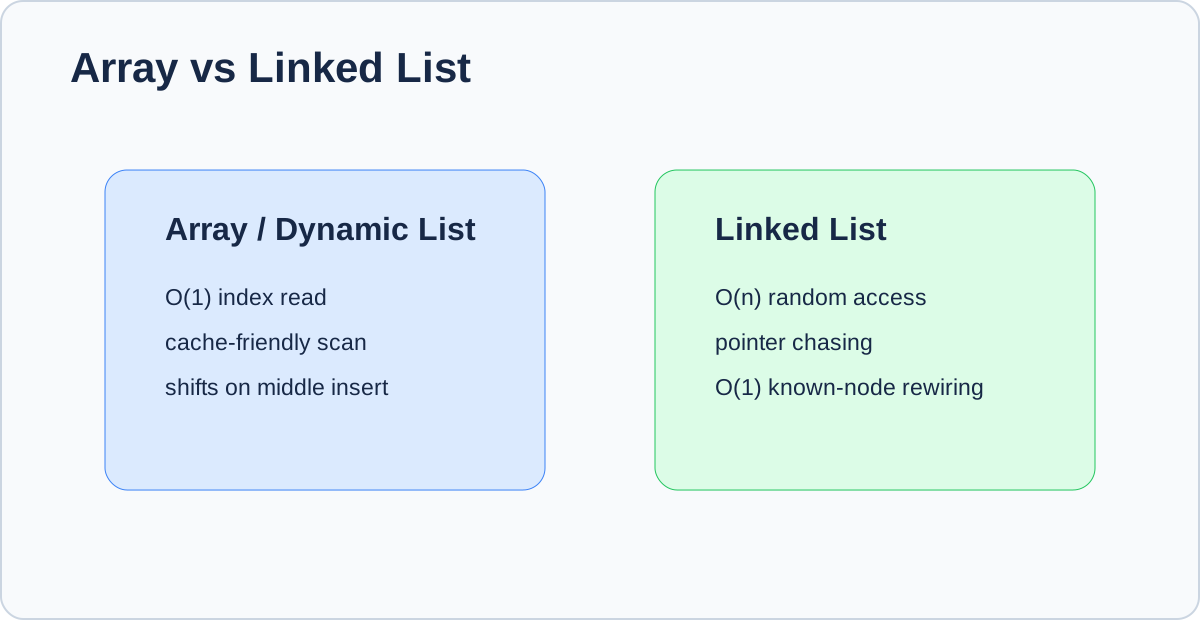
A professional answer never says one structure is universally better. It starts with the dominant operations and constraints.
| Need | Array/List | Linked list |
|---|---|---|
| Read by index | O(1) | O(n) traversal |
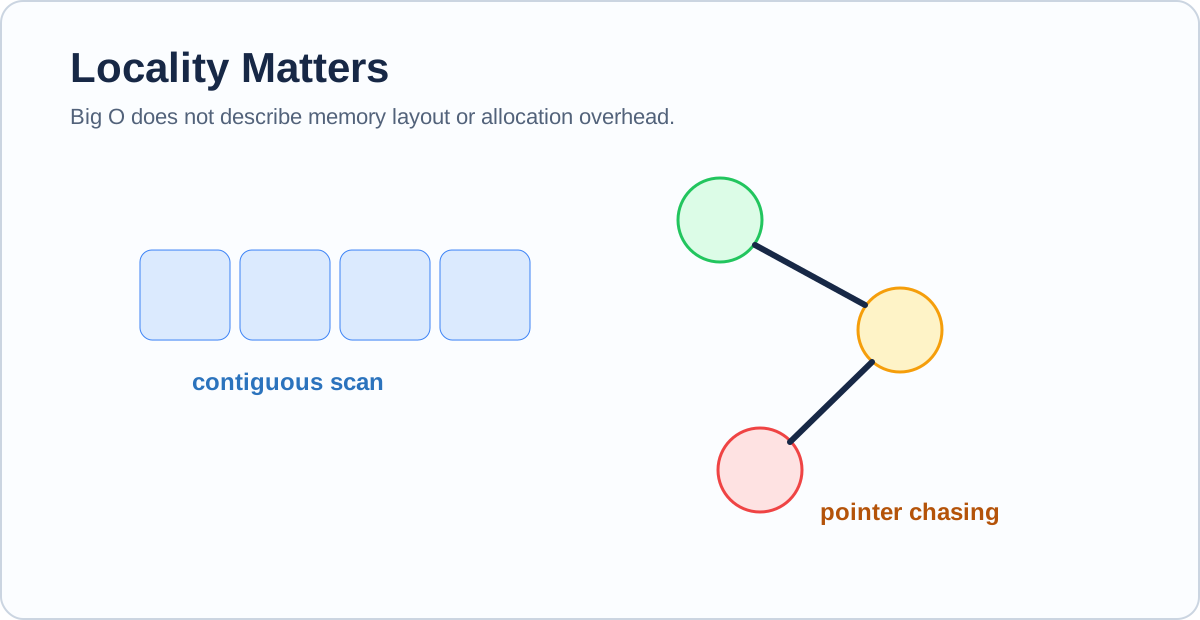
| Scan all items | Simple and cache-friendly | Pointer chasing can be slower |
| Insert after known node | May shift suffix | O(1) rewiring |
| Delete known node with previous pointer | May shift suffix | O(1) rewiring |
| Memory overhead | Compact | Extra references per node |
| Hybrid cache order | Awkward local moves | Useful with hash map lookup |
Scenario: Feed Pagination
A product feed renders pages of posts, supports direct jumps, and commonly scans visible ranges. An array or database index is usually a better fit than a linked list. A linked list would make jumping to item 500 expensive and add pointer overhead without solving the real product problem.
Same Pattern in Java, Python, and JavaScript
A common hybrid design is an LRU cache: map for lookup, linked order for recency. This pseudocode-level implementation sketch shows the structure shape.
import java.util.*;

class LruShape<K, V> {
    static class Node<K, V> { K key; V value; Node<K, V> prev, next; }
    private final Map<K, Node<K, V>> byKey = new HashMap<>();
    private Node<K, V> head;
    private Node<K, V> tail;

    // get(key): map lookup, then move the known node to the front.
    // put(key,value): update existing node or insert a new front node.
    // evict: remove tail and delete tail.key from the map.
}
Engineering Decision Standard
Use linked lists when node references are already available, local insertion/deletion dominates, and pointer overhead is acceptable. Use arrays when indexed access, iteration, compact memory, and simple ownership matter more.
Assessment trap
If your answer praises linked lists for insertion but ignores lookup, cache locality, and pointer overhead, it is not production-grade.
Interview signalFrequently Asked Interview Questions
These are canonical interview patterns for this topic, phrased as concrete problem statements. They avoid vague theory questions and prepare you for the exact reasoning interviewers expect: invariant, edge cases, complexity, and trade-off.
- Design the core structures for an LRU cache.
- A feed needs pagination, direct jumps, and range rendering. Choose array/list or linked list.
- A teammate says linked-list insertion is O(1), so replace arrays everywhere. Respond precisely.
Production practiceCompany-Style Practice Examples
These are not claimed as exact company-specific questions. They are the interview patterns repeatedly used by product companies to test whether you can move from brute force to a defensible implementation.
| Example | Brute-force approach | Stronger solution | Production notes |
|---|---|---|---|
| Product feed | Use linked list because insertion sounds cheap. | Use array/indexed storage for pagination and scanning. | Locality and indexed reads dominate. |
| LRU cache | Use array and shift on every access. | Use map plus doubly linked list. | Known-node movement is the linked-list win. |
| Undo history | Use linked list by default. | Stack/list is often simpler unless arbitrary local rewiring is required. | Choose the simplest structure that matches operations. |
Solved modelInterview Question Solutions
Question 1: LRU Cache Shape
Design the core structures for an LRU cache. Map keys to doubly linked nodes. Move known nodes to the head on access and evict from tail.
import java.util.*;

class LruCache<K, V> {
    static class Node<K, V> { K key; V value; Node<K, V> prev, next; }
    private final Map<K, Node<K, V>> byKey = new HashMap<>();
    private Node<K, V> head, tail;

    // get: find byKey.get(key), detach node, move to head.
    // put: update existing or add new head; if over capacity, remove tail.
}
Question 2: Array or Linked List for Feed
A feed needs pagination, direct jumps, and range rendering. Choose array/list or linked list. Use array/indexed storage because indexed/range access and scanning dominate. Linked lists add pointer overhead and slow jumps.
import java.util.*;
record Post(String id, String title) {}
class FeedPage { private final List<Post> posts; FeedPage(List<Post> posts) { this.posts = posts; } List<Post> page(int offset, int limit) { return posts.subList(offset, Math.min(posts.size(), offset + limit)); } }
Question 3: Explain Insertion Cost Honestly
A teammate says linked-list insertion is O(1), so replace arrays everywhere. Respond precisely. Insertion after a known node is O(1), but finding by index/value is O(n). Also mention pointer memory and locality.
class InsertAfter { static void insertAfter(ListNode node, ListNode inserted) { if (node == null) throw new IllegalArgumentException(); inserted.next = node.next; node.next = inserted; } }Solved modelWorked Interview Answer
Sketch an LRU cache shape with O(1) lookup and O(1) recency updates. Use a hash map for key-to-node lookup and a doubly linked list for recency order. Neither structure alone satisfies both operations.
import java.util.*;

class LruCache<K, V> {
    static class Node<K, V> { K key; V value; Node<K, V> prev, next; }
    private final Map<K, Node<K, V>> byKey = new HashMap<>();
    private Node<K, V> head, tail;

    // get: find byKey.get(key), detach node, move to head.
    // put: update existing or add new head; if over capacity, remove tail.
}
Hands-on drillTry It Yourself
Practice task
Choose between array and linked list for a feed, undo history, and LRU cache. For each, name the dominant operation and the trade-off.
Failure patternsCommon Mistakes to Avoid
- Ignoring cache locality.
- Ignoring extra pointer memory.
- Assuming O(1) insertion without node reference.
- Using linked lists for frequent random access.
- Forgetting hybrid structures where map lookup and list ordering work together.
Execution guardrailQuick-Start Checklist
- Name the dominant operation.
- Ask whether node references are already available.
- Consider memory overhead.
- Consider iteration and cache locality.
- Prefer arrays when indexed access or scans dominate.
- Use hybrids when one structure alone does not cover the operations.
Recall drillKnowledge Check
| Question | Strong answer |
|---|---|
| Why do arrays often scan faster? | Contiguous layout improves locality and reduces pointer chasing. |
| What does a linked list buy? | Cheap local rewiring when the node reference is known. |
| What is the LRU hybrid? | Hash map for key lookup plus doubly linked list for recency order. |
VocabularyKey Terms
| Term | Meaning |
|---|---|
| Cache locality | Performance benefit from nearby memory access. |
| Pointer overhead | Extra memory used by references in each node. |
| Hybrid structure | A design combining structures to satisfy different operations. |
| Dominant operation | The operation that most determines cost under real workload. |
Next practiceFurther Reading
- Study LRU cache, linked hash maps, and deque implementations.
- Compare arrays, linked lists, and gap buffers for editors.
- Review database indexes and memory locality as later performance topics.