Greedy Choice and Proof
Use local choices only when an exchange argument or invariant proves they cannot block the optimal answer.
What you will be able to do
Greedy algorithms make the locally best-looking choice and never revisit it. That is powerful only when you can prove the local choice is safe.
Safe Local Choice
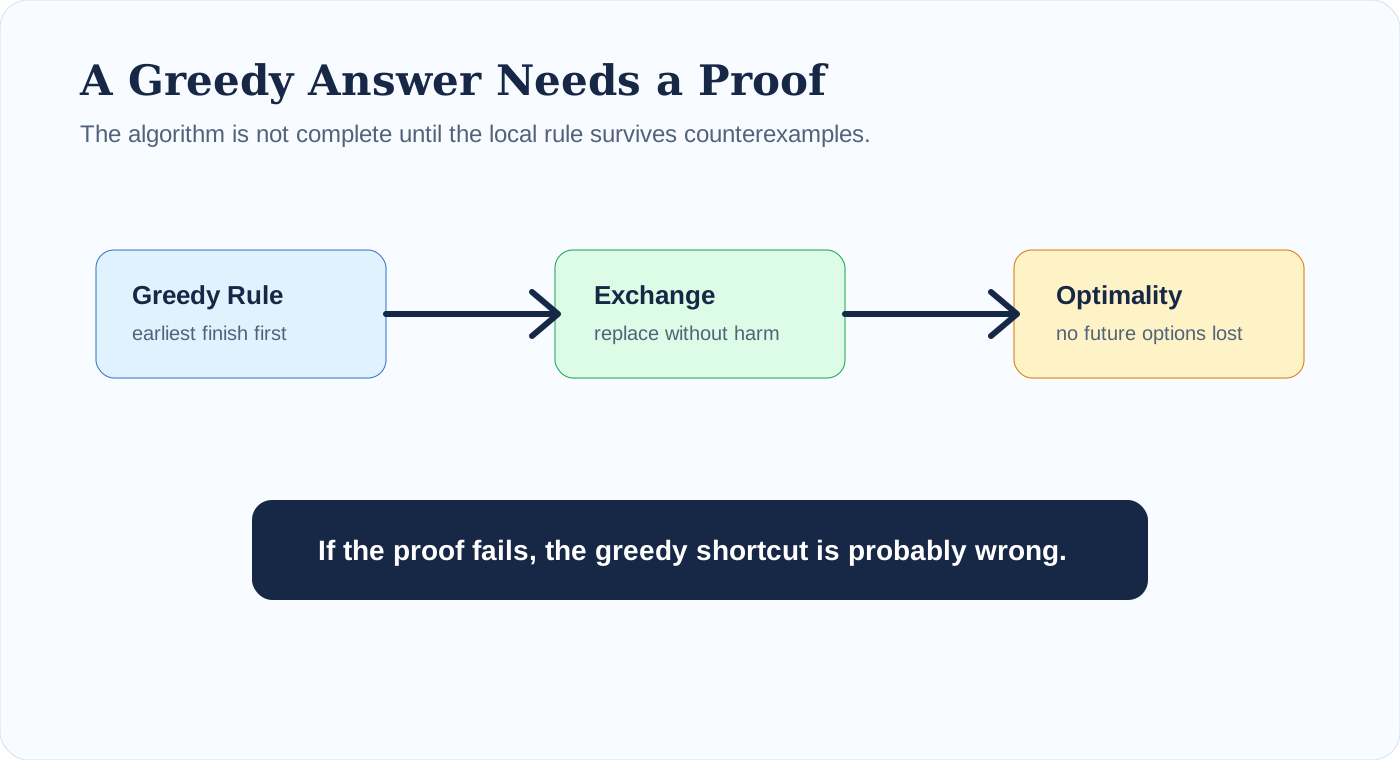
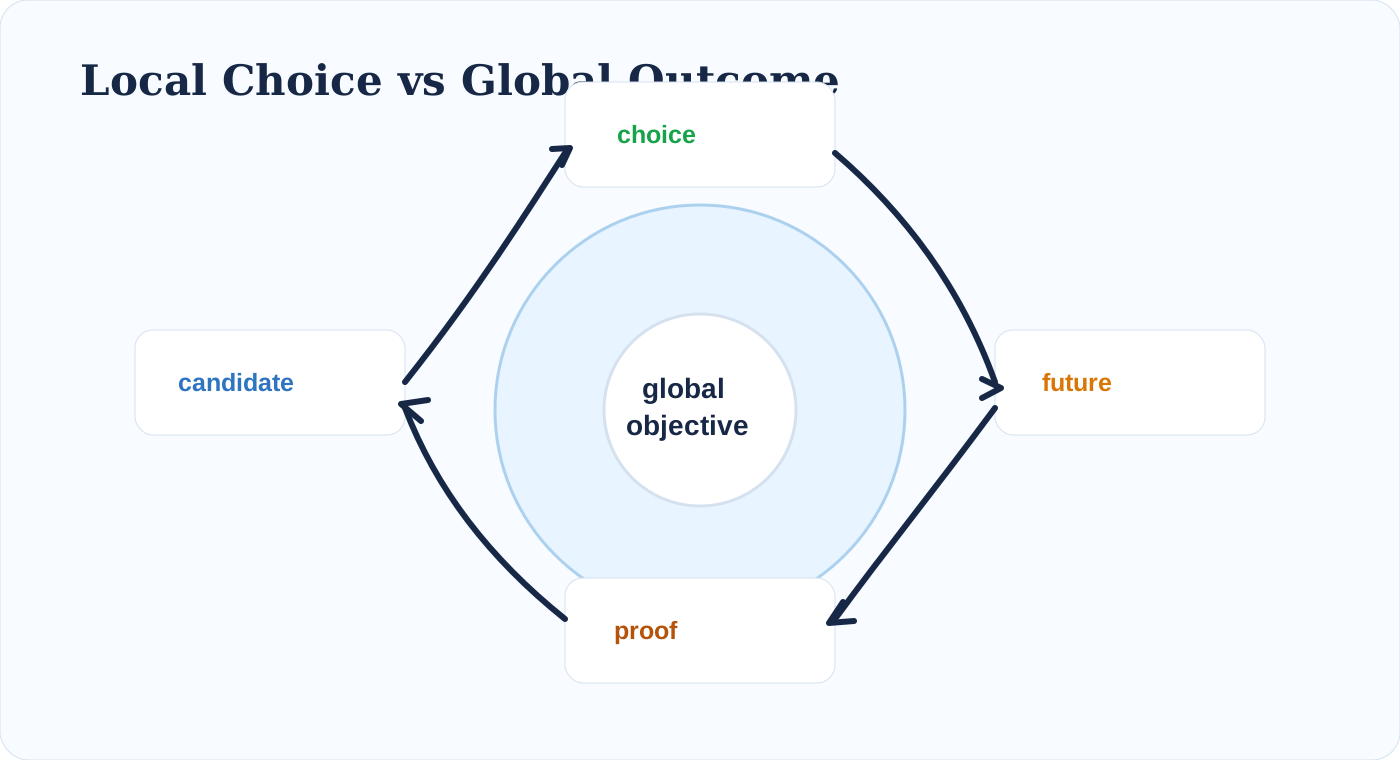
A greedy choice is valid when any optimal solution can be transformed to include that choice without making the result worse. That proof shape is called an exchange argument.
Scenario: Rate-Limit Budget
An API gateway has limited retry budget. Choosing the cheapest recovery action first can be valid if every action has independent benefit and no future dependency. If actions unlock each other, greedy can fail and stateful optimization may be required.
| Question | Greedy signal | Risk |
|---|---|---|
| Activity selection | Earliest finish leaves maximum room | Sorting by start fails. |
| Jump game reachability | Track farthest reachable index | Do not simulate every path. |
| Fractional allocation | Best value per unit is safe | 0/1 allocation is different. |
| Dependent choices | No safe exchange | Likely DP/backtracking. |
Same Pattern in Java, Python, and JavaScript
Activity selection: choose the meeting that ends earliest, then repeat among compatible meetings.
import java.util.*;

class ActivitySelection {
    static int maxMeetings(int[][] intervals) {
        Arrays.sort(intervals, Comparator.comparingInt(a -> a[1]));
        int count = 0, end = Integer.MIN_VALUE;
        for (int[] in : intervals) {
            if (in[0] >= end) { count++; end = in[1]; }
        }
        return count;
    }
}
Assessment trap
Never answer 'sort and greedily choose' without proving why the chosen ordering is safe.
Interview signalFrequently Asked Interview Questions
These are canonical interview patterns for this topic, phrased as concrete problem statements. They avoid vague theory questions and prepare you for the exact reasoning interviewers expect: invariant, edge cases, complexity, and trade-off.
- Return the maximum number of non-overlapping intervals.
- Return whether the last index is reachable.
- Return a station index that completes the circuit, or -1.
Production practiceCompany-Style Practice Examples
These are not claimed as exact company-specific questions. They are the interview patterns repeatedly used by product companies to test whether you can move from brute force to a defensible implementation.
| Example | Brute-force approach | Stronger solution | Production notes |
|---|---|---|---|
| Ad-slot allocation | Pick highest price first blindly. | Use greedy only when exchange proof holds for the objective. | Dependencies or quotas may require DP/flow. |
| Maintenance scheduling | Sort by earliest finish for max compatible windows. | Earliest finish preserves maximum future capacity. | Tie policy must be deterministic. |
| Retry budget | Spend budget on largest request first. | Use ratio/priority only when partial or independent choices make it safe. | 0/1 choices often break greedy. |
Solved modelInterview Question Solutions
Question 1: Activity Selection
Return the maximum number of non-overlapping intervals. Sort by finish time. The exchange proof is that choosing the earliest compatible finish never leaves fewer future options than any later-finishing compatible choice.
import java.util.*;

class ActivitySelection {
    static int maxMeetings(int[][] intervals) {
        Arrays.sort(intervals, Comparator.comparingInt(a -> a[1]));
        int count = 0, end = Integer.MIN_VALUE;
        for (int[] in : intervals) {
            if (in[0] >= end) { count++; end = in[1]; }
        }
        return count;
    }
}
Question 2: Jump Game
Return whether the last index is reachable. Track the farthest reachable index while scanning. If the scan reaches an index beyond farthest, there is a gap no previous choice can cross.
class JumpGame { static boolean canJump(int[] nums) { int farthest = 0; for (int i = 0; i < nums.length; i++) { if (i > farthest) return false; farthest = Math.max(farthest, i + nums[i]); } return true; } }Question 3: Gas Station
Return a station index that completes the circuit, or -1. If total gas is below total cost, no answer exists. When the running tank becomes negative at i, every candidate since the last start also fails, so restart at i + 1.
class GasStation { static int canCompleteCircuit(int[] gas, int[] cost) { int total = 0, tank = 0, start = 0; for (int i = 0; i < gas.length; i++) { int diff = gas[i] - cost[i]; total += diff; tank += diff; if (tank < 0) { start = i + 1; tank = 0; } } return total >= 0 ? start : -1; } }Solved modelWorked Interview Answer
Select the maximum number of non-overlapping meetings. Sort by finish time. The earliest finishing compatible meeting leaves the most room for all future choices, which is the exchange argument.
import java.util.*;

class ActivitySelection {
    static int maxMeetings(int[][] intervals) {
        Arrays.sort(intervals, Comparator.comparingInt(a -> a[1]));
        int count = 0, end = Integer.MIN_VALUE;
        for (int[] in : intervals) {
            if (in[0] >= end) { count++; end = in[1]; }
        }
        return count;
    }
}
Hands-on drillTry It Yourself
Practice task
For five intervals, sort by start, duration, and finish. Identify which ordering is safe for maximum non-overlapping meetings and prove it.
Failure patternsCommon Mistakes to Avoid
- Using greedy without proof.
- Sorting by intuitive but unsafe keys.
- Confusing local optimum with global optimum.
- Using greedy for 0/1 choices that need DP.
- Not stating exchange argument.
Execution guardrailQuick-Start Checklist
- Name local choice.
- State invariant.
- Prove exchange safety.
- Show progress.
- Handle ties.
- State complexity.
Recall drillKnowledge Check
| Question | Strong answer |
|---|---|
| What is exchange argument? | A proof that an optimal solution can be transformed to include the greedy choice. |
| When does greedy fail? | When local choice can block a better future combination. |
| Why earliest finish for activities? | It leaves the most remaining timeline. |
VocabularyKey Terms
| Term | Meaning |
|---|---|
| Greedy choice | Irrevocable local decision. |
| Invariant | Condition preserved after each choice. |
| Exchange argument | Proof replacing part of an optimal solution safely. |
| Counterexample | Input showing a greedy rule fails. |
Next practiceFurther Reading
- Practice activity selection, jump game, gas station, and task scheduler.
- Compare greedy with DP on knapsack variants.
- Write proof before code.