Fast and Slow Pointers
Detect cycles, find middle nodes, and reason about pointer speed, meeting points, and structural invariants.
What you will be able to do
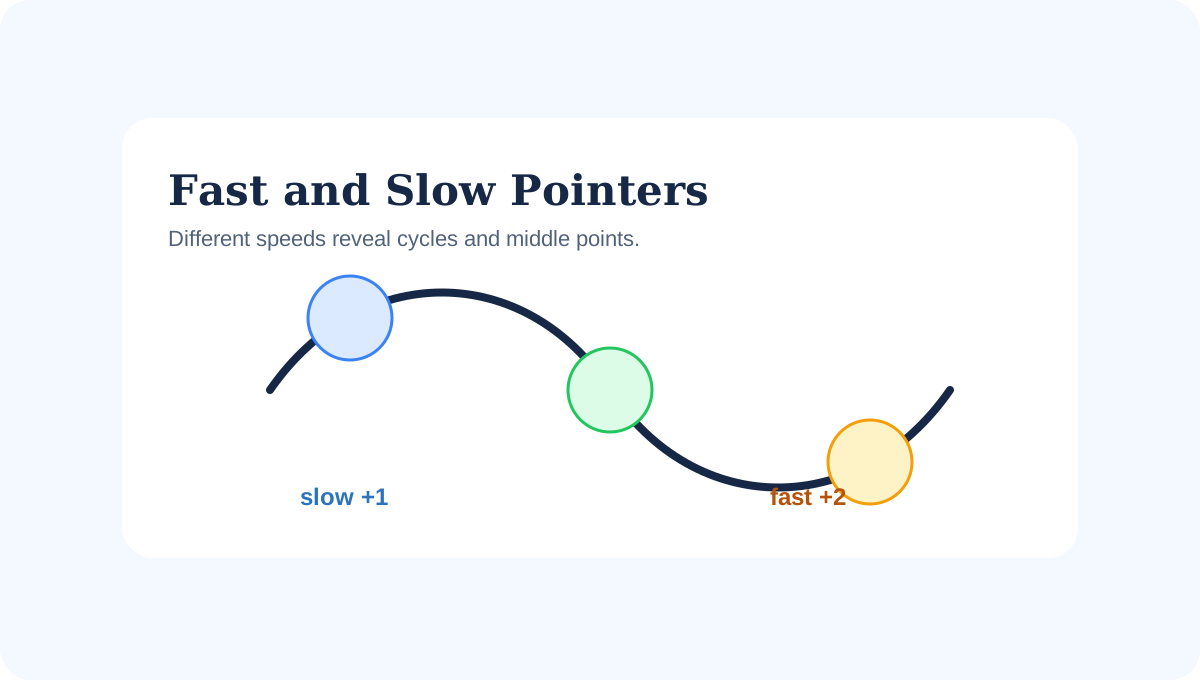
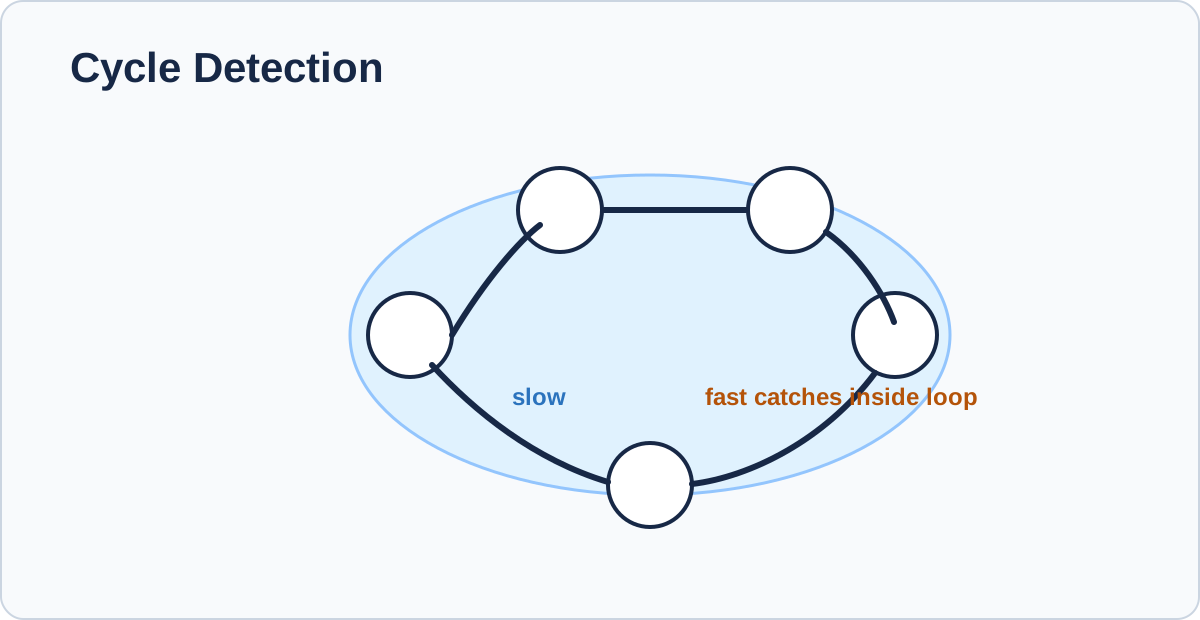
Fast and slow pointers are a structural probe. One pointer moves one step at a time; the other moves two. If the list has a cycle, the faster pointer eventually laps the slower pointer. If there is no cycle, the fast pointer reaches null.
The Speed-Difference Invariant
The algorithm works because the distance between fast and slow changes predictably. Inside a cycle, fast gains one node per iteration relative to slow. It cannot keep missing forever; eventually both references point to the same node.
Scenario: Corrupted Retry Chain
A workflow engine stores retry steps as linked next references. A bug accidentally points a failed step back to an earlier step. A naive traversal never ends. Fast/slow detection lets the system reject the corrupted chain before a worker spins forever.
| Use case | Pointer pattern | Invariant |
|---|---|---|
| Detect cycle | slow +1, fast +2 | Meeting means a loop exists. |
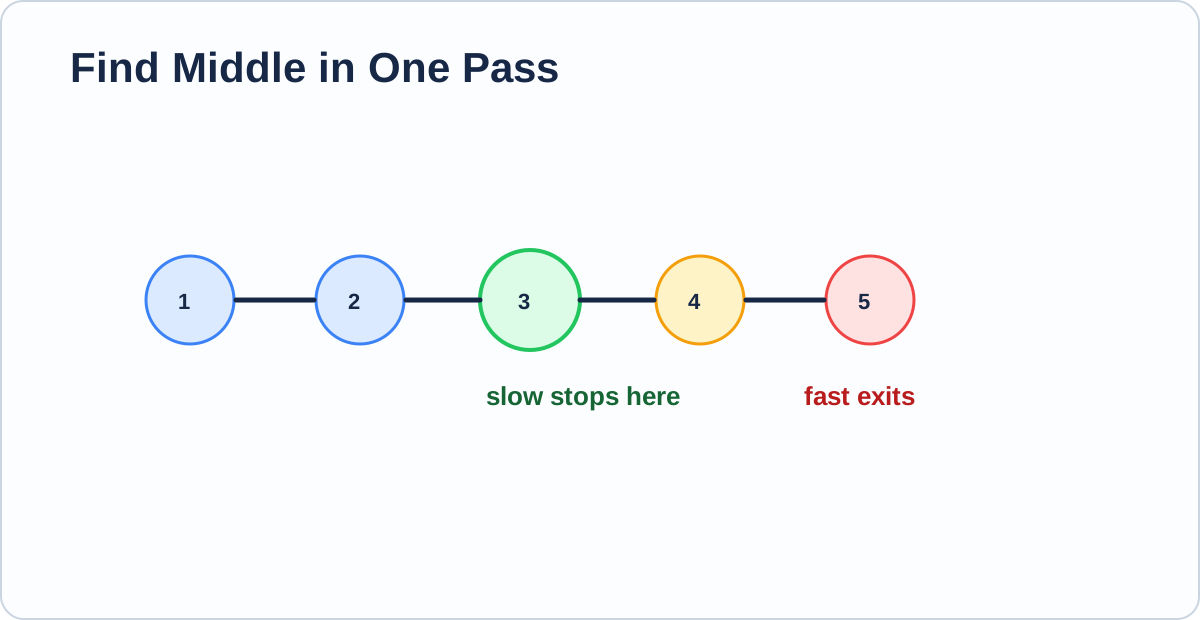
| Find middle | slow +1 while fast +2 | Slow lands near the middle when fast exits. |
| Find cycle start | Reset one pointer to head after meeting | Equal-speed pointers meet at cycle entry. |
| Avoid worker spin | Bound or detect traversal | Never trust reference chains blindly. |
Same Pattern in Java, Python, and JavaScript
Cycle detection is the canonical fast/slow problem. The null checks protect the fast pointer before reading fast.next.
class ListNode { int value; ListNode next; }

class CycleDetection {
    static boolean hasCycle(ListNode head) {
        ListNode slow = head;
        ListNode fast = head;
        while (fast != null && fast.next != null) {
            slow = slow.next;
            fast = fast.next.next;
            if (slow == fast) return true;
        }
        return false;
    }
}
Edge Cases That Matter
- Empty list: fast is null immediately.
- Single node without cycle: fast.next is null.
- Single node pointing to itself: fast and slow meet after one iteration.
- Two-node cycle: meeting still happens.
- Very long acyclic list: fast exits without extra memory.
Assessment trap
Always guard fast and fast.next before moving two steps. Most failed implementations crash on short lists.
Interview signalFrequently Asked Interview Questions
These are canonical interview patterns for this topic, phrased as concrete problem statements. They avoid vague theory questions and prepare you for the exact reasoning interviewers expect: invariant, edge cases, complexity, and trade-off.
- Return whether a linked list contains a cycle.
- Return the middle node of a linked list.
- Return the node where a linked-list cycle begins, or null if no cycle exists.
Production practiceCompany-Style Practice Examples
These are not claimed as exact company-specific questions. They are the interview patterns repeatedly used by product companies to test whether you can move from brute force to a defensible implementation.
| Example | Brute-force approach | Stronger solution | Production notes |
|---|---|---|---|
| Cycle detection | Store every visited node in a set. | Use slow and fast pointers for O(1) memory. | Compare node identity, not values. |
| Middle node | Count length, then scan halfway. | Use fast/slow in one pass. | Define first or second middle for even length. |
| Cycle start | Stop after detecting a meeting. | Reset one pointer to head and move both one step. | Meeting point reveals entry. |
Solved modelInterview Question Solutions
Question 1: Linked List Cycle
Return whether a linked list contains a cycle. Use Floyd's fast/slow pointers. A meeting means cycle; fast reaching null means no cycle.
class ListNode { int value; ListNode next; }

class HasCycle {
    static boolean hasCycle(ListNode head) {
        ListNode slow = head, fast = head;
        while (fast != null && fast.next != null) {
            slow = slow.next;
            fast = fast.next.next;
            if (slow == fast) return true;
        }
        return false;
    }
}
Question 2: Middle of Linked List
Return the middle node of a linked list. Move slow one step and fast two steps. When fast exits, slow is at the middle.
class MiddleNode { static ListNode middle(ListNode head) { ListNode slow = head, fast = head; while (fast != null && fast.next != null) { slow = slow.next; fast = fast.next.next; } return slow; } }Question 3: Cycle Start
Return the node where a linked-list cycle begins, or null if no cycle exists. After fast and slow meet, reset one pointer to head. Move both one step; their next meeting is the cycle entry.
class CycleStart { static ListNode detect(ListNode head) { ListNode slow = head, fast = head; while (fast != null && fast.next != null) { slow = slow.next; fast = fast.next.next; if (slow == fast) { ListNode p = head; while (p != slow) { p = p.next; slow = slow.next; } return p; } } return null; } }Solved modelWorked Interview Answer
Detect whether a linked list contains a cycle. Move slow one step and fast two steps. If they meet, a cycle exists; if fast reaches null, the list ends.
class ListNode { int value; ListNode next; }

class HasCycle {
    static boolean hasCycle(ListNode head) {
        ListNode slow = head, fast = head;
        while (fast != null && fast.next != null) {
            slow = slow.next;
            fast = fast.next.next;
            if (slow == fast) return true;
        }
        return false;
    }
}
Hands-on drillTry It Yourself
Practice task
Draw a list where tail points back to the second node. Move slow by one and fast by two until they meet. Record each pair of positions.
Failure patternsCommon Mistakes to Avoid
- Reading fast.next without checking fast first.
- Comparing node values instead of node identity.
- Forgetting single-node self-cycle behavior.
- Using a set when O(1) memory is explicitly required.
- Not explaining why fast eventually catches slow inside a cycle.
Execution guardrailQuick-Start Checklist
- Initialize slow and fast at head.
- Guard fast and fast.next.
- Move slow one step and fast two steps.
- Compare references, not values.
- State O(n) time and O(1) memory.
Recall drillKnowledge Check
| Question | Strong answer |
|---|---|
| Why does fast catch slow in a cycle? | Fast gains one node per iteration relative to slow inside the loop. |
| What proves no cycle? | Fast reaches null. |
| How do you find the middle? | Move slow one step while fast moves two until fast exits. |
VocabularyKey Terms
| Term | Meaning |
|---|---|
| Floyd's algorithm | Fast/slow cycle detection. |
| Cycle | A next chain that revisits a previous node. |
| Meeting point | The node where slow and fast first become the same reference. |
| Reference identity | Whether two variables point to the same node object. |
Next practiceFurther Reading
- Practice linked-list cycle, cycle start, happy number, and middle node.
- Review tortoise-and-hare proof sketches.
- Compare set-based detection with O(1)-space detection.