Binary Trees
Reason about left/right child structure, recursive shape, height, balance, traversal, and common interview patterns.
What you will be able to do
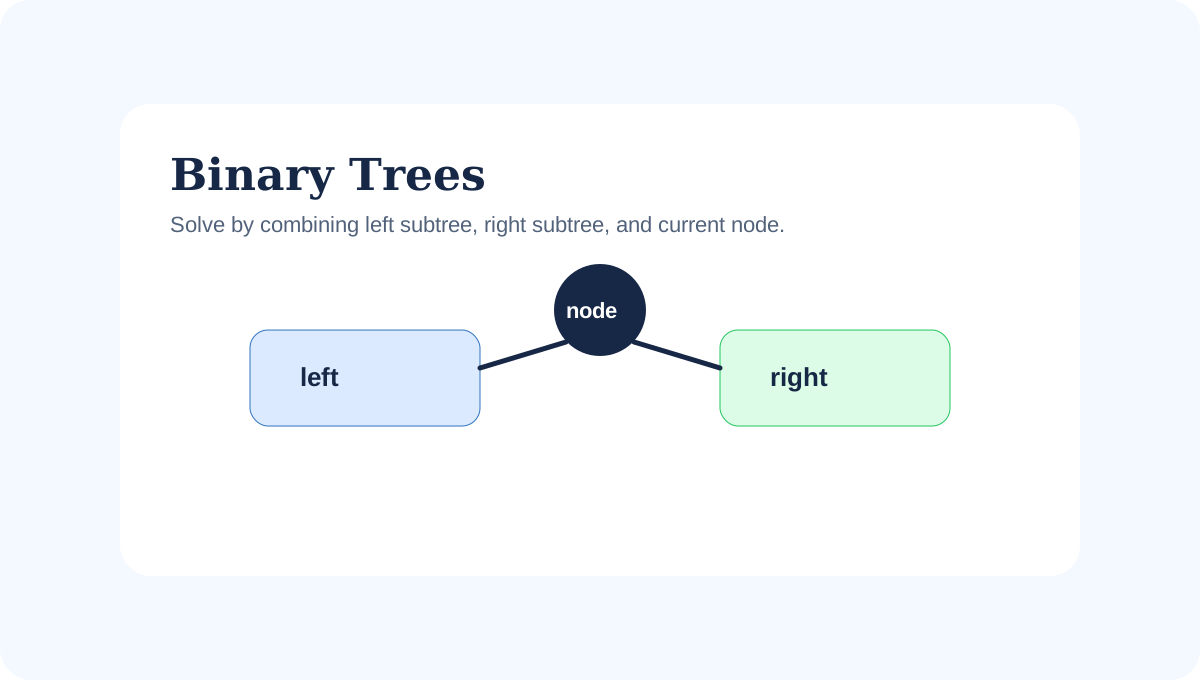
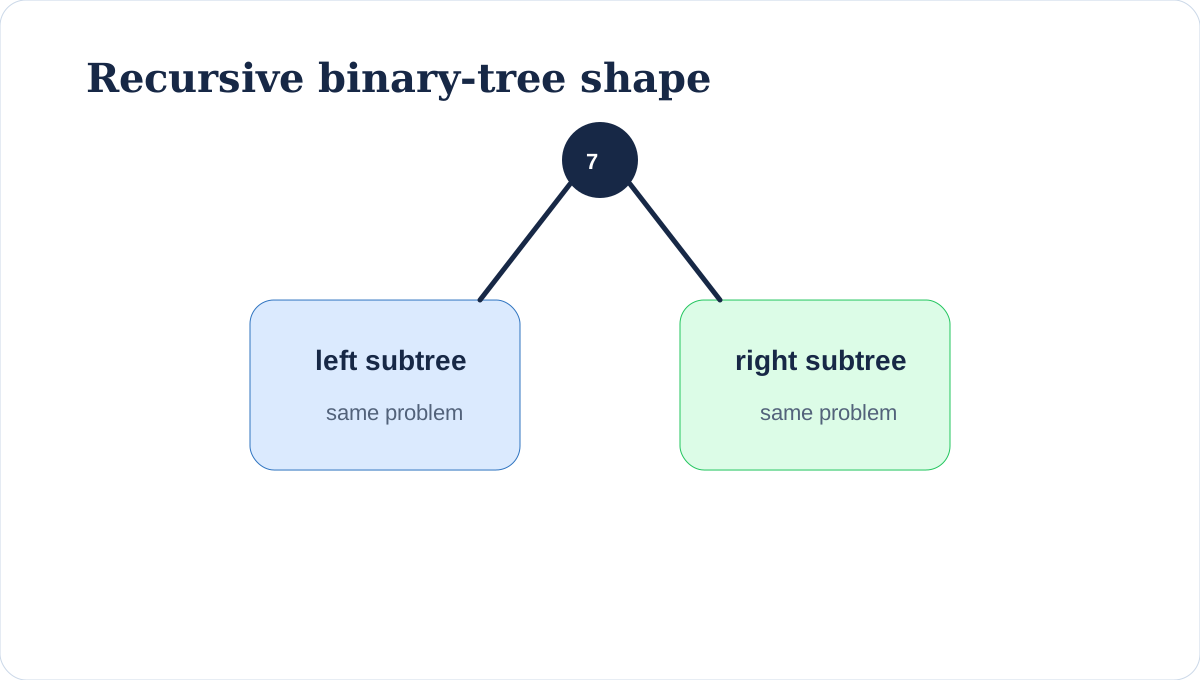
A binary tree is a recursive structure: each node has at most a left child and a right child, and each child is itself the root of another binary tree. Most binary-tree algorithms are just careful answers to: what do I need from the left subtree, the right subtree, and the current node?
The Recursive Shape
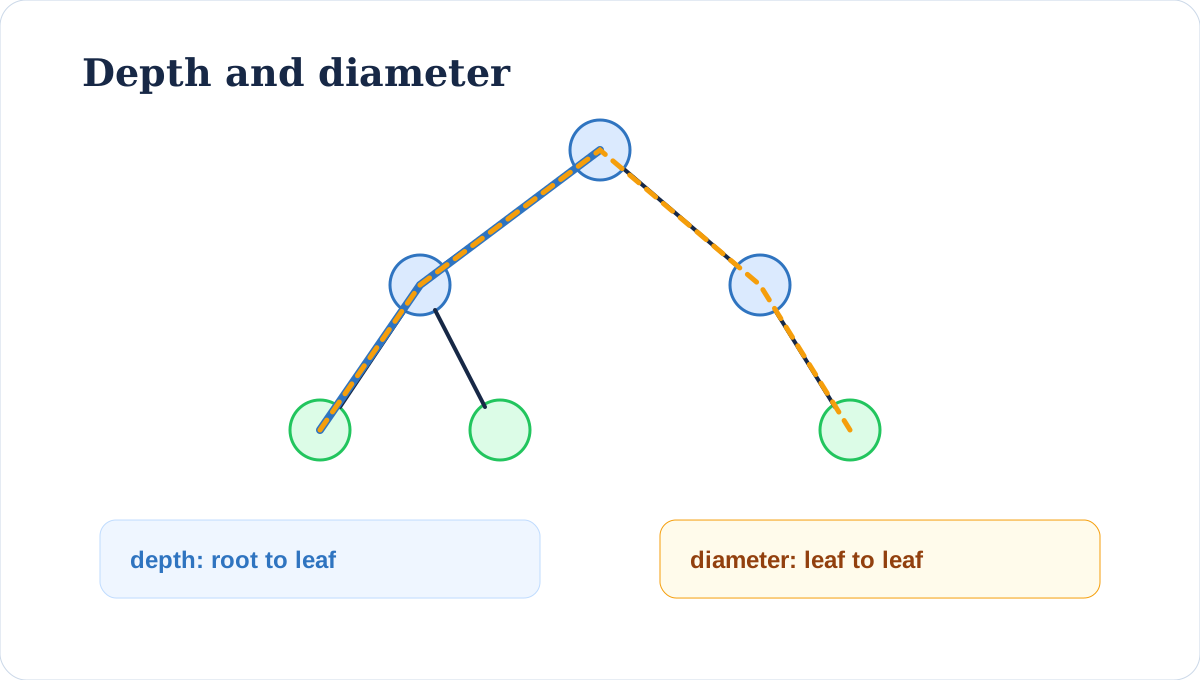
A null node is the base case. A non-null node combines answers from left and right. Maximum depth is one plus the larger child depth. Diameter is the best path through a node or inside one child.
Scenario: Comment Thread Shape
A threaded discussion can become tree-shaped. Moderation tools may need the deepest reply chain, total visible replies, or level-order display. A skewed thread behaves like a linked list and can create recursion-depth risk.
| Need | Traversal/metric | Risk |
|---|---|---|
| Deepest reply chain | Max depth | Skewed tree can be O(n) depth. |
| Render nested replies | DFS preorder | Stack depth and permissions matter. |
| Show replies by level | BFS | Queue memory grows by width. |
| Measure longest discussion path | Diameter | Need child heights at every node. |
Same Pattern in Java, Python, and JavaScript
Maximum depth is the cleanest binary-tree recursion. The same structure appears in many harder problems.
class TreeNode { int value; TreeNode left; TreeNode right; }

class MaxDepthTree {
    static int maxDepth(TreeNode node) {
        if (node == null) return 0;
        return 1 + Math.max(maxDepth(node.left), maxDepth(node.right));
    }
}
Assessment trap
Do not assume binary trees are balanced. A tree with n nodes can have height n.
Interview signalFrequently Asked Interview Questions
These are canonical interview patterns for this topic, phrased as concrete problem statements. They avoid vague theory questions and prepare you for the exact reasoning interviewers expect: invariant, edge cases, complexity, and trade-off.
- Return the maximum root-to-leaf depth of a binary tree.
- Return the length of the longest path between any two nodes.
- Return whether two binary trees have identical structure and values.
Production practiceCompany-Style Practice Examples
These are not claimed as exact company-specific questions. They are the interview patterns repeatedly used by product companies to test whether you can move from brute force to a defensible implementation.
| Example | Brute-force approach | Stronger solution | Production notes |
|---|---|---|---|
| Deepest reply chain | Count visible rows and call it depth. | Use recursive max depth over left/right children. | Skewed trees can hit O(n) stack depth. |
| Longest conversation path | Only measure root-to-leaf paths. | Compute diameter by combining left and right heights at each node. | The best path may not pass through the root. |
| Structural equality | Serialize both trees carelessly. | Compare current value, left subtree, and right subtree recursively. | Null positions matter. |
Solved modelInterview Question Solutions
Question 1: Maximum Depth of Binary Tree
Return the maximum root-to-leaf depth of a binary tree. Use postorder recursion: ask left and right for depth, then add the current node.
class TreeNode { int value; TreeNode left; TreeNode right; }

class MaxDepthTree {
    static int maxDepth(TreeNode node) {
        if (node == null) return 0;
        return 1 + Math.max(maxDepth(node.left), maxDepth(node.right));
    }
}
Question 2: Diameter of Binary Tree
Return the length of the longest path between any two nodes. At each node, left height plus right height is the best path through that node. Track the maximum while returning height upward.
class Node { Node left, right; }
class Diameter { int best = 0; int diameter(Node root) { height(root); return best; } int height(Node node) { if (node == null) return 0; int l = height(node.left), r = height(node.right); best = Math.max(best, l + r); return 1 + Math.max(l, r); } }
Question 3: Same Tree
Return whether two binary trees have identical structure and values. Compare nullness, current value, left subtree, and right subtree. Structure matters as much as values.
class Node { int val; Node left, right; }
class SameTree { static boolean same(Node a, Node b) { if (a == null || b == null) return a == b; return a.val == b.val && same(a.left, b.left) && same(a.right, b.right); } }
Solved modelWorked Interview Answer
Compute the maximum depth of a binary tree. Return one fact from each subtree: its depth. The current node contributes one level above the deeper child.
class TreeNode { int value; TreeNode left; TreeNode right; }

class MaxDepthTree {
    static int maxDepth(TreeNode node) {
        if (node == null) return 0;
        return 1 + Math.max(maxDepth(node.left), maxDepth(node.right));
    }
}
Hands-on drillTry It Yourself
Practice task
Trace max depth and diameter on a tree with one long left chain and one short right branch. Write the value returned by every node.
Failure patternsCommon Mistakes to Avoid
- Forgetting null as base case.
- Assuming balanced height.
- Confusing depth with diameter.
- Recomputing heights repeatedly in diameter.
- Ignoring recursion stack space.
Execution guardrailQuick-Start Checklist
- Define what each recursive call returns.
- Handle null node.
- Combine left and right results.
- Track global answer when needed.
- State O(n) time.
- State O(height) stack space.
Recall drillKnowledge Check
| Question | Strong answer |
|---|---|
| What is max depth? | Number of nodes or edges on longest root-to-leaf path, based on definition. |
| What is diameter? | Longest path between any two nodes. |
| What is worst-case tree height? | O(n) when skewed. |
VocabularyKey Terms
| Term | Meaning |
|---|---|
| Binary tree | Tree where each node has at most left and right child. |
| Subtree | A node and its descendants. |
| Diameter | Longest path between two nodes. |
| Skewed tree | A tree shaped like a chain. |
Next practiceFurther Reading
- Practice max depth, diameter, same tree, invert tree, and balanced tree.
- Review recursive postorder aggregation.
- Compare recursive and iterative DFS for deep trees.