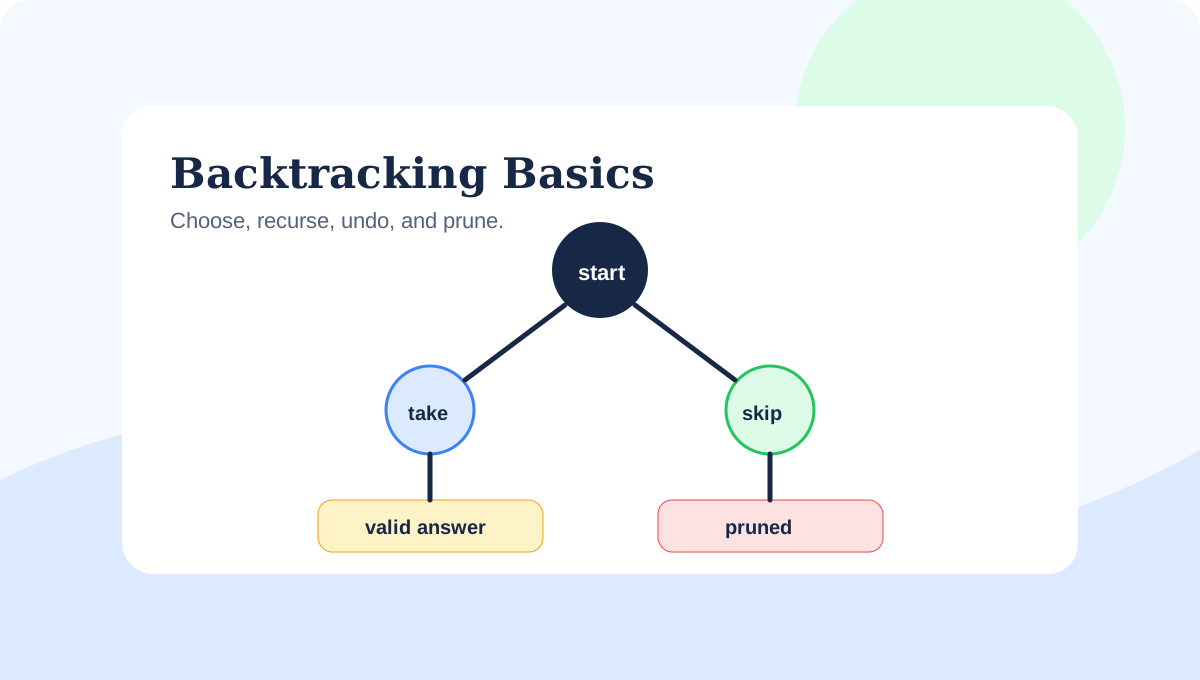
Backtracking Basics
Explore constrained search spaces with choose, recurse, undo, pruning, and assessment-grade reasoning.
What you will be able to do
Backtracking is disciplined trial and correction. You build a partial answer, explore one choice, undo it, then try the next choice. It is the foundation for permutations, subsets, combinations, Sudoku, N-Queens, path search, and many constraint problems.
Choose, Recurse, Undo
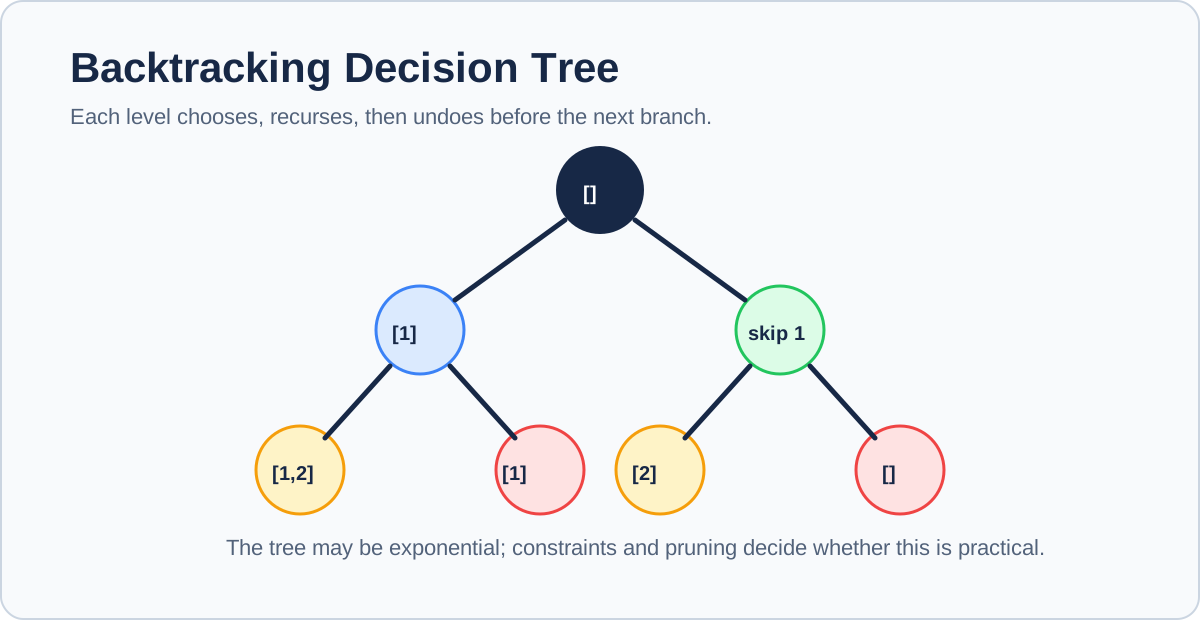
Backtracking is usually depth-first search over a decision tree. At each level, you choose a candidate, recurse with that choice included, then undo the choice so the next branch starts from a clean state.
SkillSkore principle
Backtracking is acceptable only when constraints make the search space small enough or pruning cuts enough branches.
Scenario: Constraint Scheduler
A team scheduler must assign engineers to shifts. Each shift needs one engineer, some engineers are unavailable, and no engineer should exceed a workload limit. A greedy assignment may get stuck. Backtracking tries an assignment, recurses, and backs out when a constraint fails.
| Part | Backtracking meaning | Production note |
|---|---|---|
| Choice | Assign an engineer to a shift | Order choices to fail fast. |
| Constraint | Availability and workload limit | Validate before deeper recursion. |
| Undo | Remove assignment and decrement workload | Missing undo corrupts later branches. |
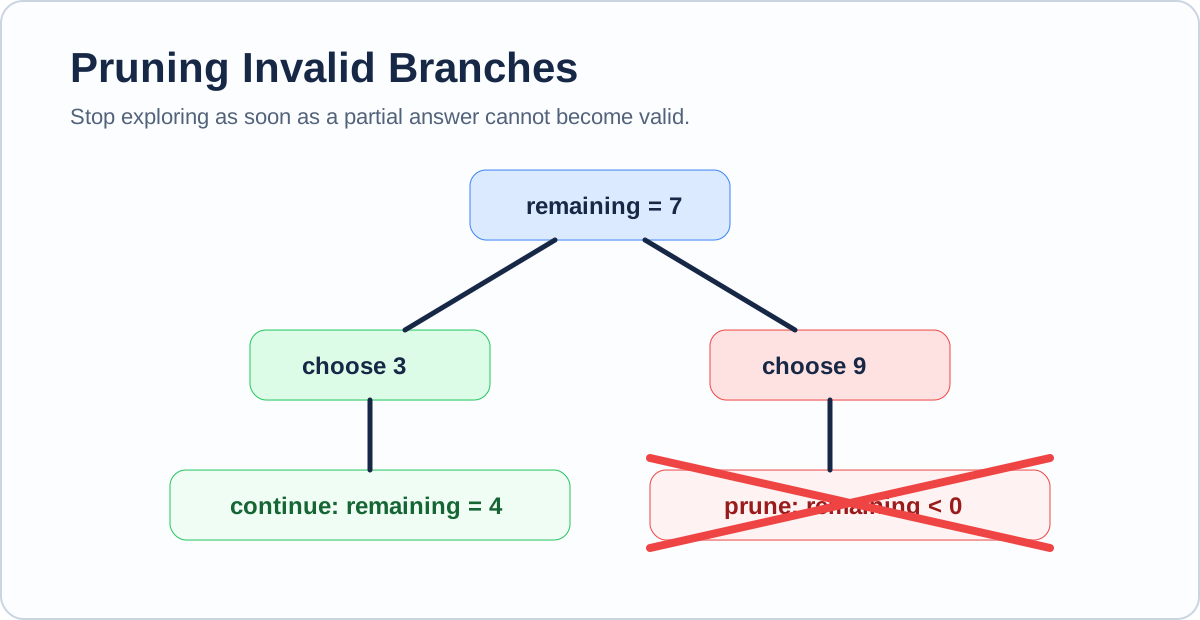
| Pruning | Stop branch when impossible | Pruning is the difference between toy and practical. |
Same Pattern in Java, Python, and JavaScript
Subsets is the cleanest starting point: for each number, choose to include it, recurse, then undo and continue.
import java.util.*;

class Subsets {
    static List<List<Integer>> subsets(int[] nums) {
        List<List<Integer>> result = new ArrayList<>();
        backtrack(nums, 0, new ArrayList<>(), result);
        return result;
    }

    private static void backtrack(int[] nums, int start, List<Integer> path, List<List<Integer>> result) {
        result.add(new ArrayList<>(path));
        for (int i = start; i < nums.length; i++) {
            path.add(nums[i]);
            backtrack(nums, i + 1, path, result);
            path.remove(path.size() - 1);
        }
    }
}
Cost and Pruning
Backtracking often has exponential worst-case cost. That is not automatically wrong. The right answer names the search space, the constraints, and the pruning rule. If n is too large and pruning is weak, backtracking is the wrong approach.
Assessment trap
Do not hide exponential complexity. State it clearly, then explain why the constraints or pruning make the solution acceptable.
Interview signalFrequently Asked Interview Questions
These are canonical interview patterns for this topic, phrased as concrete problem statements. They avoid vague theory questions and prepare you for the exact reasoning interviewers expect: invariant, edge cases, complexity, and trade-off.
- Generate all subsets of unique integers.
- Generate all permutations of distinct integers.
- Return combinations of candidates that sum to target; candidates can be reused.
Production practiceCompany-Style Practice Examples
These are not claimed as exact company-specific questions. They are the interview patterns repeatedly used by product companies to test whether you can move from brute force to a defensible implementation.
| Example | Brute-force approach | Stronger solution | Production notes |
|---|---|---|---|
| Subsets | Hard-code nested loops. | Backtrack with start index and path copy. | Output size is 2^n. |
| Permutations | Use every element at every position without tracking used. | Backtrack with used set/array. | Undo is mandatory after each branch. |
| Combination sum | Explore impossible sums. | Prune branches once sum exceeds target. | Sorting can improve pruning clarity. |
Solved modelInterview Question Solutions
Question 1: Subsets
Generate all subsets of unique integers. Backtrack with a start index and mutable path. Copy the path into results before exploring choices.
import java.util.*;

class SubsetsAnswer {
    static List<List<Integer>> subsets(int[] nums) {
        List<List<Integer>> result = new ArrayList<>();
        backtrack(nums, 0, new ArrayList<>(), result);
        return result;
    }
    static void backtrack(int[] nums, int start, List<Integer> path, List<List<Integer>> result) {
        result.add(new ArrayList<>(path));
        for (int i = start; i < nums.length; i++) {
            path.add(nums[i]);
            backtrack(nums, i + 1, path, result);
            path.remove(path.size() - 1);
        }
    }
}
Question 2: Permutations
Generate all permutations of distinct integers. At each level choose an unused number, recurse, then undo the choice.
import java.util.*;
class Permute { static List<List<Integer>> permute(int[] nums) { List<List<Integer>> res = new ArrayList<>(); backtrack(nums, new boolean[nums.length], new ArrayList<>(), res); return res; } static void backtrack(int[] nums, boolean[] used, List<Integer> path, List<List<Integer>> res) { if (path.size() == nums.length) { res.add(new ArrayList<>(path)); return; } for (int i=0;i<nums.length;i++) if (!used[i]) { used[i]=true; path.add(nums[i]); backtrack(nums, used, path, res); path.remove(path.size()-1); used[i]=false; } } }
Question 3: Combination Sum
Return combinations of candidates that sum to target; candidates can be reused. Sort candidates, track remaining target, and prune once a candidate exceeds the remaining value.
import java.util.*;
class CombinationSum { static List<List<Integer>> solve(int[] nums, int target) { Arrays.sort(nums); List<List<Integer>> res = new ArrayList<>(); backtrack(nums, target, 0, new ArrayList<>(), res); return res; } static void backtrack(int[] nums, int rem, int start, List<Integer> path, List<List<Integer>> res) { if (rem == 0) { res.add(new ArrayList<>(path)); return; } for (int i=start;i<nums.length && nums[i] <= rem;i++) { path.add(nums[i]); backtrack(nums, rem - nums[i], i, path, res); path.remove(path.size()-1); } } }
Solved modelWorked Interview Answer
Generate all subsets with choose, recurse, and undo. Backtracking keeps a mutable path. Copy the path when recording an answer, then undo after each recursive branch.
import java.util.*;

class SubsetsAnswer {
    static List<List<Integer>> subsets(int[] nums) {
        List<List<Integer>> result = new ArrayList<>();
        backtrack(nums, 0, new ArrayList<>(), result);
        return result;
    }
    static void backtrack(int[] nums, int start, List<Integer> path, List<List<Integer>> result) {
        result.add(new ArrayList<>(path));
        for (int i = start; i < nums.length; i++) {
            path.add(nums[i]);
            backtrack(nums, i + 1, path, result);
            path.remove(path.size() - 1);
        }
    }
}
Hands-on drillTry It Yourself
Practice task
For subsets [1,2,3], draw the decision tree. Mark each choose, recurse, undo, and output step.
Failure patternsCommon Mistakes to Avoid
- Forgetting to undo mutable state after recursion.
- Appending the same path reference instead of a copy.
- Hiding exponential complexity.
- Failing to prune impossible branches.
- Using backtracking when constraints are too large.
Execution guardrailQuick-Start Checklist
- Define choices at each level.
- Add valid partial or complete answer at the right time.
- Choose one candidate.
- Recurse on the reduced problem.
- Undo before the next branch.
- State search-space size.
Recall drillKnowledge Check
| Question | Strong answer |
|---|---|
| What is backtracking? | Depth-first exploration of choices with undo. |
| Why copy the path? | Because the mutable path changes after recursion returns. |
| What is pruning? | Stopping branches that cannot produce a valid answer. |
VocabularyKey Terms
| Term | Meaning |
|---|---|
| Choice | A candidate selected for the current partial solution. |
| Undo | Reverting mutable state after recursion. |
| Pruning | Skipping impossible branches. |
| Search space | All candidate states the algorithm may explore. |
Next practiceFurther Reading
- Practice subsets, permutations, combination sum, N-Queens, and Sudoku.
- Review recursion and call stack before complex backtracking.
- Compare brute force with constraint-guided search.